
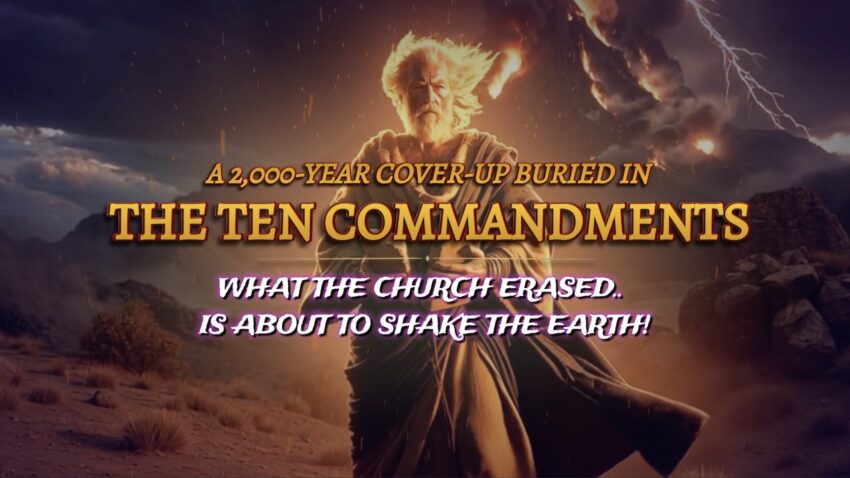
When the Stones Speak: A Prophetic Blueprint Hidden in the Ten Commandments
Something ancient is rising.
It was carved in stone with the very finger of God — not once, but twice. It thundered from the mountain in fire and smoke, then vanished into memory… buried beneath doctrines, traditions, and time. But it was never erased.
The Ten Commandments.
Or so we’ve called them.
But what if we’ve misunderstood the very foundation of God’s covenant? What if the words spoken from the mountain weren’t merely commandments… but a prophetic blueprint — alive with mystery, judgment, and redemption?
What if each line carved into stone was a spiritual seal? A mark placed on the hearts of God’s people? What if they prophesied the end of the age — the fall of the apostate church, the rise of the remnant, and the return of the Spirit’s power?
Now, as the world spirals toward its final hour, the stones are speaking again.
From Exodus to Revelation, the Ten Words echo like thunder across the ages. They are not relics of the past. They are the foundation of the covenant, the seal of God, and the blueprint of the remnant church.
And now, at the end of the age, the stones are crying out again!
“I tell you, if these stop speaking, the stones will cry out!” — Luke 19:40, NASB
The voices that once declared His name have grown silent. But the covenant was never buried.
Now, as the false church fades into shadows, the remnant rises —and the stones begin to cry out.
“Behold, days are coming,” declares the Lord GOD, “When I will send a famine on the land — not a famine of bread or a thirst for water, but rather for hearing the words of the LORD.” — Amos 8:11 (NASB)
“For the time will come when they will not tolerate sound doctrine… and will turn their ears away from the truth and will turn aside to myths.” — 2 Timothy 4:3–4 (NASB)
🎬 Watch the Full Documentary Below
The prophecy hidden in the Ten Commandments has been buried long enough. It’s time to uncover what the Church erased.
🕊️ The Ten Words, Not Ten Commandments
“And He declared to you His covenant, which He commanded you to perform, the Ten Words; and He wrote them on two tablets of stone.” — Deuteronomy 4:13 NASB
The Bible never calls them the “Ten Commandments” in Hebrew. Instead, they are called עֲשֶׂרֶת הַדְּבָרִים (Aseret haD’varim) — the Ten Words. These weren’t merely moral rules etched into stone… they were prophetic decrees. Living declarations. The very voice of God echoing into the earth.
God spoke them directly to His people — the only part of the Law given audibly from heaven. Then, with His own hand, He engraved them into stone, signifying permanence. These Ten Words were His covenant — His “cutting,” His “oath,” His spiritual mark — written into the hearts of those who would obey.
This was not a list of ancient regulations. This was the blueprint of divine relationship, written by fire, spoken by thunder, sealed in stone.
🔍 A Covenant of Words, Not Rules
In the Bible, covenants are made through cutting. In Hebrew, the word for covenant — berith — literally means “to cut.” God “cut” His words into stone, just as He later cut a covenant through Christ’s body.
But what’s more profound is this: Jesus is called the Word made flesh (John 1:14). And these Ten Words are the beginning of that Word. They are prophetic images of Jesus Himself — each one revealing a part of His nature, His purpose, and His future return.
Let’s be clear: Jesus never abolished the Ten Commandments. He taught them, fulfilled them, lived them — and declared they would never pass away.
“Do not think that I came to abolish the Law or the Prophets; I did not come to abolish but to fulfill. For truly I say to you, until heaven and earth pass away, not the smallest letter or stroke shall pass from the Law until all is accomplished.” — Matthew 5:17–18
To fulfill does not mean to destroy — it means to complete, to bring to full purpose. He was the living Word made flesh, and He sealed the covenant in blood.
Modern Christianity has fallen into a dangerous error — teaching that the commandments no longer apply. But the Word of God says otherwise. The Ten Words were never temporary. They are eternal.
“If you love Me, you will keep My commandments.” — John 14:15
“By this we know that we have come to know Him, if we keep His commandments. The one who says, ‘I have come to know Him,’ and does not keep His commandments, is a liar, and the truth is not in him.” — 1 John 2:3–4
“And this is love, that we walk according to His commandments. This is the commandment, just as you have heard from the beginning, that you are to walk in it.” — 2 John 1:6
The commandments are not burdens — they are the blueprint of covenant love. The Psalmist wrote:
“All His precepts are sure. They are upheld forever and ever; they are performed in truth and uprightness.” — Psalm 111:7–8
The law of God is perfect — and the Spirit of God writes it not on stone now, but on the hearts of His people. The commandments reveal who He is. If the Church removes them, it removes the image of God itself.
💡 But Didn’t Jesus Just Say to “Love” Instead?
Some argue that Jesus replaced the commandments with “love.” But that’s a misunderstanding of what He taught. Jesus never said love replaces obedience — He said love fulfills it.
“You shall love the Lord your God with all your heart, with all your soul, and with all your mind.” — Matthew 22:37 (referencing Deuteronomy 6:5)
“You shall love your neighbor as yourself.” — Matthew 22:39 (referencing Leviticus 19:18)
Jesus was pointing us back to the Ten Commandments — not away from them.
- The first three commandments show us how to love God.
- The last six commandments teach us how to love others.
- The fourth — honoring the Sabbath — is how we love ourselves by entering into God’s rest.
“Whoever therefore breaks one of the least of these commandments, and teaches men so, shall be called least in the kingdom of heaven.” — Matthew 5:19
“For this is the love of God, that we keep His commandments. And His commandments are not burdensome.” — 1 John 5:3
To reject the commandments is to reject covenant — because these are not merely rules. They are words. Living, breathing declarations of love and holiness, carved in stone by the hand of God. To cast them aside is to cast aside the very voice of the One who spoke them.
⛓️ From Egypt to the Wilderness: The First Prophetic Word
Before any “command” was given, God started with a revelation:
“I am the LORD your God, who brought you out of the land of Egypt, out of the house of slavery.”
— Exodus 20:2 NASB
This wasn’t an introduction — it was a prophetic decree. A call to remembrance. A marking of identity.
Egypt symbolized the flesh nature, the system of bondage and idolatry. It was not just a place — it was a condition of the heart. And “the house of slavery” represents the spiritual prison that God’s people were trapped in.
The word study of “Egypt” (מצרים / Mitzrayim) ties to meanings like besiege, confine, entrench — all related to the word for “mark” in Revelation 13 (charagma) which means to engrave, etch, or pierce.
So even in the first sentence, God declares a war between His mark and the enemy’s mark. Between those who are sealed by the Spirit… and those enslaved by the flesh.
This is where the true journey begins. These aren’t commandments to obey from fear — they’re prophetic truths to receive by revelation.
Each word is a signpost. Each one, a key. And when they are fully awakened in the remnant… the earth will shake, the temple will rise, and the true covenant will be seen again.
🔥 1. “You shall have no other gods before Me.”
“You shall have no other gods before Me.” — Exodus 20:3 NASB
This first “commandment” is not just a rule — it’s a declaration of allegiance. It’s the prophetic call of the end-times: “Choose this day whom you will serve.”
In Hebrew, the word translated “before” is פָּנִים (panim), which doesn’t just mean “ahead of” — it means in the presence of, beside, or along with. God isn’t just commanding us not to prioritize other gods — He’s commanding us not to let them coexist in His presence. He wants no rivals at all.
The Hebrew word for “gods” — אֱלֹהִים (elohim) — can also mean judges, magistrates, or political rulers. This isn’t just about bowing to statues. It’s about placing your trust in worldly powers — including governments, leaders, and systems — instead of God. In the end-times, many will take the mark of the Beast because their allegiance is to human authority rather than divine truth.
🧱 Egypt, Enslavement, and the Mark of the Beast
God opens the Ten Words by reminding them He delivered them from Egypt — not just the nation, but the system of enslavement and flesh-driven religion it represented.
In Hebrew, the word for Egypt — מצרים (Mitzrayim) — is tied to confinement, siege, and oppression. The same root ideas appear in the Greek word χάραγμα (charagma) used in Revelation 13 to describe the “mark of the Beast.”
The mark of the Beast isn’t just a future technology — it’s an allegiance to a system. It’s the acceptance of bondage disguised as freedom. It is spiritual Egypt dressed in gold and silver.
📜 False gods in the Church Age
False gods today wear religious robes. They smile from pulpits. They preach prosperity while their congregations starve spiritually. The apostate church has become a new Egypt, offering comfort in exchange for control.
Many are bowing to the gods of self, wealth, political power, or even a false Jesus — another Prince (Daniel 9:26) who offers peace without holiness. But the remnant will not bow. They will stand.
🩸 The Blood-Sealed Stone
This first Word was engraved in stone and later fulfilled in Christ. It was carved by the finger of God and sealed with blood — both on Mount Sinai and on Mount Calvary.
When Jesus said, “It is finished,” He completed the covenant. But the choice remains: who is your God? Who truly rules your heart? This is not just about idols — it is about identity, covenant, and worship.
And this is why the Ten Words begin here. It is a dividing line. The first mark placed upon the soul. The voice of God, calling His people out of Egypt again… to worship Him in spirit and in truth.
🪬 2. “You shall not make for yourself an idol or any likeness…”
“You shall not make for yourself an idol, or any likeness of what is in heaven above, or on the earth beneath, or in the water under the earth. You shall not worship them nor serve them…”
— Exodus 20:4–5 NASB
⚠️ The Three Realms of Idolatry
God explicitly forbids carved images of anything in heaven, on earth, or under the sea. Why? Because these three realms represent the totality of deception — the three locations of spiritual idolatry that plague humanity.
- Heaven above: false Christs, angelic deceptions, counterfeit visions, and doctrines of demons posing as “light.”
- Earth beneath: religion of the earth; man made religion; idolizing the flesh — wealth, success, self-image, pleasure, tradition, or politics.
- Waters below: antichrist spirit, the abyss, demonic realms, hidden darkness disguised as spirituality. The Beast rises from the sea (Rev. 13:1).
This command isn’t just about statues — it’s a warning about image-based worship. False representations. Manmade versions of God. Twisted theology that forms Christ into our image instead of transforming us into His.
👁️ The Image of the Beast
Revelation 13 tells us that the false prophet creates an image of the Beast and commands the world to worship it. This is not merely a physical statue — it is a spiritual system, a man-made imitation of God’s kingdom.
The image of the Beast is the false church. It looks like Jesus. It sounds like religion. But it is filled with the spirit of deception. It promises peace, comfort, and success — but denies the cross, repentance, and holiness.
The idol of today may be a gospel without sacrifice, a grace that excuses sin, or a Jesus who conforms to the world. These are carved in the hearts of people — not by God, but by their own desires.
✍️ The Mark and the Image
In Revelation, those who worship the image of the Beast also receive the mark. Why? Because what you worship will mark you. Worship forms identity.
The Second Word warns us: if we make our own image of God, it will mark our hearts with falsehood. But if we surrender, He will write His truth upon us instead (Jeremiah 31:33).
This is the battle of the end: the image of Christ vs. the image of the Beast. The true covenant vs. the counterfeit gospel. The living Word vs. the carved lie.
⚖️ 3. Taking His Name in Vain: The Great Deception
“You shall not take the name of the Lord your God in vain, for the Lord will not hold him guiltless who takes His name in vain.” — Exodus 20:7
This commandment is far more than a warning against using God’s name as a curse word. It is a prophetic warning to the end-times church about the danger of bearing the name of God falsely — claiming to belong to Him while walking in rebellion, hypocrisy, or counterfeit faith.
In Hebrew, the word “name” is shem (שֵׁם), which doesn’t just mean a literal label. It means:
- Mark or signature
- Character or nature
- Reputation or renown
And the word “vain” is shav (שָׁוְא), meaning:
- Empty, meaningless, or deceptive
- Falsehood, lies, or futility
So to “take the name of the Lord in vain” literally means to carry or wear the mark of God falsely — to walk in His name without His Spirit. It is the ultimate form of spiritual hypocrisy. It is claiming to be God’s people while living in rebellion against His covenant. And in the end times, this will define the false church — the harlot who rides the beast, full of blasphemous names (Revelation 17:3).
🩸 A Covenant of Name and Blood
In Scripture, taking a name is not symbolic—it is covenantal.
When a woman entered into marriage in biblical times, she received her husband’s name. That name represented covering, authority, identity, and belonging. She was no longer her own—she was joined to him by covenant.
This covenant was not merely spoken. It was sealed through consecration and the shedding of blood, marking the union as sacred and irreversible. To bear a man’s name meant to walk in faithfulness to that covenant.
God uses this imagery intentionally. To take the name of the Lord is to enter into covenant with Him. It is to bear His identity, His reputation, and His mark upon one’s life.
This is why Scripture warns so strongly against taking His name in vain. To claim His name while walking in unfaithfulness is spiritual adultery. It is covenant betrayal—bearing His name without honoring His holiness.
“Let everyone who names the name of the Lord abstain from wickedness.” — 2 Timothy 2:19
The remnant does not merely speak His name—they live it. They are marked by faithfulness, sealed by the Spirit, and set apart in truth.
📜 A Mark Upon the Forehead
Throughout Scripture, God’s name is placed upon His people as a mark of covenant. In Revelation, the faithful remnant are sealed with the name of God upon their foreheads (Revelation 14:1). This is not a physical tattoo — it is a spiritual identity. A reflection of who you serve.
Likewise, the mark of the beast is not merely about microchips or technology. It is about whose name and nature you bear. Do you carry the character of Christ? Or do you bear the nature of the flesh — pride, rebellion, greed, and lust — while still claiming to follow God?
To take His name in vain is to wear the outer garments of religion without the inner transformation of His Spirit.
⏳ The Prophetic Warning: A Time-Limited Curse
“For I, the Lord your God, am a jealous God, visiting the iniquity of the fathers on the children to the third and fourth generations of those who hate Me, but showing mercy to thousands, to those who love Me and keep My commandments.” — Exodus 20:5–6
Although this line appears under the Second Commandment, it prophetically belongs here — because it speaks directly to the result of bearing God’s name in vain versus in truth.
The third and fourth generation represents the limit of God’s judgment upon fleshly, unrepentant generations — those who pass down idolatry and rebellion under the disguise of religious tradition. It is a picture of the legacy of false Christianity — bearing His name but not His Spirit.
In contrast, God shows mercy to “thousands” — not just thousands of people, but thousands of generations — to those who truly love Him and keep His commandments. This is the prophetic promise to the remnant — those who bear His name in righteousness and truth.
So we see a stark contrast:
-
Third and fourth generation (limited curse) — for those who wear His name falsely.
-
Thousands (enduring mercy) — for those sealed by His covenant and obedience.
🕊️ Bearing His Name Is Bearing His Spirit
The name of God is not just a word — it is His character, power, and glory. To bear His name is to walk in His Spirit and truth. And to take it in vain is to profane His covenant — pretending to belong to Him while rejecting His holiness.
That’s why God says He will not hold guiltless the one who does this — because it is the ultimate deception. It is the outward show of religion without the inward reality of transformation.
This commandment, like all ten, is not just about behavior — it is about identity. About the name you carry. The mark you bear. The covenant you’ve entered into — or refused.
In the last days, the difference between the remnant and the false church will be this:
One bears His name in Spirit and truth.
The other takes His name in vain.
“For I, the Lord your God, am a jealous God, visiting the iniquity of the fathers upon the children to the third and fourth generations of those who hate Me, but showing mercy to thousands, to those who love Me and keep My commandments.” — Exodus 20:5–6
This verse isn’t merely about family lineage — it’s a prophetic time-clock.
The Hebrew word for “generation” (dor, דּוֹר) can refer not just to biological succession but to a period of time — a spiritual era.
When God says He will visit the iniquity “to the third and fourth generation,” He is declaring a limit to judgment — a fixed prophetic window that reveals the fall of those who bear His name falsely.
But that window has closed.
📜 A Time Cut Short — And a Mystery That Ends It
God declared the end from the beginning (Isaiah 46:10). From Adam to Christ, and from Christ to now, humanity has passed through ages of judgment and mercy — marked not by calendars but by spiritual condition.
Many, including myself in recent times past, have taught a literal “seven-thousand-year” timeline — assigning one thousand years per day of creation, following the pattern in Genesis. And while that model paints a helpful picture, Scripture tells us plainly: “I am coming at an hour you do not expect.”
The end will not come by a calendar. It will come by the condition of God’s people.
We are not waiting for a date — we are watching for fruit.
Daniel was told the holy people would be shattered (Daniel 12:7). That prophecy has already come to pass. The church has fallen. The temple has been defiled. God’s name has been profaned. And now the final mystery remains:
“From the time that the regular sacrifice is abolished and the abomination of desolation is set up, there will be 1,290 days. How blessed is the one who waits and attains to the 1,335 days!” — Daniel 12:11–12
Why does it end with a mystery number? Because only the remnant will understand. Only those who study the Word by the Spirit — not by tradition — will recognize the signs of the hour.
These numbers aren’t literal timelines — they are divine clues. And soon, we will uncover what they truly mean.
🔥 The Sabbath Is Here — But It Looks Like Fire
The Hebrew word for “seven” (sheva, שֶׁבַע) means oath or covenant. The seventh day has always pointed to rest — but in the Spirit, rest comes through refinement.
We are not approaching the Sabbath — we are in it. But this Sabbath is not ease and escape — it is separation and consecration. The flesh is being cut off. The remnant is being awakened. And the false church is falling silent.
God is showing mercy to thousands — not by ignoring sin, but by cleansing His name from the ones who bore it in vain. The work of circumcision has returned — not to the flesh, but to the heart. And this is how you know the final hour has come:
Not by the year on your calendar — But by the fire in your bones.
🌒 4. “Remember the Sabbath day, to keep it holy…”
“Remember the Sabbath day, to keep it holy. For six days you shall labor and do all your work, but the seventh day is a Sabbath of the Lord your God…” — Exodus 20:8–10 NASB
🕊️ A Prophetic Pause — The Completion of the Flesh
The Sabbath is not just about resting from physical labor. It is a divine shadow — a prophetic blueprint carved into the fabric of time. God wove the seventh day into creation not as a break, but as a sign. A symbol. A warning. And a promise.
In Hebrew, the word “Sabbath” (שָׁבַת – shabath) means to rest — but it also carries the weight of a deeper mystery: to cease, to destroy, to exterminate. This is the same word used in Genesis 2:2, when it says God “completed His work” — not just paused, but ended it.
The Sabbath is a prophetic decree that flesh must die before true life can begin. It represents the completion of man’s works — the final circumcision of the heart — the divine interruption of all that is built by pride and human striving. It is the holy threshold where the old man is buried, and the new man emerges, sealed in Spirit.
💀 The Church Must Die Before It Can Rise
Jesus said, “Destroy this temple and in three days I will raise it up.” This was not just about His body — it was a prophecy over the church. The temple must fall before it can be filled with glory. The church must die to itself before the remnant can rise in power.
The true meaning of the Sabbath is this: God will destroy everything built in His name that was not built by His Spirit. What began in the upper room must be restored — but only after the counterfeit system collapses. The Sabbath is a call to sanctification through destruction — the holy fire that consumes the flesh and makes ready the Bride.
“For we who have believed enter that rest… For the one who has entered His rest has himself also rested from his works, as God did from His.” — Hebrews 4:3,10
🌌 The Seventh Day — A Prophetic Age, Not a Literal Reign
The modern church is still waiting for a literal 1,000-year reign of Christ on earth — where believers rule over cities while sinners are cast outside the gates. But this view comes from a misunderstanding of Revelation, treating it as a literal timeline rather than the symbolic, multi-layered vision it was always meant to be.
Scripture says Revelation reveals “the things which were, which are, and which are to come” — not in order, but in spiritual pattern. The so-called “millennial reign” is not about real estate and earthly governments. It is about the rise, fall, and final resurrection of God’s people.
After Christ ascended, the early church rose in power — filled with the Holy Spirit and walking in truth. But over time, corruption entered. Pride. Politics. False teaching. The outpouring ceased. The wilderness began. God hid His face — waiting for repentance. Waiting for the remnant.
We are now in what the prophets saw as the seventh day — not a literal thousand-year countdown, but a spiritual age of consecration. A season of fire. A time of refining. The flesh is being cut away, and the Spirit is returning to a consecrated people. The Bride is awakening.
The Sabbath — this prophetic day of divine rest — is not about naps or rituals. It is about the death of the flesh… and the resurrection of the remnant. The Sabbath is not just the absence of work. It is the evidence of death. The old man laid down. The new man consecrated. The Bride made ready.
🕊️ The True Millennial Reign: Not a Future Kingdom, but a Present Resurrection
For generations, the Church has misunderstood the “millennial reign” of Revelation 20, imagining it as a literal thousand-year rule of Christ on earth after His return. But the Spirit reveals a deeper truth: this is not a future political empire — it is a prophetic symbol of the spiritual rise, fall, and end-times resurrection of God’s people.
Revelation 20 speaks of a first resurrection and a thousand-year reign. But this “reign” is not about earthly thrones. It is the power of the Spirit working through the Church — a spiritual kingdom established when Christ rose from the grave and conquered death. The early believers reigned with Him, filled with the Holy Spirit. They cast out demons, healed the sick, and turned the world upside down. This was the true beginning of the millennial reign — the reign of the Spirit through the Body of Christ.
But Daniel saw what would happen next. He prophesied that the “power of the holy people would be broken” (Daniel 12:7). He saw a timeline marked not by literal calendars, but by a prophetic countdown: “time, times, and half a time.” And when Christ was crucified — the ultimate act of covenant cutting — the temple veil was torn. The old system was judged. The early Church began to rise in power… but it was cut short.
This interruption — the “half a time” — represents the spiritual fall of the Church. Just as Jesus warned: “Unless those days had been cut short, no flesh would have been saved — but for the sake of the elect, they will be shortened” (Matthew 24:22). This is not about years on a calendar. This is about the *condition* of God’s people. The reign was broken. Apostasy crept in. False teachers rose. The Church traded spiritual authority for political power — and the reign of the Spirit was silenced.
And yet — the thousand years was never literal. In Scripture, a thousand is symbolic of divine fullness or completion. Psalm 90:4 declares, “A thousand years in Your sight are like yesterday when it passes by.” 2 Peter 3:8 echoes this: “With the Lord, one day is like a thousand years, and a thousand years like one day.” These are not timelines — they are spiritual conditions.
The remnant resurrection has now begun. This is the “first resurrection” — not from physical death, but from spiritual dormancy. Revelation 20:6 says, “Blessed and holy is the one who shares in the first resurrection… they will reign with Christ for a thousand years.” This is happening now. The remnant is rising in holiness, in boldness, in truth — purified by fire, consecrated for glory.
We are living in the final moments of the symbolic “millennial reign.” This is the second half — the return of the Spirit to the true temple. The first half rose in power and was cut short. But now, the Spirit is breathing life back into dry bones. The remnant is awakening. The Bride is being made ready. This is the reign of Christ in His people — not on a throne of gold, but in hearts of flesh.
And soon, the seventh trumpet will sound. The kingdoms of this world will become the kingdoms of our Lord. Not because of a war of swords — but because a purified Bride, filled with the fire of the Spirit, will shine with the glory of God.
⏳ The Hidden Clock: Time, Times, and the Wound That Cut Time in Half
For centuries, believers have tried to calculate the end of the age using literal timelines — 3½ years, 1,260 days, 42 months. But these were never meant to be understood as calendar years. They are prophetic signs — symbolic time markers that reveal the condition of God’s covenant people, not countdowns to dates. The key is not the math. It’s the meaning.
In Daniel 12:7, the angel declares: “It will be for a time, times, and half a time. When the power of the holy people has been finally broken, all these things will be completed.” The Hebrew word for “half” here is chetsiy (חֵצִי), from a root that means to cut, divide, or break apart. It is directly related to the concept of covenant cutting — a severing to establish a holy vow. This isn’t about partial years. It’s about a prophetic rupture in the spiritual timeline — a wound in history.
This same prophetic “half” is echoed in Daniel 9:27, where the Messiah is said to be “cut off in the middle of the week.” That “week” is not a literal seven-day span — it’s symbolic of a covenant period. And in the middle of it — the chetsiy — Jesus, the true Carpenter (châtsav), was cut off. His death divided the ages. It split time itself. The crucifixion was the wound that cut time in half — BC to AD — and marked the true beginning of the end.
When Jesus was crucified, He fulfilled what Daniel saw: the power of the holy people was broken. The temple veil tore. The covenant was not abolished — it was sealed in blood. The law was no longer written only on tablets, but on hearts. The church would rise, fall, and be restored — and all of it would be marked by symbolic time signatures, not earthly clocks.
These same time phrases reappear in Revelation 11–13: 1,260 days, 42 months, “time, times, and half a time.” They surround the testimony of the two witnesses, the persecution of the woman in the wilderness, and the reign of the beast. But none of these numbers point to specific dates. They are spiritual benchmarks describing periods of anointing, judgment, silence, and counterfeit rule.
For example, in Revelation 12:6, the woman (God’s faithful people) flees into the wilderness for 1,260 days. This is a mirror of Elijah’s drought — not literal time, but symbolic of a spiritual famine. Again in Revelation 11:3, the two witnesses prophesy for 1,260 days — not three and a half literal years, but a symbol of the remnant voice during a time of apostasy. In 13:5, the beast is given authority for 42 months — a false reign mimicking divine patterns. These repeating numbers are prophetic patterns, not clocks.
🔢 Symbolic Meanings of Prophetic Timeframes:
- 3½ (time, times, and half a time / 42 months / 1,260 days): Half of seven — a divine cycle interrupted. It represents the *cutting short* of spiritual wholeness due to apostasy or judgment. A wounded timeline.
- Chetsiy (חֵצִי): The Hebrew word for “half” means to cut or divide — linked to covenant cutting and even to the word carpenter (châtsav), pointing to Christ as the one who was “cut off” to divide time itself.
- 1,290 days (Daniel 12:11): Adds 30 to 1,260 — a symbolic period of mourning or purification. Thirty days was the traditional period of mourning in Israel (e.g., Deut. 34:8).
- 1,335 days (Daniel 12:12): Adds another 45 — symbolic of testing, transition, and grace. The number 40 often represents testing (wilderness), and 5 represents grace.
- These extra numbers are not measurements — they are mystery delays pointing to purification, waiting, and the ultimate reward for the faithful who endure.
Even Jesus confirms this in Matthew 24:22: “If those days had not been cut short, no one would survive. But for the sake of the elect, they will be shortened.” The Greek word for “cut short” is kolobóō — meaning to mutilate, amputate, or blunt. This implies time itself would be wounded — cut off not to hasten judgment, but to preserve the remnant. This is a prophetic picture of mercy: shortening the season of deception so the faithful can endure.
Likewise, in Daniel 12:11–12, the angel gives mystery numbers: 1,290 and 1,335 days. These do not match any known feast cycle or historical duration. They are sealed symbols — meant to point to purification, delay, and spiritual separation. Daniel is told to “seal the words until the time of the end.” That sealing wasn’t about keeping a date hidden — it was about preserving the meaning until the appointed people could understand it.
Today, we are not waiting for 3½ literal years to tick down. We are living in the time after the power of the holy people has been broken. The apostasy has already happened. The temple has already been torn down. The wound has already occurred. And now — in this prophetic Sabbath age — God is consecrating a remnant. Refining. Restoring. Preparing His Bride.
The question isn’t, “How many days are left?” The question is: Are we bearing fruit? Jesus said the signs of the end would be unmistakable — not dates, but conditions: betrayal, false prophets, lawlessness, love growing cold (Matthew 24:10–12). All of these are visible now. Not on a calendar — but in the Spirit.
The end doesn’t come with a stopwatch. It comes when the remnant is ready.
Revelation is not about calculating. It’s about awakening. And the true remnant doesn’t count time — they discern the signs. They don’t carry charts — they carry oil in their lamps. The cry at midnight is already ringing out. And those who recognize the voice of the Bridegroom… are rising now.
🌱 The Third Day Prophecy: Separation, Wilderness, and End-Time Fruit
In the creation account, every day holds a symbolic blueprint. But one day stands apart — Day Three. It is the only day in Genesis 1 where God speaks twice. And within those two divine commands lies a prophetic mystery of time, separation, and spiritual restoration.
Then God said, “Let the waters below the heavens be gathered into one place, and let the dry land appear”; and it was so. God called the dry land earth, and the gathering of the waters He called seas; and God saw that it was good. Then God said, “Let the earth sprout vegetation, plants yielding seed, and fruit trees on the earth bearing fruit after their kind with seed in them”; and it was so. The earth brought forth vegetation, plants yielding seed after their kind, and trees bearing fruit with seed in them, after their kind; and God saw that it was good. There was evening and there was morning, a third day. —Genesis 1:9–13 NASB
Why two divine acts? Because this day holds a prophetic split — a picture of the “cut” in time, just as we saw in Daniel’s time, times, and half a time, and the crucifixion of Christ which divided history. The first command on Day Three separates the waters, revealing dry ground. The second command brings forth seed and fruit. These aren’t just acts of nature — they’re symbols of the spiritual journey and the remnant timeline.
🔹 Prophetic Symbols in the Third Day
- Waters gathered: In prophetic language, waters often represent peoples, nations, or spirits (see Revelation 17:15). The gathering of the waters into one place speaks of God drawing out what was scattered — separating the holy from the profane. It echoes the spiritual separation of the remnant from the apostate church.
- Dry land appeared: The emergence of land represents foundation — the revealing of truth after a time of chaos. In Hebrew, the word for “earth” here (’erets) can symbolize a people or a kingdom. The remnant is being revealed — standing on solid spiritual ground after the waters are gathered.
- The wilderness: Dry land appearing also mirrors the wilderness season — a time of testing, dryness, and refinement. Just as Israel wandered in the wilderness and the woman in Revelation 12 fled there, so too does the remnant emerge in a dry place before fruit is born.
- Vegetation and fruit: Only after the land is revealed does fruit-bearing begin. This is the second “God said” moment — a picture of spiritual maturity and harvest. The remnant does not bear fruit until after the timeline is cut, the waters are gathered, and the dry land appears. This aligns with the prophetic truth: only the purified can bear the fruit of the Spirit (Galatians 5:22–23).
- Seed within itself: The emphasis on plants and trees bearing seed after their kind reflects the righteous reproducing righteousness. This is a picture of the remnant passing on truth — fruit that multiplies after its own kind, untouched by corruption.
🔹 The Third Day and the Prophetic Timeline
There is also a deeper layer. Day Three prophetically aligns with resurrection — for Jesus rose on the third day. The revealing of the land and the bearing of fruit represent spiritual resurrection after death — not just of Christ, but of His Body. The remnant, emerging from dry wilderness, will be the restored Church — fruit-bearing, rooted, and consecrated.
In Hebrew, the number three (shalosh) often signifies completion or divine perfection — but it also carries the idea of harmony after division. The two acts on Day Three mirror this: first division (waters from land), then harmony (fruit from soil). This pattern matches the covenant-cutting and timeline-splitting we’ve seen in Daniel and Revelation.
This is not an accidental detail. The Third Day is the only creation day with twice the declaration “God saw that it was good.” It is a double-blessing day — one of separation and restoration, of division and fruitfulness. Just like the Church: wounded, refined, resurrected, and finally fruitful.
The pattern of Day Three declares this truth prophetically:
The dry land will appear. The fruit will come. But only after the cutting. Only after the wilderness. Only after the waters are gathered and the remnant is revealed.
This is the age we are now in — a prophetic Third Day season. The time of resurrection. The time of fruit. The time when the hidden land is being uncovered, and the Bride is being made ready.
👑 5. “Honor your father and your mother…”
“Honor your father and your mother, so that your days may be prolonged on the land which the Lord your God gives you.” — Exodus 20:12 NASB
👁️ The Forgotten Inheritance — Spiritual Lineage and Legacy
This commandment has often been reduced to a moral rule for children — but in prophecy, it reveals far more. The “father and mother” represent our spiritual inheritance: the Father is our God, the source of all truth; and the Mother, prophetically, is the Holy Spirit — the Helper, Counselor, and Comforter who births us into the covenant.
Scripture says that both man and woman were made in the image of God (Genesis 1:27). The man reflects the authority and image of the Father — the woman reflects the feminine aspect of God’s nature — the Spirit of wisdom, nurture, comfort, and counsel. This is not to say the Holy Spirit is female, but that the woman was patterned after this side of God’s personality.
📜 Solomon and the Feminine Spirit of Wisdom
King Solomon, under divine inspiration, often described the Spirit of God’s wisdom as a woman — using feminine pronouns and roles:
“Wisdom has built her house, she has hewn out her seven pillars… she calls from the heights of the city, ‘Whoever is naïve, let him turn in here!’” — Proverbs 9:1–4
“Do not forsake her, and she will guard you; love her, and she will watch over you.” — Proverbs 4:6
Solomon even referred to the ant — a creature known for industrious wisdom — as a female: “Go to the ant, O sluggard, observe her ways and be wise.” (Proverbs 6:6) This prophetic insight is remarkable, given that worker ants are biologically female. How did Solomon know? Because the Spirit of God reveals the hidden things — and here again, He likens wisdom, labor, and teaching to the feminine aspect of His divine image.
🧱 Spiritual Ancestry — The Builders of the Temple
Ephesians 2:20 tells us that the apostles and prophets are the foundation stones, with Christ as the cornerstone. To honor the “father and mother” is to honor the full nature of our spiritual heritage — truth and comfort, instruction and nurture. When we forsake either, we lose our balance. We are cut off from the vine.
To break this commandment is to cut the branch from its root — and with no root, there can be no fruit, no growth, no life.
📉 Prophetic Implication — Days Cut Short
“That your days may be prolonged…” — this promise extends far beyond physical years. It speaks of spiritual longevity, the enduring inheritance of the faithful. But when the church dishonors the “Father” — by rejecting His Word — and the “Mother” — by silencing the Holy Spirit — their days are spiritually cut short. They become desolate, orphaned, and powerless.
“They are corrupt, they are not His children… A perverse and crooked generation. Do you thus repay the Lord, O foolish and unwise people? Is He not your Father who bought you?” — Deuteronomy 32:5–6
🕊️ Restoration — The Spirit of Elijah Returns
Malachi prophesied that Elijah would come to turn the hearts of the fathers to the children, and the children to their fathers. This is the final restoration of the covenant family. The remnant will remember their spiritual lineage — Word and Spirit, Father and Mother — and walk in unity with both. They will no longer be orphans, but sons and daughters of truth.
To honor your spiritual Father is to obey His Word.
To honor your spiritual Mother is to welcome the Spirit who comforts, teaches, and sanctifies.
The inheritance belongs to those who cherish both truth and intimacy — the Word and the Spirit — the full image of God in covenant restoration.
🔔 The Blueprint Is Only Half Revealed
What you have just read is only the first half of the pattern. The opening commandments lay the foundation — identity, covenant, allegiance, name, and rest. But a foundation is never the finished structure.
In Part Two, the remaining commandments complete the prophetic blueprint —
exposing the fall of the false church, the corruption of covenant, the counterfeit image, and the final separation between the harlot system and the consecrated Bride.
Together, both parts reveal what was carved in stone from the beginning: not rules for a nation, but a timeline for a people.
📜 The Stones Are Not Finished Speaking…
The blueprint continues. The covenant deepens. If Part One revealed the foundation, Part Two exposes the heart of the Church — and what must be healed.
➡️ Continue to Part Two of the Ten Commandments Prophecy
✦ A Final Word to the Remnant
This was never just a law. It was a living Word. A seal. A covenant. A prophecy. What was carved in stone is now being written again — not on tablets of rock, but on the hearts of those who hear the cry of the Spirit in these final hours.
If you feel the stones trembling… if the fire is burning in your bones… then you are being called. The Ten Words are rising again. And the remnant is being marked — not with ink, or doctrine, or digital chains, but by the fire of truth, love, and obedience.
Now Is the Time to Act
- 📖 Share this revelation with those who are ready to awaken.
- 🧭 Subscribe to the Truth Hunters Show — new hidden prophecies are unfolding weekly.
- 🤲 Support the mission — every dollar fuels future documentaries and teachings. (Links below)
- 📜 Watch the full end-time prophecy series:
➡️ The Number of the Beast: Humanity’s Final Test
➡️ The Eden Blueprint: The Forbidden Truth of Eden
➡️ The Mark of America’s Messiah: The Beast We Never Saw Coming
💎 Support the Mission
This is a 100% viewer-supported mission. If this work blesses you, consider helping Lyn continue bringing these deep truths to light:
- 🟣 Venmo: @LynLeahz
- 🔵 PayPal: paypal.me/LynLeahz
- 🟠 Patreon: patreon.com/LynLeahz
- ✉️ Mail a gift: Lyn Leahz | P.O. Box 727 | Springboro, OH 45066
Every gift helps spread the message. Every share awakens a heart.


TV Show Host, Live Zoom Bible Study Teacher, Video Creator, Biblical Researcher & Truth Teller. Be sure and check out all her videos on her channel, https://youtube.com/lynleahz. You can email Lyn Leahz at Info@TruthHuntersShow.Com


2 thoughts on “What Was Carved in Stone Will Shake the Earth: The Ten Commandments as End-Time Revelation — Part One”