
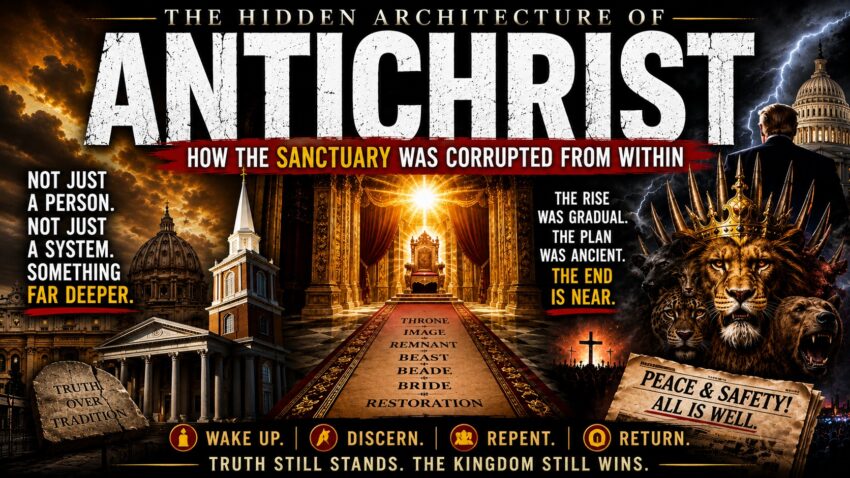
Every generation seems to do it. A ruler rises. A nation trembles. A movement forms. A statue appears. A boast is spoken. A crowd cheers. Then suddenly the prophecy machine wakes up, grabs Revelation, Daniel, Thessalonians, and the evening news, and begins stitching together another end-times villain.
Now the internet is once again asking the same question it has asked about presidents, popes, kings, emperors, dictators, reformers, celebrities, and political figures throughout history: Is this man the Antichrist?
But what if that question is already leading people down the wrong road?
What if the greatest deception is not that people fail to identify one final political villain, but that they have been trained to look outside the house of God while Scripture keeps warning about corruption inside the temple? What if the Bible’s warning is not mainly about the secular world producing a monster, but about the fallen church enthroning the image of fallen man where Christ alone should reign?
“Children, it is the last hour; and just as you heard that antichrist is coming, even now many antichrists have appeared.”
1 John 2:18
Notice what John actually said. He did not say only one antichrist would appear at the very end of history. He said many antichrists had already appeared. The warning was not merely future. It was already active. It was not merely singular. It was already plural. It was not merely political. It was spiritual, doctrinal, covenantal, and connected to those who claimed association with the faith.
“They went out from us, but they were not really of us.”
1 John 2:19
That phrase is the hinge. They went out from us. The antichrist pattern was not first introduced as some strange beast rising from the outer nations while God’s people watched safely from the balcony. John located the danger within the covenant community. The deception came from those who appeared close enough to the truth to depart from it. That is why this issue cannot be reduced to one politician, one election cycle, one statue, or one headline.
The modern prophecy world keeps searching for one man to accuse, but Scripture keeps exposing a spirit, a system, a counterfeit image, and a fallen religious structure that replaces Christ while still using His name. That is why this discussion is much bigger than Donald Trump. It is bigger than any president. It is bigger than any king, pope, emperor, or ruler who has ever been called the Antichrist throughout history.
The deeper question is not, “Which man is the Antichrist?” The deeper question is this: What has the fallen church enthroned instead of Christ?
What “Antichrist” Really Means
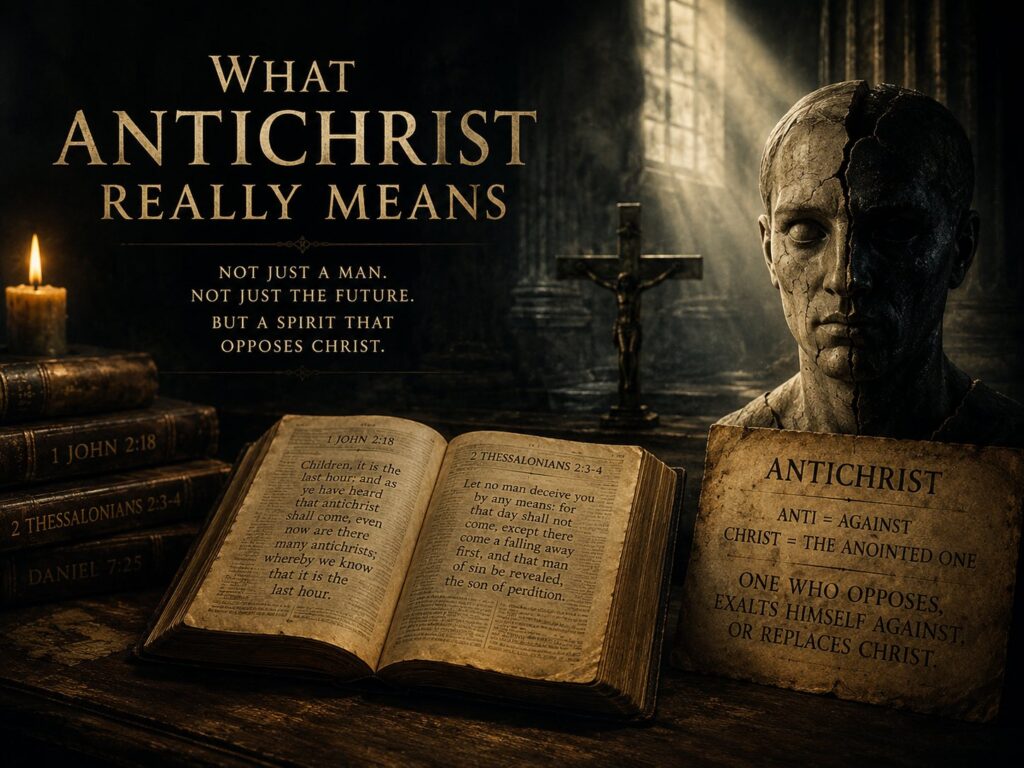
One of the greatest problems in modern prophecy teaching is that many believers inherit definitions instead of examining them. A phrase is repeated enough times through movies, prophecy books, church traditions, YouTube channels, and fear-driven teaching systems until eventually people stop asking whether the definition itself was ever tested carefully against Scripture.
The word “antichrist” is one of the clearest examples of this. Most people hear the word and immediately imagine one future political monster openly raging against Jesus while the entire world watches in horror. Entire industries have been built around this image. Endless books, charts, documentaries, conspiracy theories, and internet debates revolve around trying to identify one final villain hidden somewhere in the headlines.
But Scripture repeatedly commands believers to test teachings carefully instead of blindly accepting inherited interpretations. Acts chapter seventeen says the Bereans were called noble because they searched the Scriptures daily to test whether the things being taught to them were actually true. They did not reject examination in the name of tradition. They examined everything carefully.
“Now these were more noble-minded than those in Thessalonica,”
“for they received the word with great eagerness,”
“examining the Scriptures daily to see whether these things were so.”
Acts 17:11
Paul gave Timothy the same kind of command. He did not tell him to merely repeat inherited religious assumptions. He told him to accurately handle the word of truth. That means the believer is not being rebellious when he or she tests a popular teaching; they are being obedient.
“Be diligent to present yourself approved to God as a workman who does not need to be ashamed, accurately handling the word of truth.”
2 Timothy 2:15
That matters deeply when discussing the word “antichrist,” because the word has often been reduced to something much narrower than the biblical pattern itself. The prefix anti does not only carry the sense of being openly against Christ. It also carries the idea of standing in the place of, substituting for, or replacing. In other words, antichrist is not merely opposition. It is counterfeit replacement.
This changes the entire atmosphere of the discussion. The danger is not only a man screaming hatred toward Jesus from a throne somewhere in the future. The danger is a substitute savior. A counterfeit Christ. An image placed where Christ should be. A religious system that uses the language of God while replacing the nature of Christ with the image of fallen man.
This is why any political leader, ruler, movement, teacher, institution, or religious system can become antichrist in function when God’s people look to it for the things Christ promised. Peace. Security. Restoration. Deliverance. Prosperity. Identity. Protection. Salvation. When the church begins seeking from earthly power what belongs to Christ alone, the spirit of antichrist is already operating through substitution.
That does not mean every political leader is “the Antichrist.” It means the church must recognize the pattern of replacement. The real issue is not merely who sits in an earthly office. The deeper issue is what the fallen church enthrones in the place of Christ.
Many Antichrists Have Already Come
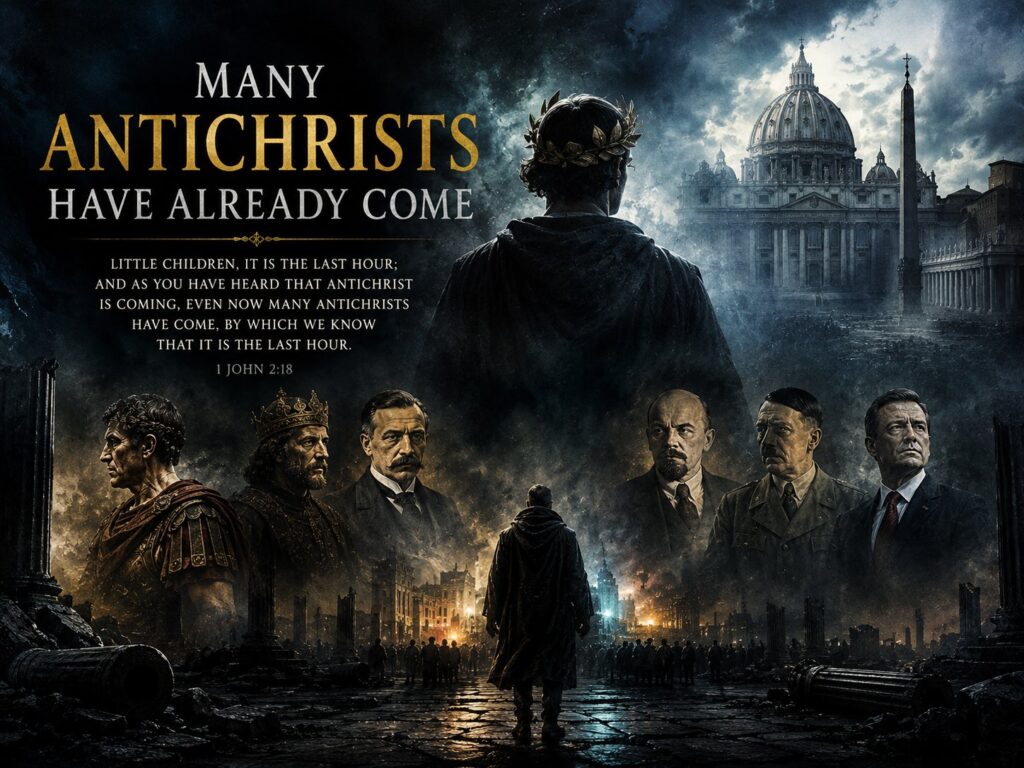
Once the word “antichrist” is understood as something that can mean a substitute, a replacement, or something standing in the place that belongs to Christ, the writings of John begin to sound very different from the modern prophecy narrative. John did not present antichrist as merely one distant political figure waiting at the end of history. He warned that the antichrist pattern was already active among God’s people.
“Children, it is the last hour; and just as you heard that antichrist is coming, even now many antichrists have appeared.”
1 John 2:18
That verse alone should make every serious reader pause. John acknowledges that believers had heard antichrist was coming, but then immediately says that many antichrists had already appeared. The warning is not locked inside one future personality. It is plural. It is present. It is already operating in the covenant community during John’s own time.
This matters because modern prophecy culture often treats “the Antichrist” as if Scripture built the entire doctrine around one final world ruler, yet the clearest passages that actually use the word antichrist speak of many. John’s language does not flatten the danger into a single man. It exposes a spirit, a pattern, a counterfeit image, and a religious departure from the truth.
Even Jesus Himself repeatedly warned about many false christs and false prophets arising among the people rather than centering His warnings on one final political supervillain. His emphasis remained on deception, counterfeit spirituality, corrupted leadership, and false representations of truth spreading among those connected to the covenant community.
“For many will come in My name, saying, ‘I am the Christ,’ and will mislead many.”
Matthew 24:5
The phrase “false christs” likely reaches far deeper than merely individuals verbally claiming to be Jesus Himself. Scripture repeatedly warns about counterfeit shepherds, substitute spiritual authorities, false teachers, distorted representations of God, and religious systems presenting another image of Christ entirely. A false christ is ultimately a counterfeit representation of salvation, authority, kingdom, and truth standing in the place that belongs to Christ alone.
This becomes especially important because if one final antichrist individual were truly the central prophetic warning of Scripture, it is difficult to imagine Jesus repeatedly emphasizing many false christs, many false prophets, wolves among the flock, hypocrisy within the sanctuary, and inward corruption among religious leaders without more directly centering His warnings on that single coming figure.
Even Daniel’s prophetic language often appears to move through kingdoms, rulers, powers, and recurring spiritual patterns using the same symbolic “he” language across shifting historical contexts. The prophecy flows across eras, empires, conflicts, and covenant struggles in ways that many believe point less toward one isolated future individual and more toward a recurring spirit of exaltation, rebellion, counterfeit authority, and opposition to God moving through history itself.
“They went out from us, but they were not really of us.”
1 John 2:19
This is one of the most important lines in the entire discussion. John does not say the antichrist spirit came from the outer nations while the people of God stood untouched. He says, “They went out from us.” The deception had an internal religious origin. It was connected to those who were close enough to the truth to depart from it, distort it, counterfeit it, and carry another spirit while still appearing connected to the faith.
That is why the focus must remain on the church, the fallen church, the false shepherds, the counterfeit teachers, and the corrupted temple system that claims the name of God while replacing the nature of Christ. The prophetic warning is not mainly about the secular world accidentally becoming evil. The warning is about covenant corruption. It is about those who were near the sanctuary, near the truth, near the language of Christ, yet departed from the life and Spirit of Christ.
“And every spirit that does not confess Jesus is not from God; this is the spirit of the antichrist.”
1 John 4:3
Again, John says the spirit of antichrist was already present. This does not fit neatly with a system that teaches people to keep postponing the danger into one future figure while ignoring the spirit already working through false doctrine, religious pride, corrupted worship, and counterfeit Christ-representation among those who claim to belong to God.
Many people imagine “not confessing Jesus” means openly declaring, “Jesus Christ is not the Son of God.” But Scripture repeatedly warns about something far more deceptive: claiming to follow Jesus while presenting a different Jesus entirely. A counterfeit Christ. A distorted image. A substitute gospel wearing Christian language outwardly while denying the actual nature, Spirit, teachings, and character of Christ inwardly.
This is why Paul warned about those preaching “another Jesus.” The danger was never merely open atheism. The greater danger was religious counterfeit operating close enough to the truth to deceive the sanctuary itself.
“For if one comes and preaches another Jesus whom we have not preached…”
2 Corinthians 11:4
The antichrist spirit does not have to appear with horns, smoke, and a dramatic soundtrack. It can appear dressed in ministry language. It can preach another Jesus. It can promise the benefits of Christ while denying the way of Christ. It can offer power without holiness, prosperity without repentance, salvation without transformation, and kingdom promises without the cross.
It can give people a substitute savior, a substitute kingdom, a substitute gospel, and a substitute image. That is why the fallen church becomes the central battleground.
This is also why thousands of people throughout history have been accused of being the Antichrist. Nero, popes, emperors, Napoleon, Hitler, presidents, kings, reformers, and modern political leaders have all been placed into the prophecy machine. Every generation thinks it has finally found the face of the beast. But if the accusation keeps changing while the pattern remains, then perhaps the real issue is not that every generation failed to identify the right man. Perhaps the issue is that many were trained to look for one man when Scripture was exposing a recurring spirit inside the corrupted house of worship.
The question is not whether a political ruler can function as an antichrist figure. Any leader, system, teacher, movement, or image can become antichrist when God’s people begin seeking from it what belongs to Christ alone: peace, safety, prosperity, healing, deliverance, identity, restoration, and salvation. When the church looks to a man for what Jesus promised, that man becomes a substitute throne whether he realizes it or not.
This is why the issue is so much larger than one statue, one president, one headline, or one viral controversy. The antichrist pattern is not merely about open hostility toward Jesus. It is about replacement. It is about anything that steps into the place reserved for Christ inside the people who claim His name.
When Prophecy Became a Marketplace
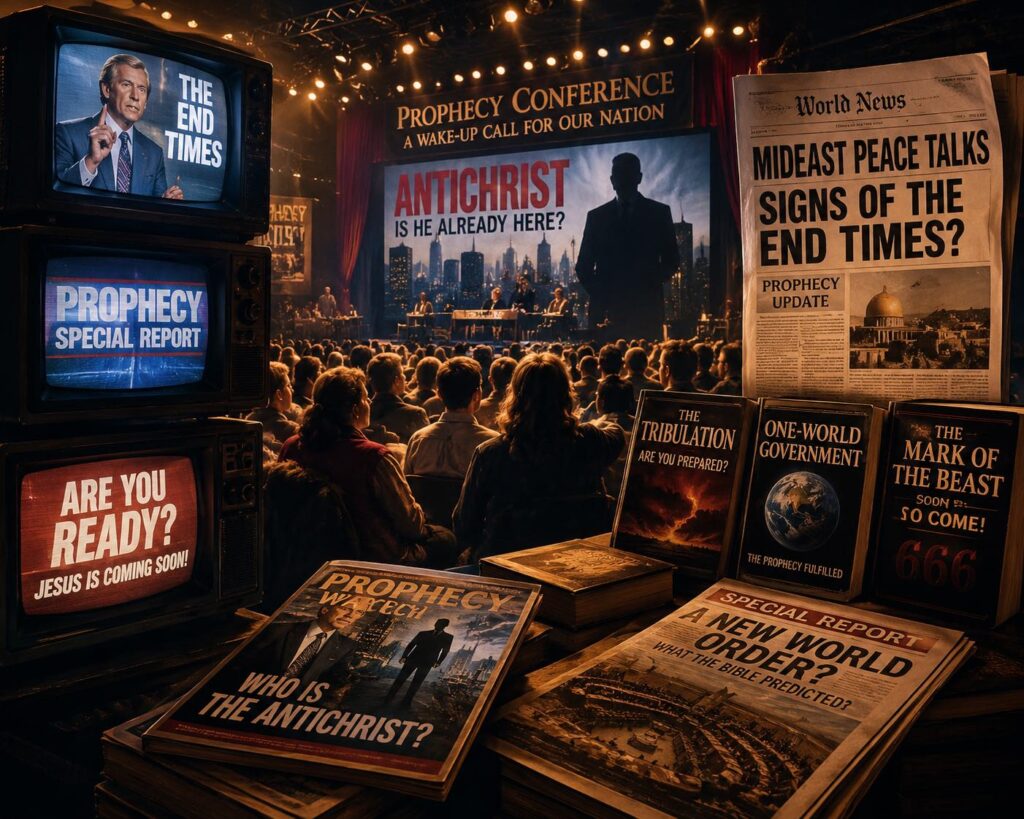
One of the most important questions modern believers rarely ask is this: if the clearest biblical passages about antichrist speak about many antichrists, counterfeit spirits, false teachers, corrupted worship, and deception already operating within the covenant community during the days of the apostles… then how did modern Christianity become so overwhelmingly fixated on one future political supervillain?
The answer is partly theological, but it is also deeply cultural.
For much of church history, Revelation was commonly understood symbolically, spiritually, typologically, or covenantally. Early Christians, church fathers, reformers, and many historical interpreters often viewed the beasts, Babylon, the harlot, the temple, and the prophetic imagery of Revelation as symbolic patterns revealing spiritual corruption, apostasy, persecution, covenant conflict, and the ongoing battle surrounding the people of God.
But during the twentieth century, especially in America, a dramatic shift began to occur. Prophecy interpretation increasingly moved from symbolic and spiritual readings toward highly literalized futurism focused on geopolitical speculation, sensational timelines, global conspiracies, and one coming world dictator identified as “the Antichrist.”
One of the largest turning points came in 1970 with the publication of The Late Great Planet Earth by Hal Lindsey and Carole C. Carlson. While literal dispensational interpretations already existed beforehand, the book became the primary catalyst that exploded this framework into mainstream evangelical culture.
Selling more than twenty-eight million copies by 1990 and becoming the top-selling nonfiction book of the 1970s, the work transformed Bible prophecy into mass-market popular culture. Suddenly Revelation was no longer primarily approached as symbolic spiritual architecture concerning covenant corruption and the people of God. It became a prophetic decoding system tied directly to current events, political movements, Cold War fears, global conflict, and end-times speculation.
Russia was connected to Gog. The European Economic Community became the revived Roman Empire. Newspapers were read like prophetic roadmaps. The Antichrist became a coming global dictator. The Rapture became a dominant cultural expectation. Fear, urgency, speculation, and prophetic decoding entered mainstream evangelical imagination on an unprecedented scale.
The movement expanded even further through television ministries, prophecy conferences, radio broadcasts, documentaries, films, bestselling books, and eventually massive franchises such as Left Behind. Entire ministries, media empires, speaking circuits, publishing industries, and financial ecosystems emerged around the constant anticipation of a literalized apocalypse centered on identifying the beast, decoding current events, and predicting the arrival of the final Antichrist figure.
This does not mean every teacher within these systems acted maliciously or intentionally sought deception. Many sincerely believed they were warning people faithfully. But the result was still profound: modern prophecy culture became increasingly driven by fear, spectacle, sensationalism, political obsession, and endless anticipation of catastrophic world events.
Meanwhile, the deeper biblical warnings concerning the sanctuary, covenant corruption, counterfeit worship, false shepherds, spiritual intoxication, and the transformation of the church itself often faded into the background. The spotlight shifted outward toward geopolitical villains while the prophetic mirror aimed at the covenant community became increasingly neglected.
The prophecy marketplace became enormously profitable because fear sells. Spectacle sells. Mystery sells. The constant search for the beast generates attention, books, conferences, clicks, algorithms, donations, ratings, and emotional urgency. Every generation becomes convinced it is finally watching the rise of the ultimate Antichrist figure.
Yet while faces continually change, the deeper spiritual pattern remains remarkably consistent: counterfeit worship, substitute saviors, corrupted sanctuaries, false peace, political intoxication, spectacle religion, and the gradual replacement of the Spirit of Christ with the image of fallen man operating inside the visible covenant structure itself.
Perhaps the greatest irony is that the modern obsession with identifying the beast in the outer world may itself distract from the very place Scripture repeatedly warns believers to watch most carefully: the sanctuary.
The Temple of God Was Never Just Stone
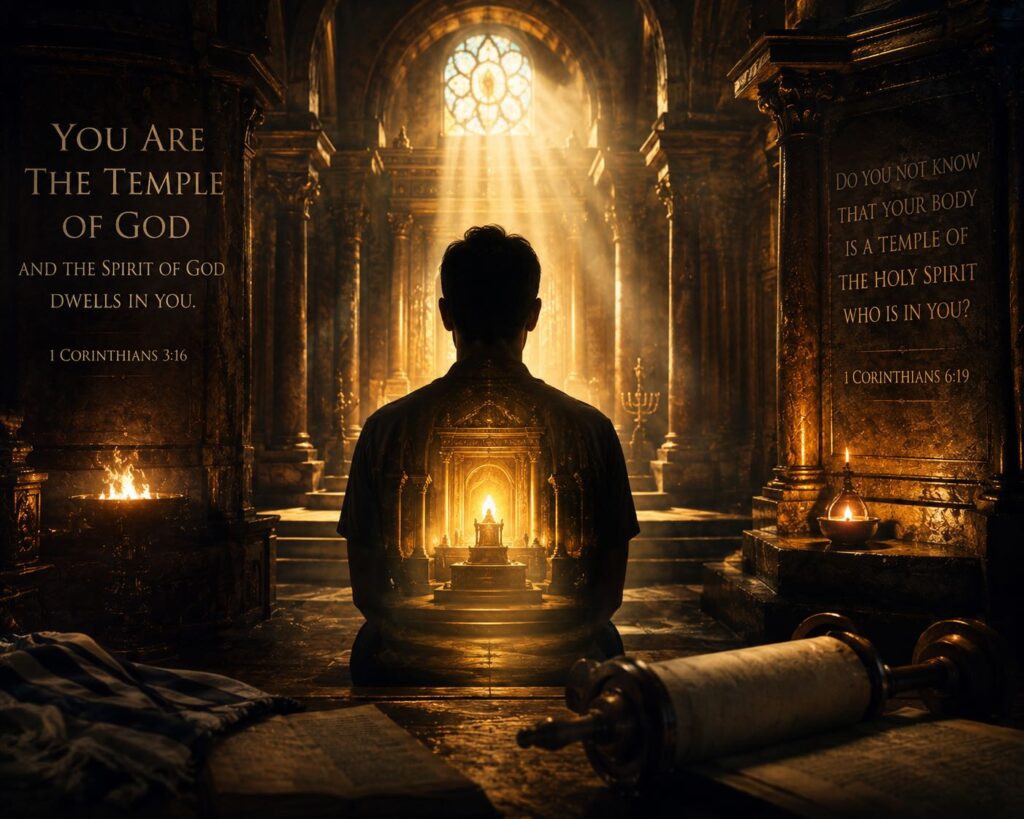
One of the greatest assumptions in modern prophecy teaching is that whenever the New Testament speaks about the temple of God prophetically, it must automatically be referring to a future physical building somewhere in Jerusalem. Entire end-times systems have been constructed around this assumption. Yet the New Testament repeatedly shifts the meaning of the temple away from stone walls and toward the people of God themselves.
“Do you not know that you are a temple of God and that the Spirit of God dwells in you?”
1 Corinthians 3:16
Paul did not describe believers as merely visiting the temple. He described them as being the temple. The sanctuary imagery moved inward. The dwelling place of God was no longer centered upon geographic stone structures but upon living vessels carrying the Spirit of God.
“Or do you not know that your body is a temple of the Holy Spirit who is in you?”
1 Corinthians 6:19
Again and again the New Testament repeats the same pattern. Temple language becomes covenant language. Sanctuary language becomes inward language. The throne room moves into the heart. This is why many believers have begun questioning whether the prophetic warnings about corruption in the temple were ever primarily about one future man entering one future building, or whether the deeper warning concerns corruption arising within the house of God itself.
This is what makes Jesus’ warning about the “abomination of desolation” so fascinating. Most modern interpretations immediately move the reader toward geopolitical speculation or a rebuilt physical temple somewhere in the future. But Jesus’ own teachings repeatedly shift the focus of defilement inward toward the sanctuary itself.
“But when you see the abomination of desolation standing where it ought not…”
Mark 13:14
Matthew’s parallel account says “standing in the holy place.” That language is deeply important because it describes something occupying consecrated space illegitimately. Something standing where it does not belong. A counterfeit presence inside the sanctuary.
And only a few chapters earlier in Mark’s Gospel, Jesus radically reframes the entire concept of defilement itself. Instead of focusing merely on outward contamination, ritual washing, or external corruption, He points directly to the inward condition of man.
“That which proceeds out of the man, that is what defiles the man.”
Mark 7:20
Jesus then lists pride, deceit, sensuality, envy, slander, arrogance, and wickedness flowing outward from within the heart itself. In other words, the corruption proceeds from inside the sanctuary of man. The holy place becomes profaned from within.
This creates a striking prophetic pattern throughout Scripture: the danger is not merely something attacking the sanctuary from the outside. The greater warning is about something occupying sacred space internally. A substitute presence. A counterfeit enthronement. Flesh sitting where Spirit belongs. The image of fallen man standing where only Christ should reign.
Once these passages are viewed together, the warning begins sounding far less like a distant movie scene involving one future villain entering a building, and far more like an ongoing prophetic revelation concerning corruption, counterfeit worship, and defilement inside the covenant sanctuary itself.
This inward emphasis appears throughout the teachings of Jesus and the apostles again and again. The focus repeatedly moves away from outward flesh and toward the inward condition of the soul. Even when speaking about persecution, suffering, and death, Jesus continually redirected attention beyond the temporary body toward the deeper spiritual reality within man.
“Do not fear those who kill the body but are unable to kill the soul; but rather fear Him who is able to destroy both soul and body in hell.”
Matthew 10:28
The New Testament consistently shifts the reader away from obsession with outward structures and toward the inward sanctuary where spiritual corruption, transformation, worship, defilement, and covenant allegiance truly take place. The battle is not merely about external flesh, stone buildings, or visible systems. It is about what occupies the holy place within man himself.
“He Takes His Seat in the Temple of God”
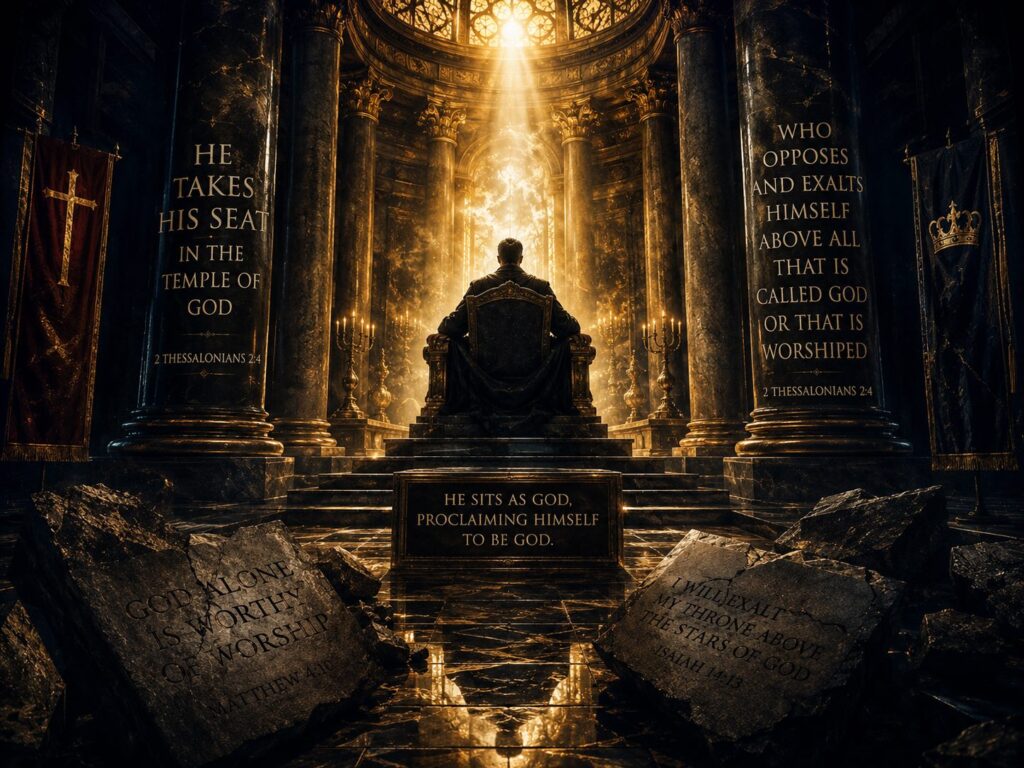
One of the most quoted passages used to support the idea of a single future Antichrist figure comes from Second Thessalonians. For generations, many believers have interpreted the passage as referring to one final political ruler physically entering a rebuilt temple in Jerusalem and declaring himself to be God. Yet when the passage is examined within the larger symbolic framework of the New Testament, another possibility begins to emerge.
“…so that he takes his seat in the temple of God, displaying himself as being God.”
2 Thessalonians 2:4
If Paul repeatedly defines the people of God as the temple elsewhere in his writings, why would the symbolic framework suddenly shift here without explanation? God is not the author of confusion. The issue is not that Scripture contradicts itself, but that human interpretation often fractures the symbolic continuity already established throughout the New Testament.
The New Testament repeatedly moves the sanctuary inward. The temple becomes the people of God. The dwelling place becomes the heart. The throne becomes spiritual allegiance. This is why many believers see the warning in Thessalonians not as the story of one future politician entering one future building, but as a prophetic picture of counterfeit enthronement arising within the covenant community itself.
The imagery becomes even more striking when placed beside Ezekiel twenty-eight. There, the ruler of Tyre declares himself exalted while seated “in the seat of gods in the heart of the seas.” The language is deeply symbolic. The heart becomes a throne. The seat becomes a place of spiritual rulership. The issue is not merely geography, but inward exaltation and false divinity arising within what was supposed to belong to God.
“Because your heart is lifted up and you have said, ‘I am a god, I sit in the seat of gods in the heart of the seas’; yet you are a man and not God, although you make your heart like the heart of God.”
Ezekiel 28:2
The warning of Scripture repeatedly returns to the same central issue: what sits upon the throne of the heart within the house of God? Christ, or the image of fallen man?
The Fallen Church and the Search for Earthly Saviors
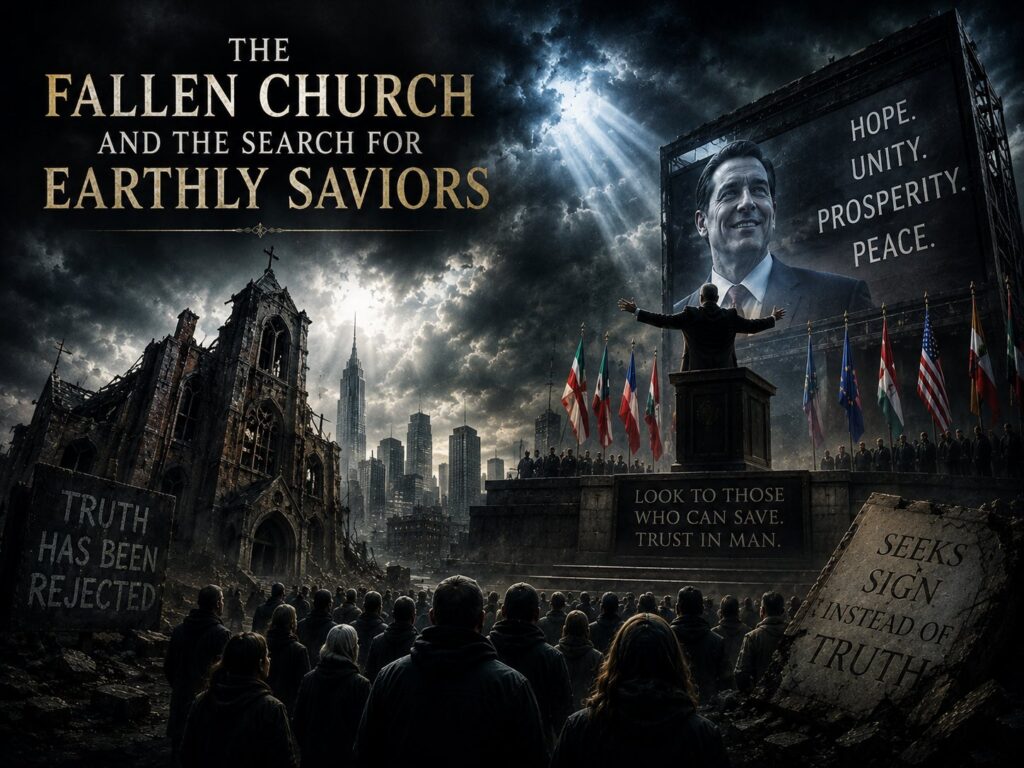
The modern prophecy world spends enormous amounts of time searching the outer world for monsters while often ignoring the warnings Scripture repeatedly directs toward the house of God itself. The New Testament continually warns about false shepherds, false apostles, false prophets, another gospel, and deception arising from within the covenant community. Yet many believers have been trained to look almost exclusively toward secular politics and global conspiracies while overlooking the spiritual condition of the visible church.
This is one reason political figures repeatedly become objects of near-messianic devotion among segments of the church. Believers begin looking to earthly rulers for the things Christ promised to provide through His kingdom. Safety. Restoration. Prosperity. National healing. Deliverance. Strength. Victory. The political figure becomes more than a leader. He becomes a vessel for misplaced hope.
This pattern is not new. Israel repeatedly desired visible kings like the surrounding nations. Even after God warned them what earthly rulers would eventually do, they still cried out for a human king to reign over them. The temptation was never merely political. It was spiritual. Fallen humanity continually longs for visible power it can rally around instead of walking by faith under the invisible reign of God.
“They have rejected Me from being king over them.”
1 Samuel 8:7
This is why the spirit of antichrist cannot be reduced merely to one future politician. Any leader, movement, religious structure, or system can function in an antichrist role whenever it begins occupying the place that belongs to Christ alone. The issue is substitution. Replacement. Counterfeit enthronement. Something standing in the place where Christ should reign within the hearts of God’s people.
This is also why thousands of people throughout history have been accused of being “the Antichrist.” Emperors, kings, popes, dictators, presidents, reformers, military leaders, and political rulers have all worn the label at one point or another. Each generation confidently believes it has finally identified the beast. Yet the accusations constantly change while the deeper spiritual condition remains.
The real danger may not be that the church fails to identify one final villain. The real danger may be that the church continually enthrones substitutes in place of Christ while believing it is defending the faith.
The Number of Man
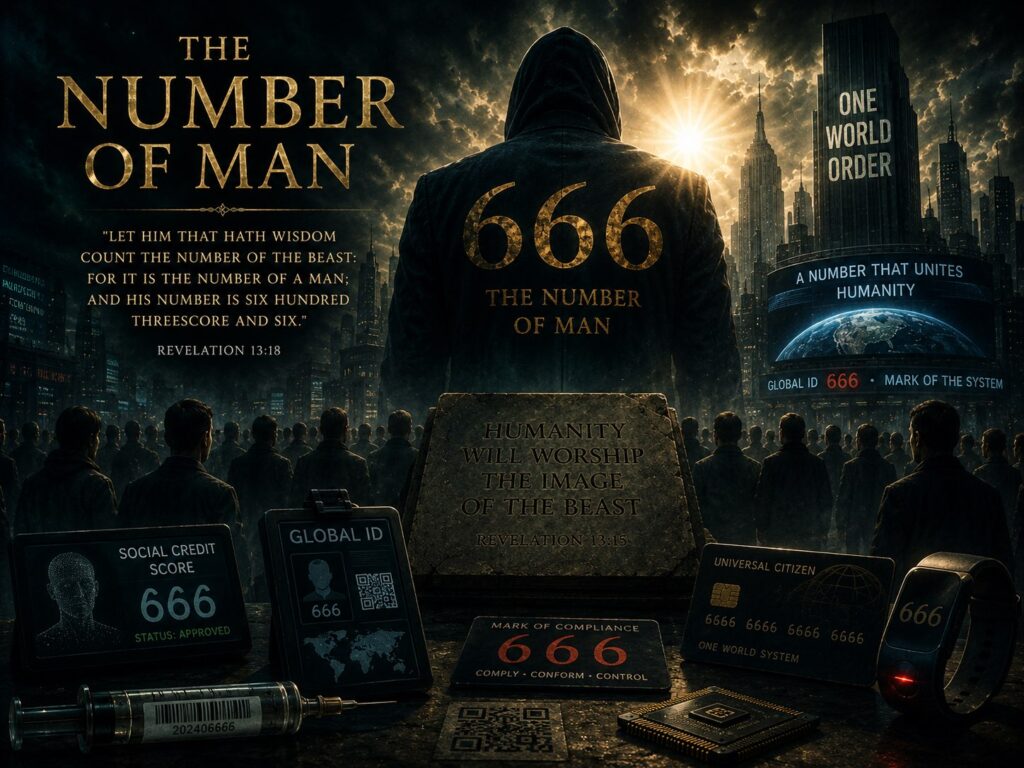
Perhaps no chapter has fueled more fear, speculation, obsession, and endless prophecy theories than Revelation thirteen. Entire ministries have been built around trying to decode the beast by attaching the number six hundred sixty-six to politicians, world leaders, technologies, barcodes, corporations, governments, and public figures. Yet in the middle of all the noise, one of the most important details is often overlooked entirely.
“Let him who has understanding calculate the number of the beast, for the number is that of man.”
Revelation 13:18
Many modern translations render the passage differently, often inserting the phrase “a man,” which immediately pushes the reader toward imagining one isolated future individual. But older renderings and alternate translations preserve a broader reading: the number of man. The distinction is not small. One interpretation points toward a single final supervillain. The other points toward something much larger — the image of fallen man itself.
Throughout Scripture, man apart from God represents fallen flesh, self-rule, rebellion, pride, counterfeit glory, and corrupted worship. The beast imagery in Revelation repeatedly connects to worship, image-bearing, spiritual allegiance, false prophecy, and counterfeit authority. This is why many believers have begun questioning whether Revelation’s warning was ever mainly about identifying one politician, or whether it was exposing the rise of a corrupted religious system bearing the image of fallen man while claiming to represent God.
The obsession with finding one final villain can become a distraction in itself. The church scans the horizon searching for one evil ruler while often ignoring the far more uncomfortable possibility that the image being enthroned within the sanctuary is the image of fallen flesh itself. The issue was never merely external control. The issue was worship. Allegiance. Image. Covenant identity.
This is why the warnings of Revelation repeatedly circle back to the people of God, the churches, false prophets, spiritual adultery, harlot imagery, counterfeit worship, and corruption within what claims to belong to God. The battle is not merely political. It is covenantal. It concerns what image the visible church ultimately reflects.
The Statue, the Golden Calf, and the Modern Church
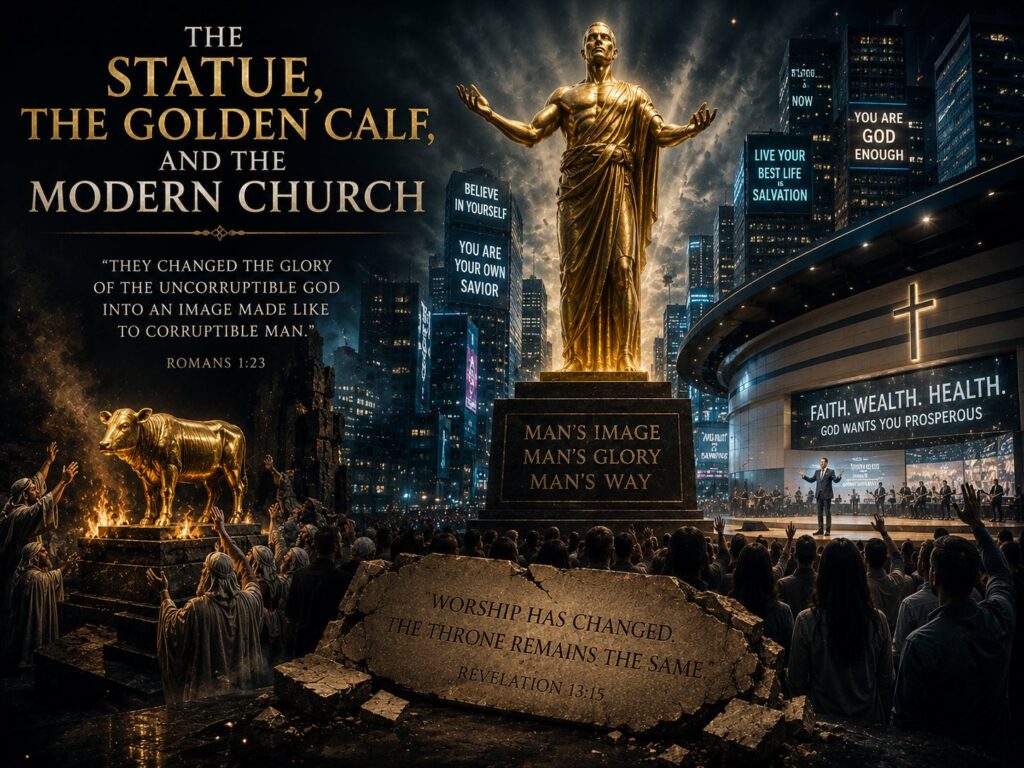
The recent controversy surrounding golden statues, political imagery, and messianic-style devotion among segments of the visible church has once again reignited the endless internet debate about “the Antichrist.” For many people, the symbolism feels obvious. Gold imagery. Political exaltation. Religious loyalty attached to earthly power. Nationalistic fervor mixed with spiritual language. To many observers, the parallels to the golden calf or Nebuchadnezzar’s image appear impossible to ignore.
But the deeper issue is not whether one statue proves one man fulfills prophecy. Statues have existed throughout history for kings, presidents, military leaders, emperors, reformers, saints, and political figures. Entire nations are filled with monuments honoring rulers and leaders from the past. If the mere existence of statues automatically proved someone was “the Antichrist,” then history itself would collapse into confusion.
The real issue is what these symbols reveal about the heart of the visible church. Scripture repeatedly warns that fallen people long for visible saviors they can rally around. The temptation has always been to replace invisible trust in God with visible power, visible rulers, visible movements, visible strength, and visible kingdoms.
“They made a calf in Horeb and worshiped a molten image. Thus they exchanged their glory for the image of an ox that eats grass.”
Psalm 106:19-20
The golden calf was never merely about sculpture. It was about replacement. Israel desired something visible to represent strength, leadership, certainty, and divine presence. The danger was not the metal itself. The danger was the exchange. They exchanged the glory of God for an image.
This same pattern continues whenever the visible church begins seeking from earthly rulers what belongs to Christ alone. Salvation becomes political. Restoration becomes nationalistic. The kingdom becomes earthly power. Leaders become symbolic saviors carrying the emotional hopes of the people. At that point, the issue is no longer merely politics. It becomes spiritual enthronement.
This is why any leader can function in an antichrist role whenever the visible church begins looking to that leader instead of Christ for peace, deliverance, restoration, security, identity, or salvation. The issue is not simply opposition to Christ. The issue is substitution in place of Christ.
Why Every Generation Creates a New Antichrist
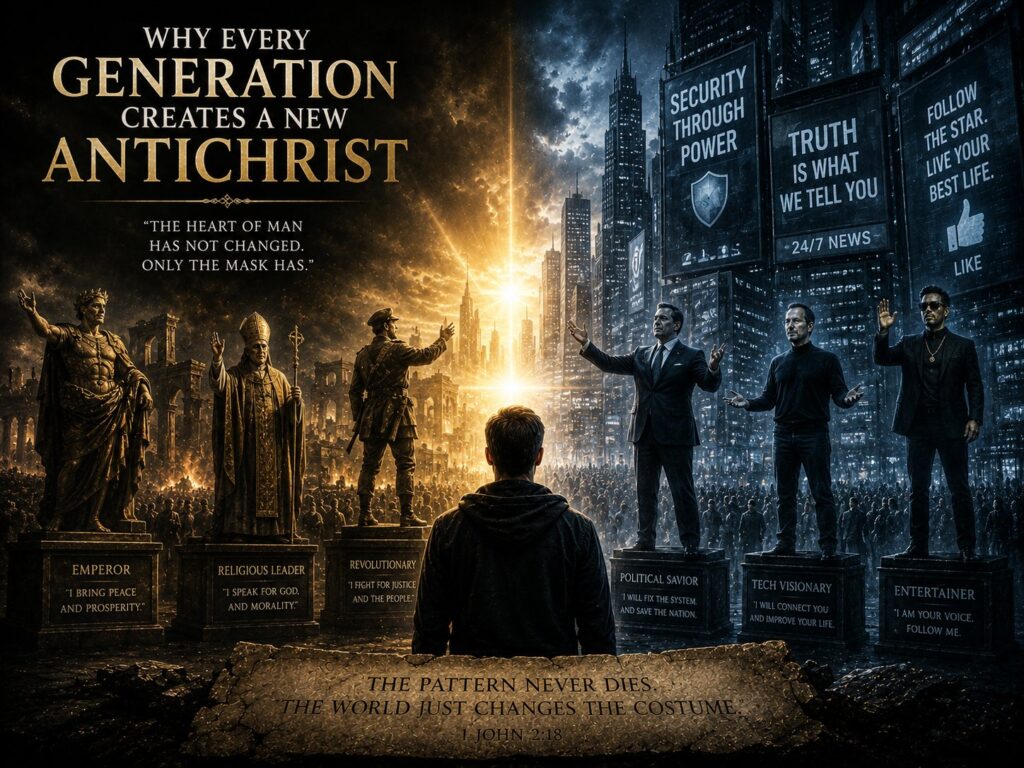
One of the strangest patterns in prophecy culture is that nearly every generation becomes convinced it has finally identified the ultimate Antichrist. As history moves forward, the names change constantly, yet the certainty always sounds the same. Entire books, ministries, documentaries, and movements have repeatedly declared that the mystery has finally been solved.
Nero was called the Antichrist. Various popes were called the Antichrist. Napoleon was called the Antichrist. Hitler was called the Antichrist. Presidents, kings, reformers, military rulers, and political leaders across generations have all carried the accusation at one point or another. Every age believes it has discovered the final beast hiding in its own headlines.
Yet despite the endless predictions, the pattern continues repeating itself. The names change, but the deeper spiritual condition remains untouched. The visible church continues struggling with false shepherds, counterfeit worship, political idolatry, spiritual compromise, celebrity religion, and substitute saviors while prophecy culture remains consumed with identifying one final villain somewhere outside the sanctuary.
“For the mystery of lawlessness is already at work.”
2 Thessalonians 2:7
Paul did not describe the mystery of lawlessness as something existing only in the distant future. He said it was already operating in his own day. John said many antichrists had already come. The spirit of antichrist was already in the world. The warnings of Scripture repeatedly point toward an ongoing spiritual corruption working itself through the visible church across generations.
This is why prophecy becomes distorted whenever believers reduce the entire warning to one future political celebrity. The focus shifts away from discernment within the house of God and toward endless speculation about worldly rulers. Meanwhile the deeper biblical warnings concerning false worship, false shepherds, counterfeit spirituality, and apostasy within the covenant community remain largely ignored.
The issue is not merely identifying one evil man. The issue is recognizing the recurring image of fallen man repeatedly enthroned within what claims to belong to God.
What Sits Upon the Throne?
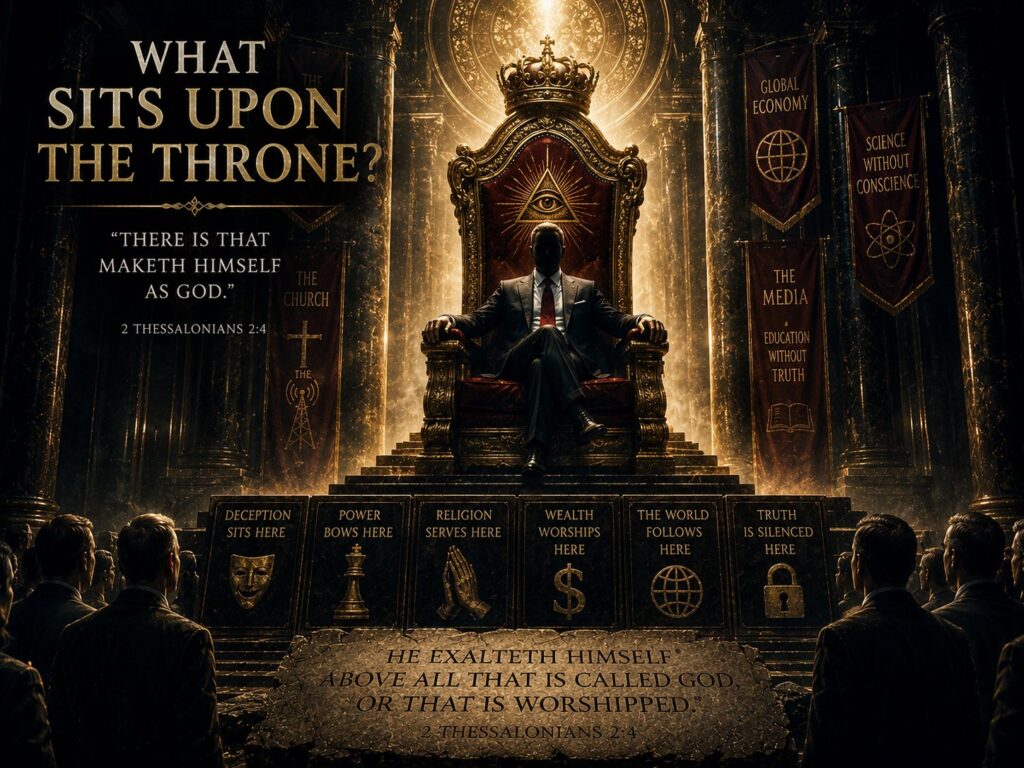
At the center of all prophetic symbolism lies one great question. Not merely who rules nations. Not merely what political system rises or falls. Not merely what leader captures headlines for a moment in history. The deeper question running beneath the surface of Scripture is this: what sits upon the throne within the house of God?
The Bible repeatedly moves the reader inward. The sanctuary becomes the people of God. The temple becomes the dwelling place of the Spirit. The throne becomes spiritual allegiance. Worship becomes image-bearing. The battle is not merely external. It concerns what the visible church ultimately reflects.
This is why the warnings concerning antichrist, false prophets, apostasy, and deception cannot simply be reduced to political speculation. Scripture repeatedly warns about corruption arising within what claims to belong to God. Wolves among the flock. False apostles disguising themselves as servants of righteousness. Another gospel entering the sanctuary. The danger comes clothed in religious language while carrying another spirit.
“For such men are false apostles, deceitful workers, disguising themselves as apostles of Christ.”
2 Corinthians 11:13
The greatest danger may not be that the church fails to identify one final evil ruler. The greatest danger may be that the church slowly conforms itself to the image of fallen flesh while continuing to speak the language of God. Pride replaces humility. Power replaces servanthood. Spectacle replaces holiness. Political kingdoms replace the kingdom of Christ. Substitute saviors rise while the visible church believes it is defending truth.
This is why believers must become like the Bereans once again. Scripture must be searched carefully. Traditions must be tested. Interpretations must be examined honestly. Prophecy should not be approached as entertainment, fear theater, or endless villain hunting. It should lead the people of God toward repentance, discernment, holiness, and faithfulness within the covenant community.
The final warning of Scripture is not merely about identifying beasts in the outer darkness. It is about guarding the sanctuary from counterfeit enthronement within the house of God itself.
The question was never simply, “Who is the Antichrist?”
The question is: what sits upon the throne where Christ alone should reign?
The Final Warning Hidden in the Temple
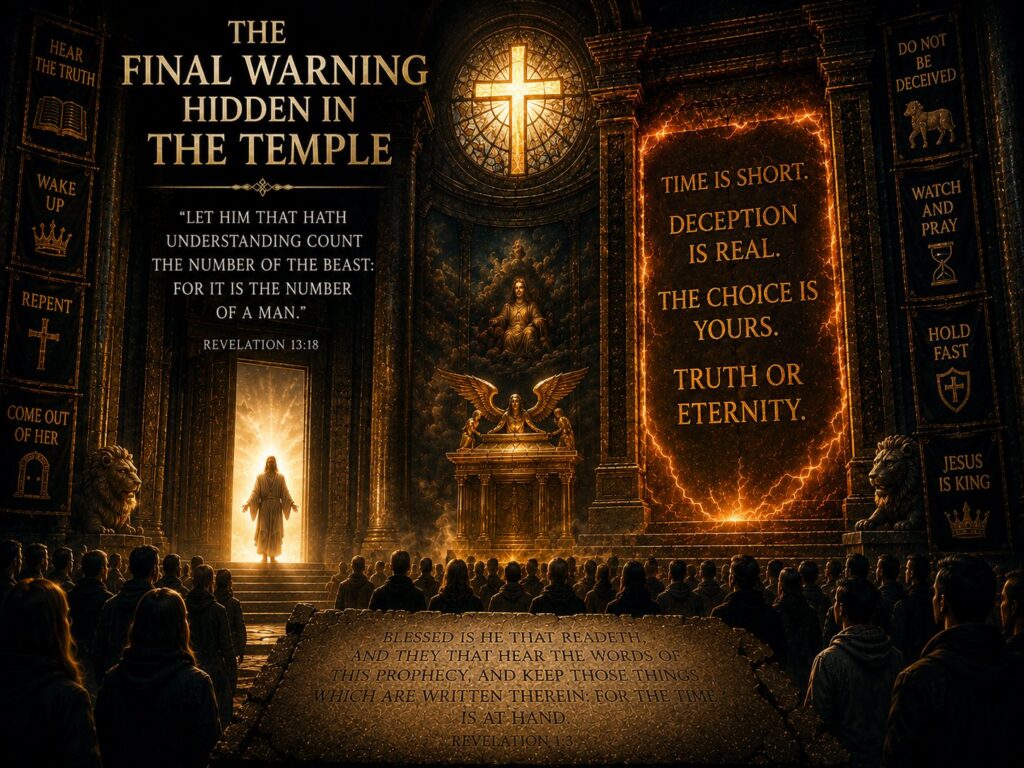
For generations, believers have been taught to stare endlessly into the outer darkness searching for one final political beast rising from the nations. Entire prophetic systems have conditioned the church to scan headlines, governments, technologies, world leaders, and global events while often ignoring the warnings Scripture repeatedly directs toward the sanctuary itself.
Yet the New Testament continually turns the spotlight inward. The churches in Revelation are warned. The shepherds are warned. False apostles are warned. False prophets are warned. The covenant community is warned. Again and again the danger emerges not merely from the outer world, but from corruption growing within what claims to belong to God.
“Judgment must begin at the house of God.”
1 Peter 4:17
This is why the prophetic warnings surrounding antichrist cannot simply be reduced to one future ruler or one political system. The issue is much deeper. It concerns worship, allegiance, image, covenant faithfulness, and what the visible church ultimately reflects. The danger is not merely opposition to Christ. The danger is replacement in place of Christ.
Whenever earthly power becomes the hope of the church, the pattern begins repeating. Whenever political figures become messianic symbols, the pattern begins repeating. Whenever spectacle replaces holiness, whenever false prophecy replaces discernment, whenever movements and personalities become enthroned where Christ alone should reign, the spirit of antichrist is already at work within the sanctuary.
The greatest deception may not be that believers fail to identify one final villain. The greatest deception may be that the visible church continually exchanges the glory of God for the image of fallen man while believing it is defending truth.
This is why believers must return to careful discernment. The Scriptures must be searched honestly. Traditions must be tested. Teachings must be examined. Prophecy must lead to repentance, holiness, humility, and faithfulness to Christ rather than fear, obsession, spectacle, and endless political fixation.
The final battle was never merely about identifying one beast in the distance. It was always about guarding the throne within the temple.
The Bereans, Rightly Dividing the Word, and the Courage to Question Tradition
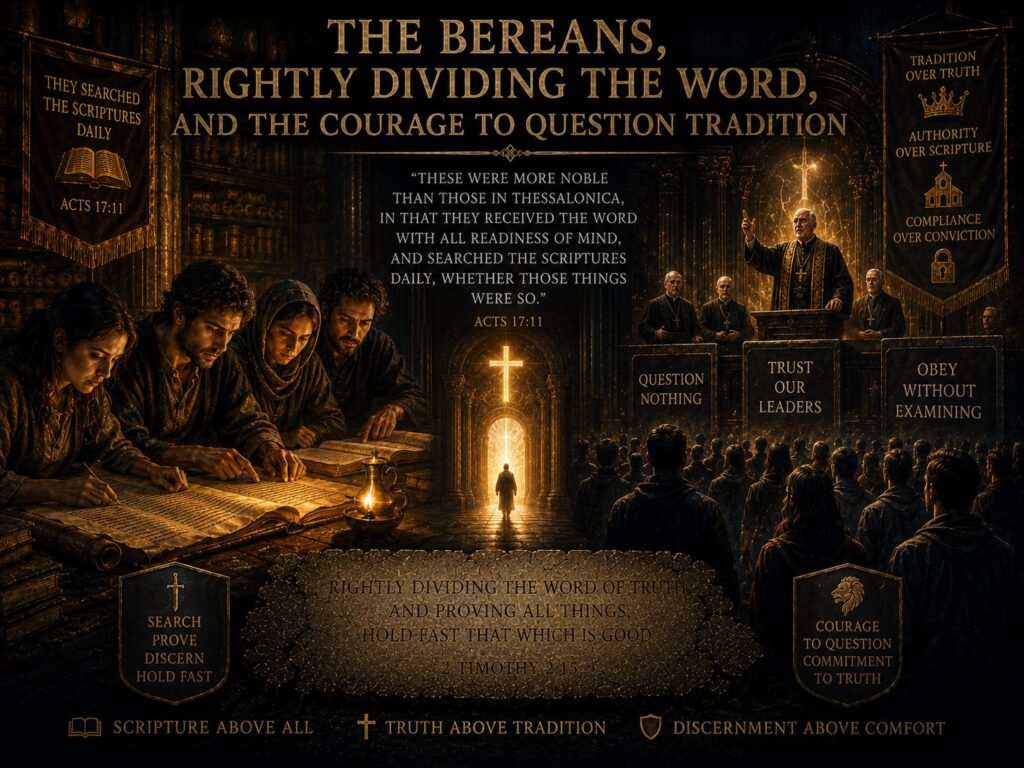
One reason many believers become uncomfortable when long-held prophetic traditions are questioned is because modern church culture often treats inherited interpretations as though they were equal with Scripture itself.
“Be diligent to present yourself approved to God as a workman who does not need to be ashamed, accurately handling the word of truth.”
2 Timothy 2:15
The Mystery Already at Work
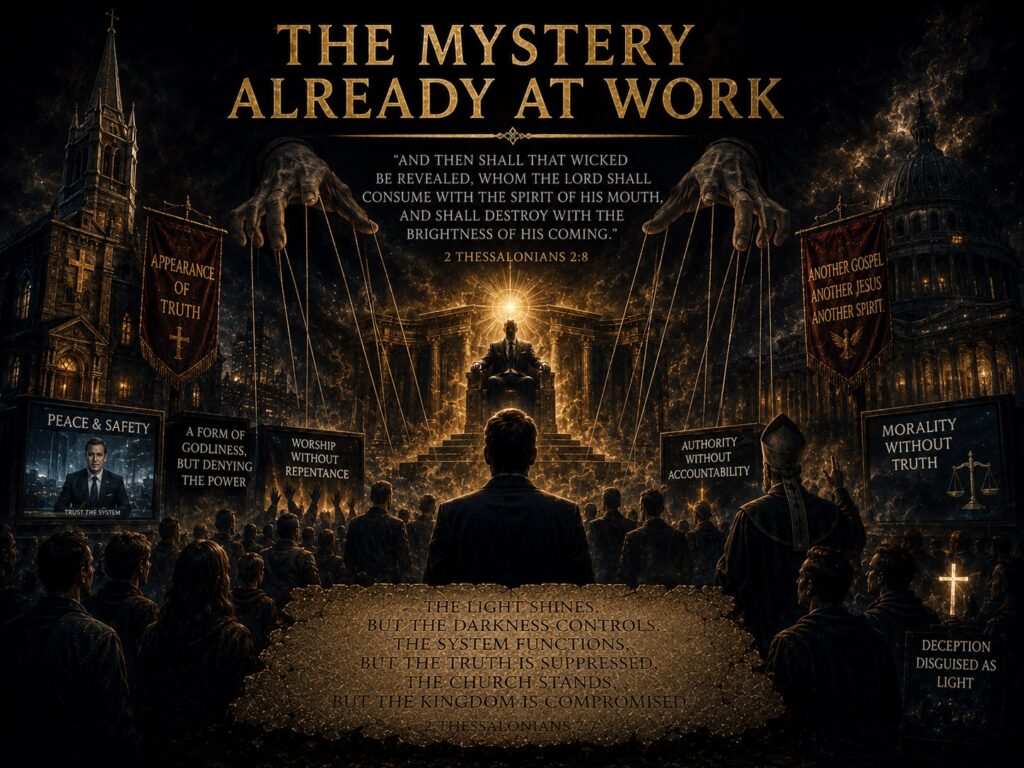
One of the most overlooked details in modern prophecy teaching is that the New Testament repeatedly describes the spirit of deception as something already operating in the days of the apostles themselves. The warnings were not framed merely as distant future events disconnected from the condition of the early church. The corruption had already begun moving through the sanctuary.
“For the mystery of lawlessness is already at work.”
2 Thessalonians 2:7
Paul did not describe the mystery as something waiting thousands of years before appearing. He said it was already active. John gave the same warning when he wrote that many antichrists had already come and that the spirit of antichrist was already in the world. The pattern was present long before modern prophecy culture began constructing elaborate systems around one future political supervillain.
“Every spirit that does not confess Jesus is not from God; this is the spirit of the antichrist, of which you have heard that it is coming, and now it is already in the world.”
1 John 4:3
The warnings continually circle back toward false worship, counterfeit teaching, corrupted leadership, and deception arising within what claims to belong to God. The danger is not merely secular darkness outside the covenant community. The danger is spiritual corruption growing within the visible church while still using the language of God.
This is why prophecy cannot be reduced to endless speculation about politicians and governments while ignoring the condition of the sanctuary itself. The mystery was already working in the days of the apostles because the battle has always concerned worship, image, allegiance, and what spirit ultimately reigns within the house of God.
False Prophets, Spectacle Religion, and Counterfeit Authority
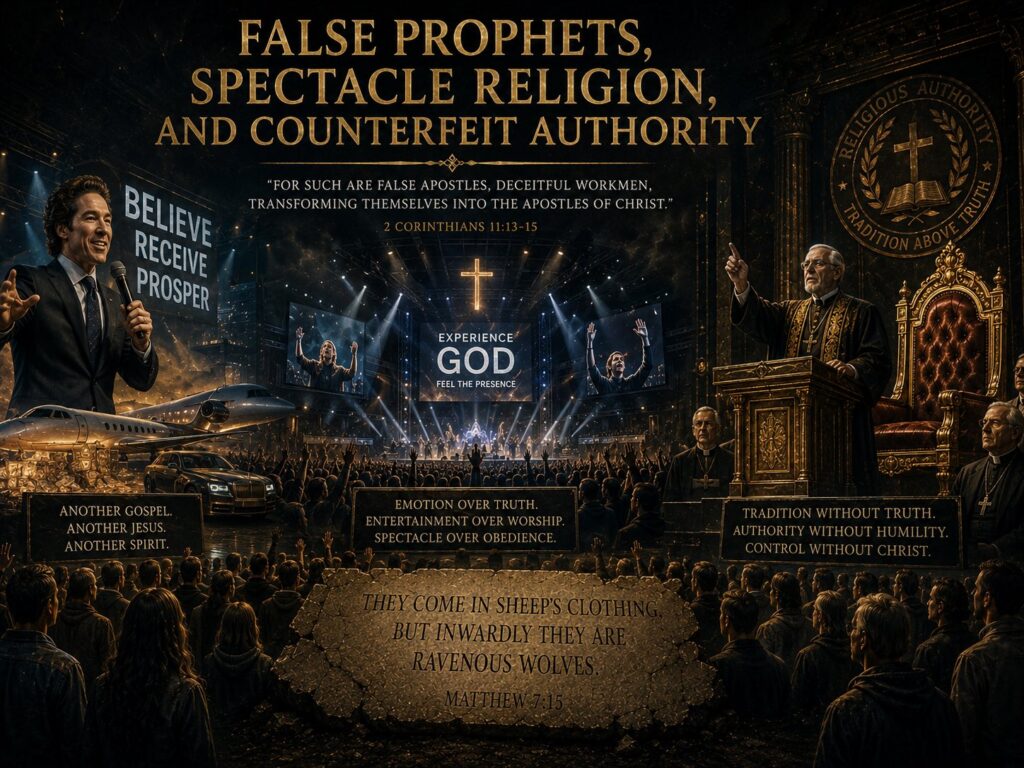
One of the clearest themes running throughout the New Testament is the repeated warning about false spiritual leadership arising within the visible church. Jesus warned about false prophets. Paul warned about false apostles. Peter warned about false teachers secretly introducing destructive teachings among the people of God. Yet modern prophecy culture often focuses so intensely on worldly rulers that many believers overlook the enormous amount of biblical attention placed upon deception within the sanctuary itself.
“Beware of the false prophets, who come to you in sheep’s clothing, but inwardly are ravenous wolves.”
Matthew 7:15
The danger Jesus described was not primarily atheistic governments or secular institutions pretending to be the church. The danger came clothed in sheep’s garments. The corruption wore the appearance of spirituality while carrying another nature underneath. This is why discernment becomes so critical in the last days. The counterfeit does not always appear openly evil. Often it appears religious, charismatic, prophetic, patriotic, emotionally powerful, and spiritually exciting.
Modern spectacle-driven religion often conditions believers to chase personalities, signs, emotional hype, political power, prophetic celebrity culture, and visible displays of authority while neglecting humility, holiness, repentance, discernment, and obedience to Christ. The sanctuary slowly becomes filled with performance while the inward throne drifts further from the Spirit of God.
“For false christs and false prophets will arise and will show great signs and wonders, so as to mislead, if possible, even the elect.”
Matthew 24:24
Notice that Jesus warned about false christs in the plural. False representations. False substitutes. Counterfeit spiritual authority repeatedly arising among the people of God. This is why the issue cannot simply be reduced to identifying one final political figure. The warning concerns a recurring spiritual pattern operating within the visible church itself.
The Image, the Mark, and the Counterfeit Reflection
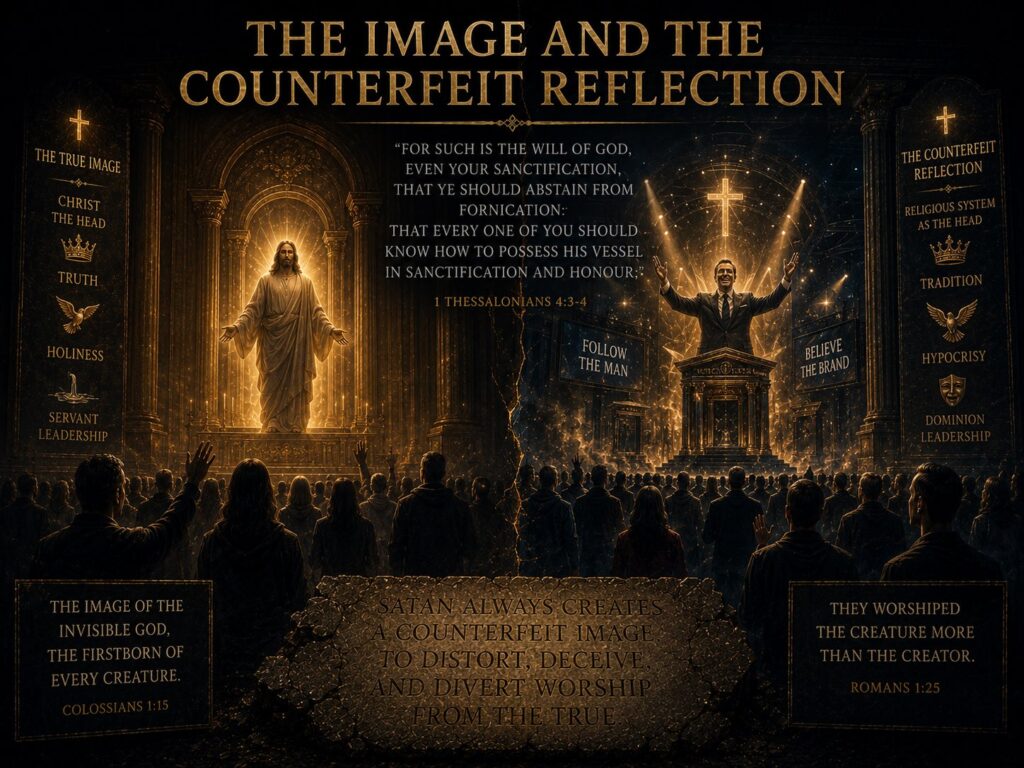
One of the most misunderstood themes in Revelation is the relationship between image, worship, allegiance, and the mark itself. Modern prophecy culture often reduces the mark to external speculation while overlooking the deeply spiritual and covenantal language woven throughout the entire book. Revelation repeatedly centers upon worship, identity, obedience, image-bearing, and spiritual loyalty.
The beast is connected to an image. The image is connected to worship. Worship is connected to allegiance. Allegiance becomes visible through what people reflect, obey, trust, and ultimately serve. This is why the issue cannot simply be reduced to technology, politics, or one outward event detached from the condition of the heart.
“They exchanged the truth of God for a lie, and worshiped and served the creature rather than the Creator.”
Romans 1:25
Throughout Scripture, fallen humanity continually exchanges the image of God for the image of fallen flesh. Pride replaces humility. Earthly power replaces servanthood. Spectacle replaces holiness. Visible strength replaces faith. The pattern begins repeating wherever the visible church conforms itself to the image of the beastly nature instead of the image of Christ.
This is why Revelation repeatedly contrasts two groups: those sealed by God and those marked by the beast. The issue is not merely external ownership. The issue is spiritual identity. One group bears the character, loyalty, and image of Christ. The other reflects the nature of fallen man while still existing within a religious system claiming divine authority.
“Do not be conformed to this world, but be transformed by the renewing of your mind.”
Romans 12:2
The final battle in Revelation is ultimately a battle of reflection. What image will the visible church bear? The image of Christ, or the image of fallen man enthroned within the sanctuary?
The Churches of Revelation Were the First Warning
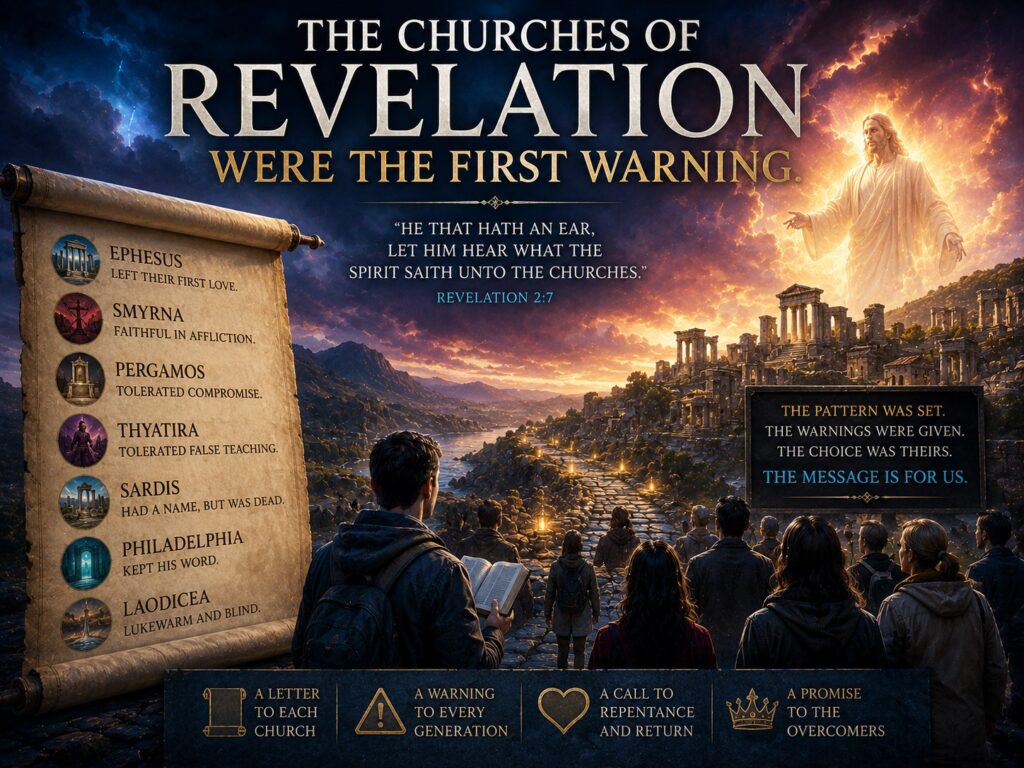
One of the most revealing details about the book of Revelation is that before the beasts, bowls, seals, trumpets, and judgments are ever unfolded, the message begins with warnings directed toward the churches themselves. The prophetic spotlight does not first turn toward pagan Rome, secular governments, or worldly institutions. It turns toward the condition of the covenant community.
The churches are warned about compromise, false doctrine, spiritual adultery, dead works, lukewarmness, counterfeit apostles, corrupted leadership, loss of first love, and mixture with the world. The sanctuary itself becomes the first battlefield in Revelation.
“I know your deeds, that you are neither cold nor hot… because you are lukewarm, and neither hot nor cold, I will spit you out of My mouth.”
Revelation 3:15-16
These warnings are deeply important because they reveal the true prophetic atmosphere of the book. Revelation is not merely a roadmap for identifying future political villains. It is a covenant warning exposing what happens when the visible church drifts away from the Spirit of Christ while continuing to carry His name.
This is why the imagery of harlotry becomes so central later in Revelation. Spiritual adultery throughout Scripture repeatedly refers to covenant unfaithfulness among the people of God. The danger is not merely the existence of darkness outside the sanctuary. The danger is mixture within the sanctuary itself.
“You tolerate the woman Jezebel, who calls herself a prophetess, and she teaches and leads My bond-servants astray.”
Revelation 2:20
The warnings of Revelation repeatedly return to counterfeit spirituality operating within the visible church itself. False prophecy. False authority. False worship. Mixture. Compromise. Counterfeit leadership. These are not secondary themes hidden at the edges of the book. They are foundational to the prophetic architecture from the very beginning.
“They Went Out From Us”
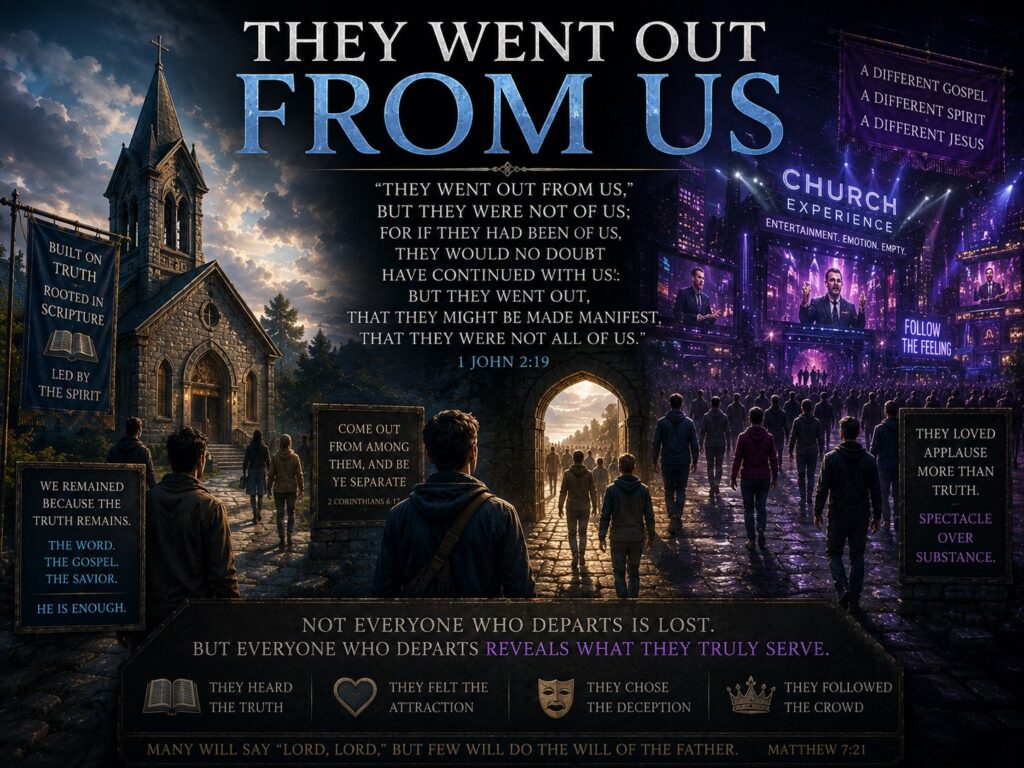
One of the clearest verses concerning the spirit of antichrist is often overlooked entirely because it does not fit comfortably into the popular image of one isolated political dictator suddenly appearing at the end of history. John described antichrist as something emerging from within the covenant structure itself.
“They went out from us, but they were not really of us.”
1 John 2:19
That single statement changes the atmosphere of the discussion completely. The danger was not merely hostile secular governments attacking the church from outside. The corruption emerged from among those who appeared connected to the covenant community itself. They carried the language, appearance, and proximity of faith while departing from the Spirit of truth.
This is why the New Testament repeatedly warns about wolves among the flock, false brethren, false apostles, and another gospel entering the sanctuary. The counterfeit rarely announces itself openly at first. It often appears spiritually convincing while slowly redirecting worship, allegiance, and trust away from Christ and toward something else.
“For such men are false apostles, deceitful workers, disguising themselves as apostles of Christ.”
2 Corinthians 11:13
The issue is not merely open opposition to Christ. The issue is substitution in place of Christ while still operating inside the visible structure of religion. This is why antichrist is deeply connected to counterfeit worship, false representation, and the replacement of Christ with the image of fallen man inside the sanctuary itself.
John’s warning reveals something deeply important: the greatest deceptions are often not those standing furthest from the church, but those arising closest to the altar.
The Throne of the Heart
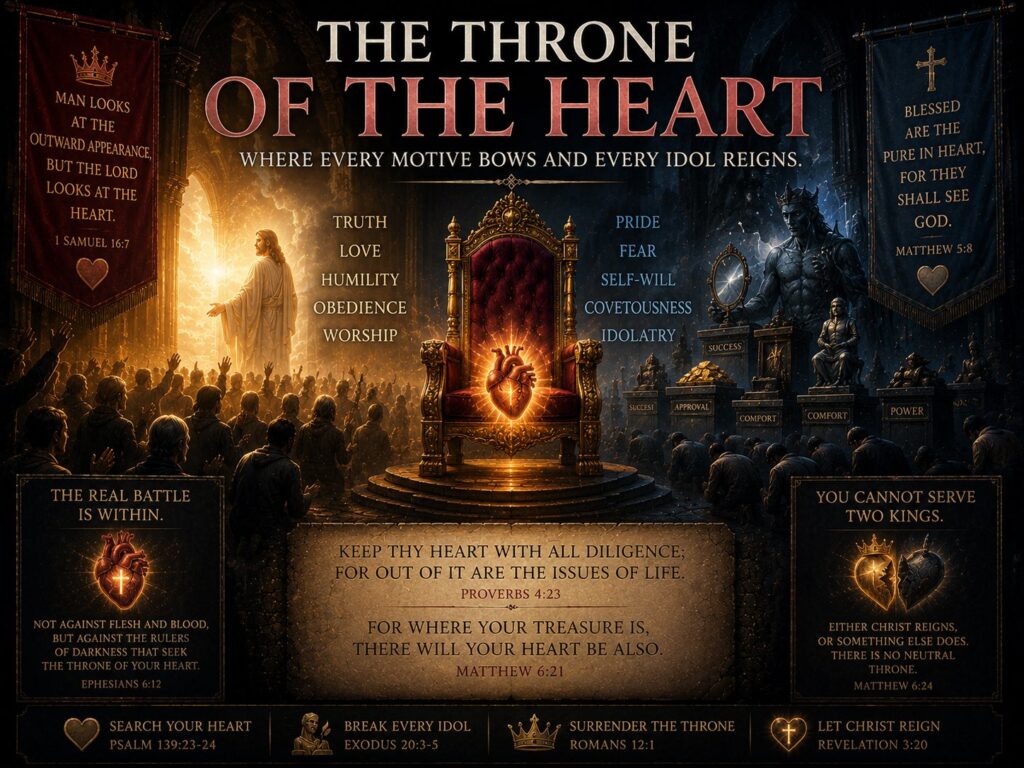
Throughout Scripture, the battle between God and rebellion is repeatedly described through throne imagery. Kings sit upon thrones. Gods sit upon thrones. Authority occupies seats. Worship surrounds thrones. Yet the Bible continually moves these symbols beyond mere furniture and geography into the deeper realm of spiritual allegiance and inward rule.
This is why Ezekiel twenty-eight becomes so important when discussing the spirit of antichrist and counterfeit enthronement. The ruler of Tyre is described using language that moves beyond ordinary politics into the realm of spiritual exaltation, corrupted worship, and the heart attempting to occupy the place that belongs to God.
“Because your heart is lifted up and you have said, ‘I am a god, I sit in the seat of gods in the heart of the seas’; yet you are a man and not God, although you make your heart like the heart of God.”
Ezekiel 28:2
Notice how the language continually returns to the heart. The throne imagery is tied directly to inward exaltation. The issue is not merely geography or architecture. The issue is the heart attempting to enthrone itself in the place belonging to God. Pride becomes counterfeit divinity.
This is why many believers see powerful parallels between Ezekiel’s imagery and Paul’s warning about something taking its seat in the temple of God. The New Testament repeatedly identifies the people of God as the temple, while Ezekiel repeatedly identifies the heart as the seat of false enthronement. Together, the symbolism forms a unified prophetic architecture centered upon corruption arising within the sanctuary itself.
“For where your treasure is, there your heart will be also.”
Matthew 6:21
The final battle of prophecy ultimately concerns worship, allegiance, and what rules the sanctuary within. The question is not merely what governments rise in the outer world. The question is what spirit occupies the throne of the heart among the people of God.
The Falling Away and the Corruption of the Sanctuary
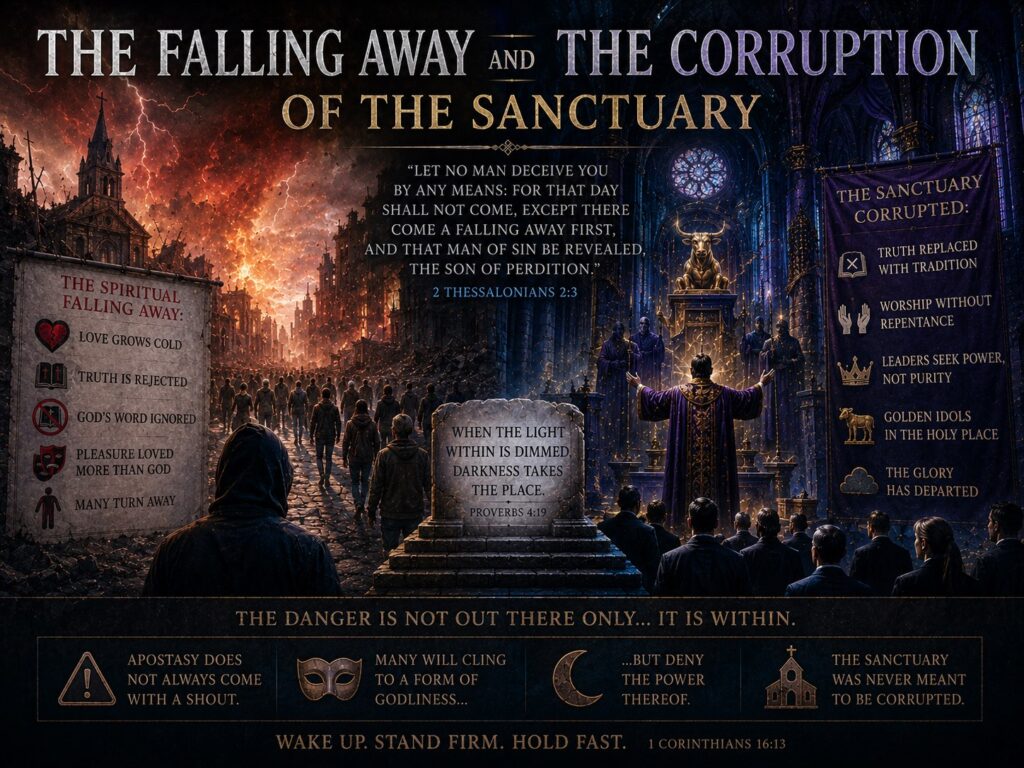
One of the central prophetic warnings connected to the spirit of antichrist is the warning of a great falling away. Modern prophecy culture often imagines this almost entirely as the collapse of secular society, yet Paul’s warning was directed toward the covenant community itself. Apostasy cannot occur where covenant never existed. The falling away concerns corruption within what claims to belong to God.
“Let no one in any way deceive you, for it will not come unless the apostasy comes first.”
2 Thessalonians 2:3
The Greek word often translated “falling away” carries the idea of departure, defection, revolt, and apostasy. The sanctuary itself becomes compromised. This is why the New Testament repeatedly warns about corrupted shepherds, counterfeit teachers, and spiritual deception spreading among the churches. The danger is not merely darkness outside the walls. The danger is corruption entering the holy place itself.
This pattern echoes throughout Scripture. Israel repeatedly drifted into mixture while still carrying the language of covenant. The prophets continually warned about worship systems that honored God outwardly while inwardly becoming corrupted by pride, idolatry, injustice, and false worship. The issue was never merely external rebellion. The issue was a polluted sanctuary.
“This people honors Me with their lips, but their heart is far away from Me.”
Matthew 15:8
The final warning of prophecy is deeply connected to this same pattern. The visible church can continue carrying religious language, rituals, symbols, and outward forms while slowly drifting away from the Spirit of Christ inwardly. This is why discernment becomes essential. The greatest deception often appears closest to the altar.
Babylon, Intoxication, and the Seduction of the Visible Church
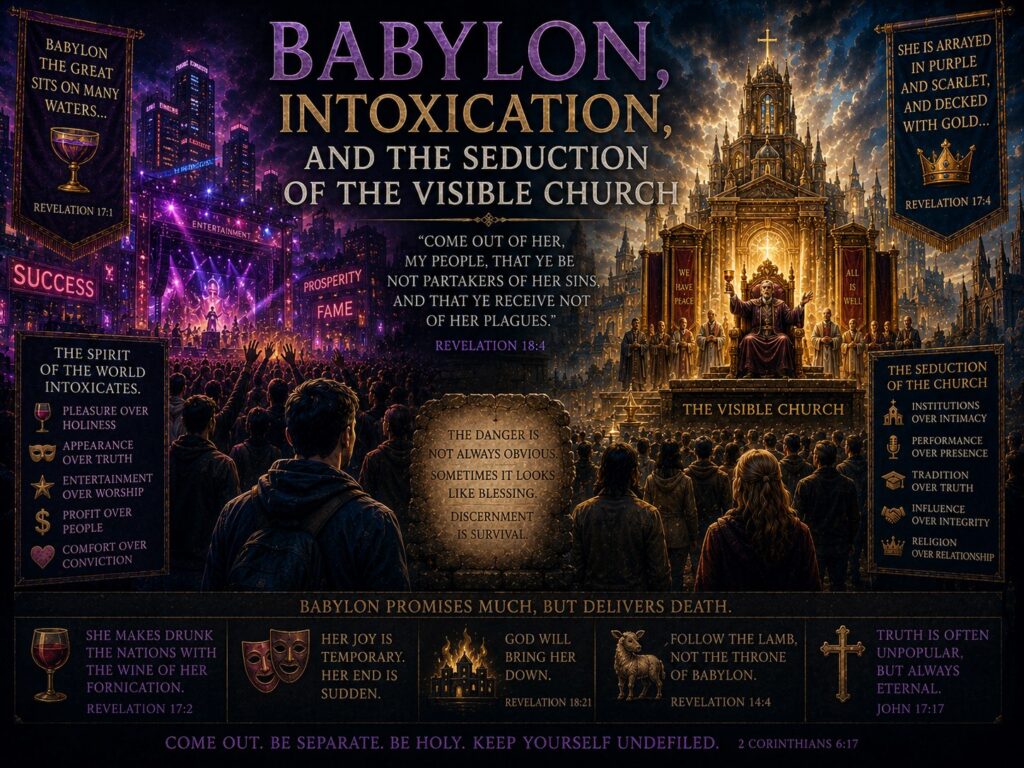
Throughout Revelation, Babylon is described not merely as political power, but as intoxication. The imagery is spiritual, seductive, and deeply covenantal. Kings become intoxicated. Nations become intoxicated. The visible church itself becomes vulnerable to intoxication whenever it begins craving power, spectacle, wealth, influence, earthly glory, and visible dominion more than faithfulness to Christ.
“For all the nations have drunk of the wine of the passion of her immorality.”
Revelation 18:3
Wine throughout Scripture often symbolizes spiritual influence, teaching, covenant mixture, and intoxication of the mind. Babylon does not merely conquer through military force. She seduces. She dazzles. She intoxicates. The danger is not merely persecution from outside the sanctuary. The danger is seduction within the sanctuary itself.
This is why spectacle-driven religion becomes so dangerous. The visible church can slowly become addicted to emotional hype, political influence, celebrity personalities, prophetic sensationalism, visible power, and outward glory while drifting away from humility, holiness, repentance, and obedience to Christ. The sanctuary becomes filled with noise while the inward throne grows empty.
“Come out of her, My people, so that you will not participate in her sins and receive of her plagues.”
Revelation 18:4
Notice the language carefully. “My people.” The warning is directed toward those still connected to God while dwelling within a corrupted system. Babylon is not merely the outer darkness. The warning concerns mixture, compromise, counterfeit glory, and spiritual intoxication operating close enough to the sanctuary that God still calls His people to come out from her.
The final deception is not merely open rebellion against God. It is the seduction of the visible church into reflecting the image of earthly glory while still speaking the language of heaven.
The Man of Sin and the Image of Fallen Man
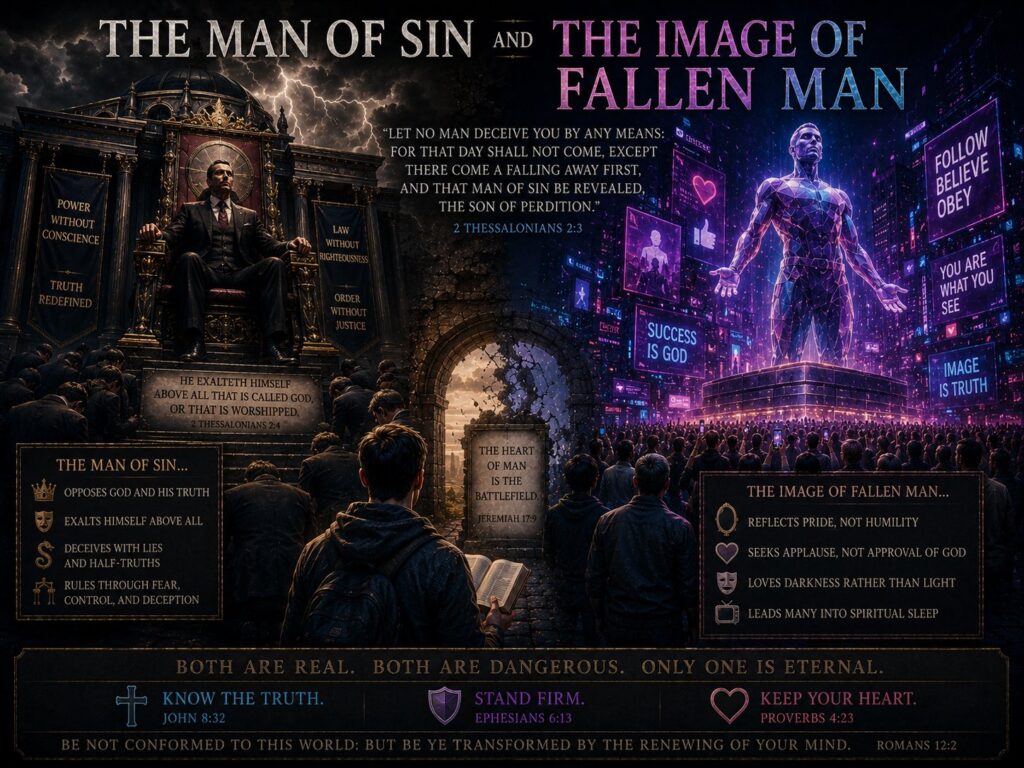
One of the most debated prophetic phrases in the New Testament is Paul’s reference to the “man of sin” or “man of lawlessness.” For generations, many readers have immediately interpreted the phrase as referring exclusively to one future political ruler. Yet the symbolic language surrounding the passage opens the door to a much broader covenantal pattern tied to the corruption of the sanctuary itself.
“Let no one in any way deceive you, for it will not come unless the apostasy comes first, and the man of lawlessness is revealed.”
2 Thessalonians 2:3
Notice that Paul connects the revealing of the man of sin directly to apostasy within the covenant structure. The context is not merely worldly politics. It concerns spiritual corruption tied to the temple, deception, counterfeit enthronement, and the falling away among those claiming covenant identity.
Throughout Scripture, “man” repeatedly symbolizes fallen Adamic nature apart from God. Revelation speaks of the number of man. Paul contrasts the old man with the new creation in Christ. The fleshly nature becomes a recurring prophetic image representing pride, rebellion, self-rule, and corruption separated from the Spirit of God.
“Put on the new self, which in the likeness of God has been created in righteousness and holiness of the truth.”
Ephesians 4:24
This is why many believers see the “man of sin” not merely as one isolated politician, but as the revelation of fallen flesh enthroned within the sanctuary itself. The issue is not simply one evil ruler appearing from outside the covenant community. The issue is the image of fallen man replacing the image of Christ within what claims to be the temple of God.
The prophetic conflict ultimately concerns two images: the image of Christ formed within the people of God, or the image of fallen man enthroned in His place.
“Give Us a King”: The Ancient Pattern Repeating Again
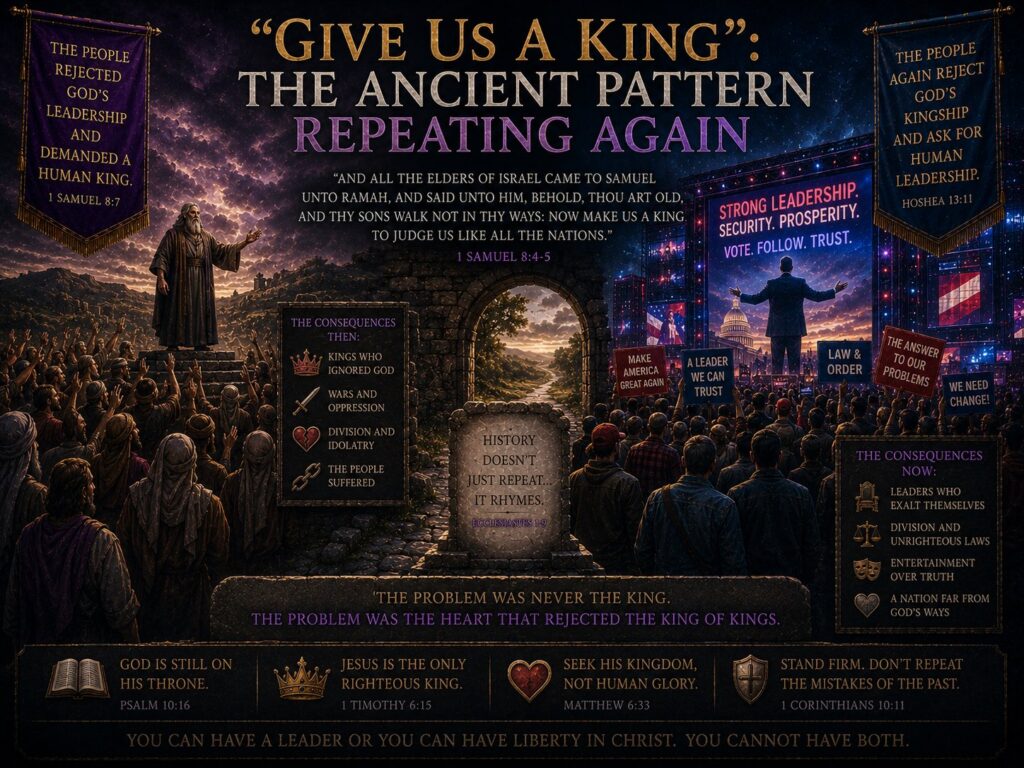
Long before Revelation was written, Scripture already revealed a recurring temptation among the people of God: the desire for visible earthly rulers to stand where trust in God alone should remain. Israel repeatedly struggled with this pattern. Rather than resting under the invisible reign of God, the people desired kings like the surrounding nations.
“Now appoint a king for us to judge us like all the nations.”
1 Samuel 8:5
The request sounded political on the surface, but God revealed the deeper spiritual issue underneath it. The people were not merely requesting governmental structure. They were exchanging trust in divine kingship for visible human authority. The throne of the heart was shifting.
“They have not rejected you, but they have rejected Me from being king over them.”
1 Samuel 8:7
This ancient pattern still echoes through the visible church today. Whenever believers begin looking to political rulers, national movements, earthly power, or charismatic leaders for salvation, restoration, protection, identity, or spiritual hope, the same temptation begins resurfacing again. The issue is not merely politics. It is enthronement.
This is why any leader can function in an antichrist role whenever the visible church begins placing upon that leader expectations that belong to Christ alone. The issue is substitution. A counterfeit savior occupying the emotional and spiritual space where trust in God should remain.
The temptation has always remained the same: the people of God longing for visible power like the nations instead of remaining faithful to the invisible kingdom of Christ.
Outward Religion and the Inward Sanctuary
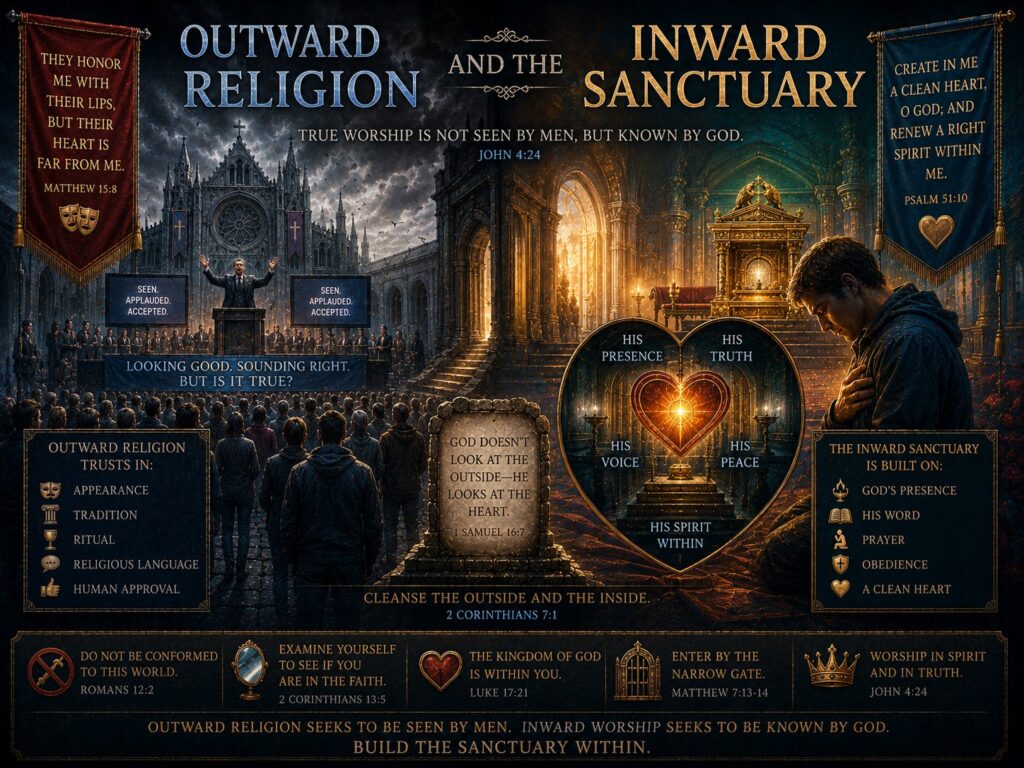
One of the greatest dangers throughout biblical history has never been merely open rebellion against God. Often the greater danger has been outward religion continuing to function while the inward sanctuary slowly becomes corrupted. The language of covenant remains. The rituals remain. The symbols remain. Yet the heart drifts far from the Spirit of God.
“This people honors Me with their lips, but their heart is far away from Me.”
Matthew 15:8
Jesus repeatedly warned that deception within the covenant community would often appear deeply religious outwardly. People would prophesy. Teach. Build ministries. Perform works in His name. Yet outward activity alone was never proof of true inward transformation.
“Many will say to Me on that day, ‘Lord, Lord, did we not prophesy in Your name?’”
Matthew 7:22
This is why the prophetic warnings concerning antichrist, false prophets, and apostasy continually return to the condition of the heart. The issue is not merely public identity. The issue is inward allegiance. A sanctuary can appear alive outwardly while becoming spiritually hollow inwardly.
The visible church can become filled with spectacle, political passion, prophetic excitement, and emotional intensity while slowly losing humility, repentance, holiness, discernment, and the actual character of Christ. The danger is not merely false religion existing outside the church. The danger is counterfeit spirituality growing within the sanctuary itself.
This is why the final prophetic battle concerns what image the people of God ultimately reflect. Outward religion alone was never the goal. The sanctuary itself must belong fully to Christ.
The Image of Christ Versus the Image of Fallen Man
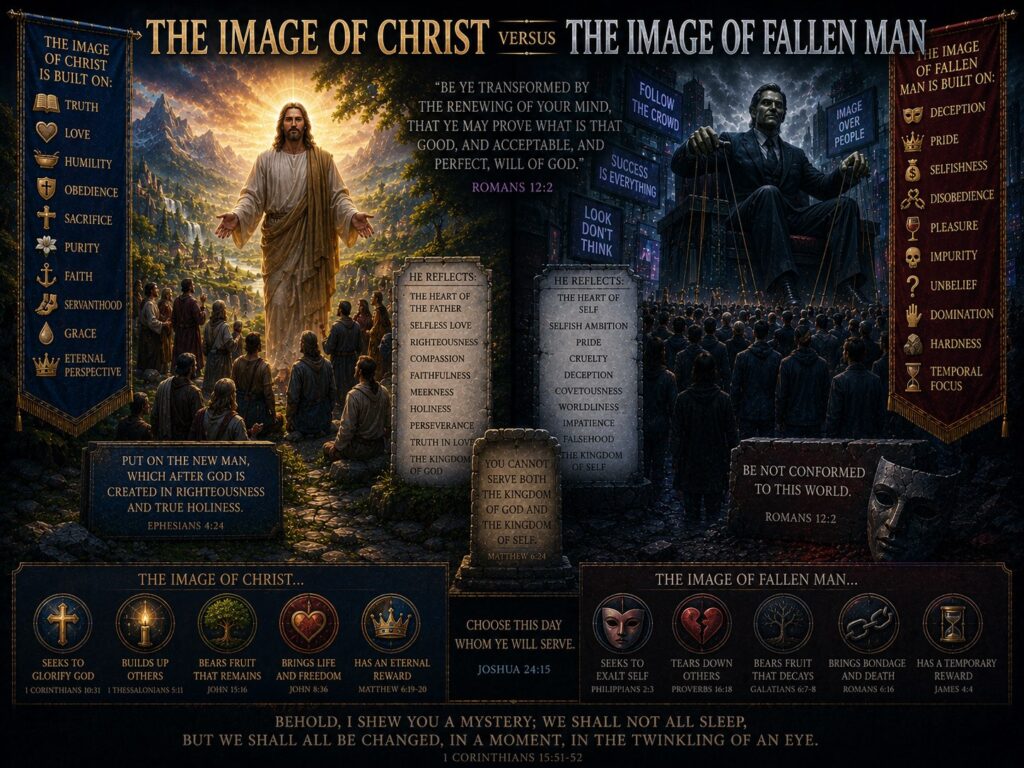
At the center of Scripture stands a conflict between two images. One image reflects the nature of Christ: humility, obedience, holiness, truth, sacrificial love, and submission to the Spirit of God. The other reflects the fallen nature of man: pride, self-exaltation, domination, spectacle, fleshly ambition, and the desire to rule apart from God.
From Genesis onward, humanity continually struggles with the temptation to become like gods through self-rule rather than transformation through obedience. The serpent’s ancient promise in the garden appealed directly to pride, exaltation, and independence from God. The battle was never merely about information. It was about image and enthronement.
“For those whom He foreknew, He also predestined to become conformed to the image of His Son.”
Romans 8:29
The purpose of redemption is not merely outward religious identity. It is transformation into the image of Christ. This is why the warnings of Revelation repeatedly revolve around worship, image-bearing, marks, seals, allegiance, and spiritual conformity. Every kingdom produces an image after its own nature.
The danger facing the visible church is not merely persecution from outside powers. The greater danger is inward conformity to the image of fallen man while still carrying the language of God. Pride can wear religious clothing. Flesh can quote Scripture. Counterfeit authority can stand behind pulpits. Entire systems can appear spiritually powerful outwardly while reflecting a completely different kingdom inwardly.
“Beloved, now we are children of God… we know that when He appears, we will be like Him.”
1 John 3:2
The final prophetic conflict ultimately concerns what image the sanctuary will bear. The image of Christ formed within the people of God, or the image of fallen flesh enthroned in His place.
A Final Call to Discernment
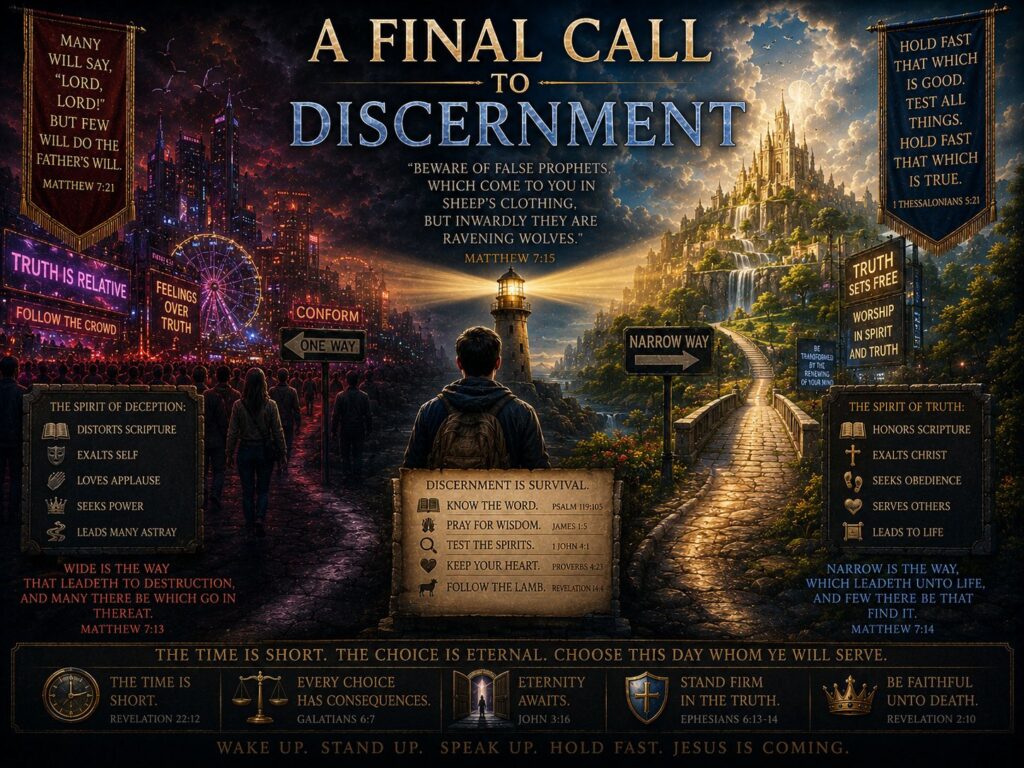
The purpose of prophecy was never merely to create fear, obsession, speculation, or endless fascination with political villains. The purpose of prophecy is to awaken discernment within the people of God. Scripture was given to expose deception, reveal the condition of the sanctuary, call the covenant community to repentance, and prepare a faithful remnant reflecting the image of Christ.
This is why the warnings surrounding antichrist, false prophets, apostasy, counterfeit worship, and the beast cannot simply be reduced to identifying one future ruler. The prophetic warnings continually turn inward toward the visible church itself. Again and again the question becomes spiritual rather than merely political: what rules the sanctuary within the people of God?
“Test yourselves to see if you are in the faith; examine yourselves!”
2 Corinthians 13:5
The call of Scripture is not merely to identify deception in others while remaining blind to the condition of the heart. The people of God are repeatedly called to examine themselves, test teachings carefully, search the Scriptures honestly, and remain faithful to Christ above movements, personalities, political systems, spectacle religion, or earthly power.
This is why believers must become like the Bereans once again. The Word of God must be searched diligently. Traditions must be tested. Emotional manipulation must be resisted. Counterfeit spirituality must be discerned carefully. The visible church must stop confusing outward excitement with inward transformation.
“Sanctify them in the truth; Your word is truth.”
John 17:17
The final battle was never merely about one ruler rising somewhere in the distance. It was always about the condition of the sanctuary, the image reflected by the people of God, and what ultimately sits upon the throne where Christ alone should reign.
The greatest deception may not be failing to recognize one final beast.
It may be failing to recognize what has been enthroned within the sanctuary itself.
The Mirror the Church Keeps Avoiding
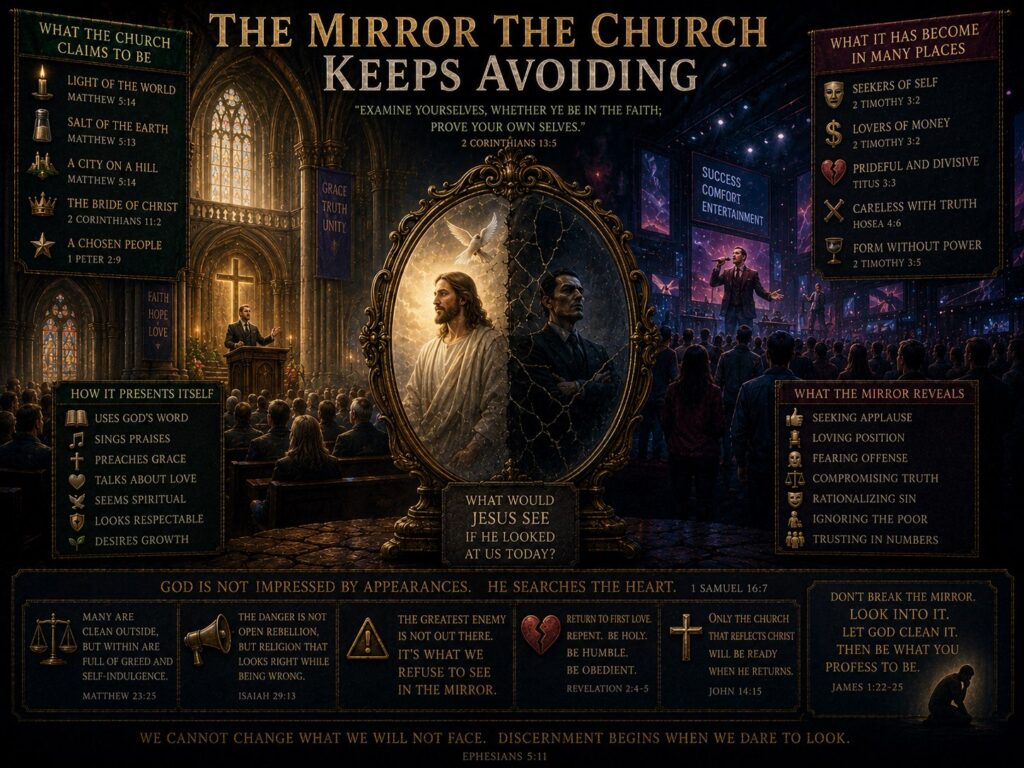
One reason prophecy discussions so often become consumed with identifying villains in the outer world is because outward enemies are easier to confront than inward corruption. It is easier to search for beasts in governments, headlines, technologies, and political systems than to confront the possibility that the sanctuary itself has become compromised. Yet Scripture repeatedly turns the mirror back toward the covenant community.
Again and again the prophets warned Israel while the people continued assuming the real danger existed somewhere outside the camp. The temple still stood. The rituals continued. The language of worship remained. Yet inwardly the sanctuary was drifting away from the Spirit of God. The appearance of covenant survived while the heart slowly hardened.
“Has this house, which is called by My name, become a den of robbers in your sight?”
Jeremiah 7:11
Jesus later repeated this same warning when He entered the temple and overturned the tables. The issue was not merely commerce. The issue was corruption occupying sacred space. The sanctuary had become filled with mixture while still carrying the appearance of holiness outwardly.
This same danger still confronts the visible church today. It is possible to defend doctrine outwardly while enthroning pride inwardly. It is possible to speak the language of prophecy while becoming intoxicated with spectacle, fear, political power, celebrity culture, and substitute saviors. It is possible to search endlessly for antichrist in the outer world while ignoring the counterfeit images forming within the sanctuary itself.
“For judgment must begin at the house of God.”
1 Peter 4:17
The prophetic warnings of Scripture were never merely designed to produce fear about future world events. They were designed to awaken discernment within the people of God. The mirror keeps returning to the same place: the sanctuary, the throne, the heart, and the image being formed within the covenant community.
“Peace and Safety”: The Comforting Voice Before Collapse
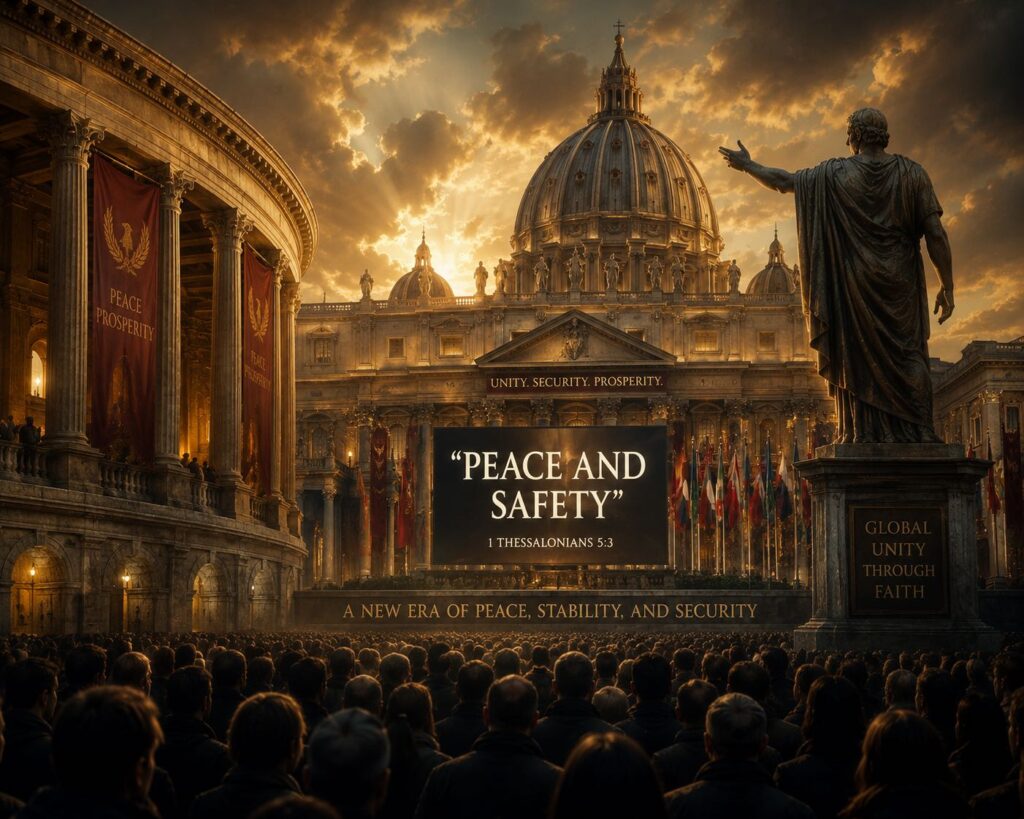
One of the recurring patterns throughout Scripture is that spiritual decline is often accompanied by voices promising peace, stability, blessing, and safety while the sanctuary itself is quietly drifting into corruption. False assurance becomes part of the deception. The people are comforted outwardly while inward decay continues spreading through the temple of the heart.
“While they are saying, ‘Peace and safety!’ then destruction will come upon them suddenly.”
1 Thessalonians 5:3
The warning is not merely about political slogans or secular culture. Throughout biblical history, false prophets repeatedly proclaimed peace while ignoring the actual spiritual condition of the people of God. They soothed the conscience of the sanctuary while corruption remained unaddressed.
“They have healed the brokenness of My people superficially, saying, ‘Peace, peace,’ but there is no peace.”
Jeremiah 6:14
This pattern became especially visible when the persecuted early church moved into the shadow of imperial favor. With the Edict of Milan, Christianity was granted legal recognition within the Roman Empire. What appeared outwardly as relief, peace, and protection also opened the door for a dangerous new mixture: the visible church stepping into the embrace of political power.
Then came the Edict of Thessalonica, when Christianity was no longer merely tolerated but became bound to imperial authority. The faith that had once survived by the power of the Spirit beneath persecution began to be reshaped by empire, institution, hierarchy, state approval, and earthly power. The sanctuary gained protection, but the question is what entered through that protection.
This is the terrifying pattern of “peace and safety.” The danger does not always arrive looking like destruction. Sometimes it arrives dressed as acceptance. Sometimes persecution ends, but corruption begins. Sometimes the church gains influence, but loses discernment. Sometimes the visible structure becomes safer outwardly while the inward sanctuary becomes more vulnerable to compromise.
This same prophetic pattern echoes through America’s own religious history, where political power, national identity, and Christian language became fused into a counterfeit image of Jesus shaped by empire rather than the Holy Spirit. I explored that historical pattern more fully in The American Jesus: The Hidden History No One Dares to Tell.
This same danger still exists within the visible church. Whenever repentance is replaced with self-affirmation, whenever holiness is replaced with emotional comfort, whenever discernment is replaced with spectacle, and whenever covenant faithfulness is replaced with political excitement or prosperity promises, the sanctuary becomes vulnerable to deception while still believing itself spiritually secure.
The spirit of antichrist does not always arrive through open persecution. Sometimes it enters through flattering words, false assurance, counterfeit peace, political protection, religious popularity, and messages that soothe the flesh while leaving the inward throne untouched.
This is why prophecy must ultimately lead the people of God toward repentance, humility, discernment, and renewed faithfulness to Christ rather than merely fear-driven fascination with worldly events. The true question is not whether the visible church feels safe. The true question is whether the sanctuary still belongs fully to Christ.
When Prophecy Becomes Intoxication
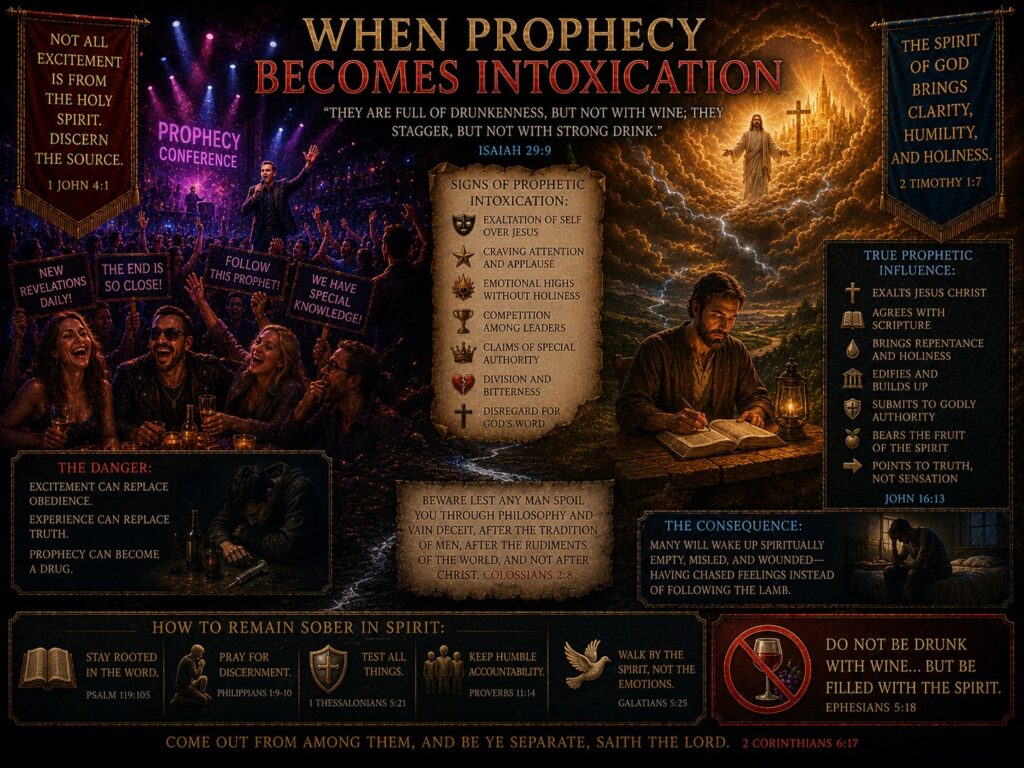
One of the most dangerous spiritual traps in the modern church is that prophecy itself can become a form of intoxication. The pursuit of hidden knowledge, sensational revelations, endless decoding, political fear, conspiratorial excitement, and constant anticipation of catastrophe can slowly replace the quieter work of holiness, humility, repentance, obedience, and transformation into the image of Christ.
The problem is not prophecy itself. Scripture commands believers to remain watchful and discerning. The danger comes when the human heart becomes addicted to spectacle rather than sanctification. Prophecy turns into emotional stimulation instead of spiritual refinement.
“For the time will come when they will not endure sound doctrine.”
2 Timothy 4:3
Babylon intoxicates not only through false doctrine, but through emotional seduction. Mystery becomes addictive. Fear becomes addictive. The constant hunt for hidden codes, secret revelations, and shocking prophetic claims can slowly replace the actual pursuit of Christ Himself.
This is why the visible church must remain sober-minded. Discernment must remain anchored in Scripture rather than emotional hype. Prophecy should lead the people of God toward holiness and faithfulness, not toward endless obsession with fear, spectacle, personalities, and sensationalism.
“Be sober in spirit, be on the alert.”
1 Peter 5:8
The final deception is not merely false information. It is spiritual intoxication that keeps the sanctuary fascinated while drifting further away from transformation into the image of Christ.
The Remnant and the Seal of God
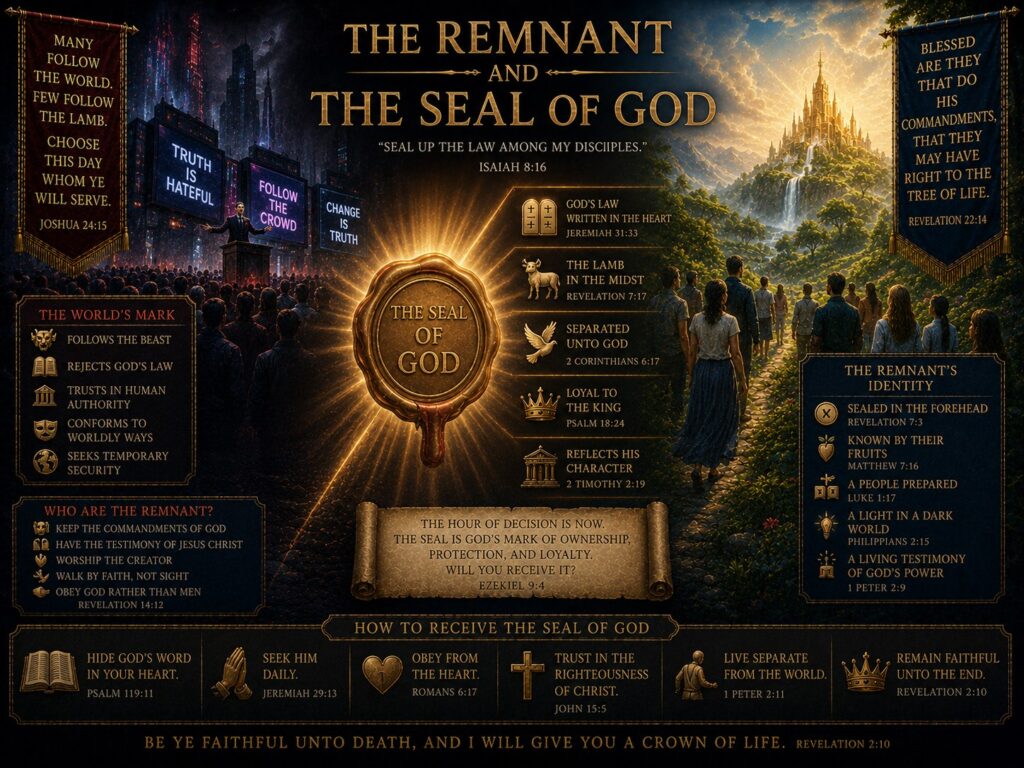
While Revelation warns about counterfeit images, false worship, deception, and the spirit of antichrist operating within the visible church, it also reveals another people moving through the midst of the corruption: a remnant sealed by God Himself. The contrast throughout Scripture is never merely between religious people and irreligious people. The contrast is between outward religion and inward transformation.
The remnant is not defined merely by slogans, movements, political loyalty, church branding, or outward profession. The remnant is marked by the Spirit of God, transformed inwardly into the image of Christ, and faithful to truth even in the midst of widespread compromise.
“Do not grieve the Holy Spirit of God, by whom you were sealed for the day of redemption.”
Ephesians 4:30
Throughout Revelation, sealing language is deeply connected to ownership, covenant identity, and spiritual allegiance. One group bears the mark of the beastly nature. Another bears the seal of God. The conflict is ultimately about what image is reflected within the sanctuary.
This is why the remnant continually appears small, purified, refined, and separated from mixture throughout Scripture. The prophets repeatedly describe God preserving a faithful people even during times of widespread corruption within the visible covenant structure.
“I have left for Myself seven thousand men who have not bowed the knee to Baal.”
Romans 11:4
The final prophetic hope of Scripture is not the triumph of spectacle religion or earthly kingdoms. It is the restoration of a faithful people reflecting the image of Christ through the power of the Spirit. A remnant purified within the sanctuary while the visible systems around them drift further into counterfeit glory.
The Beastly Nature and the War Within the Sanctuary
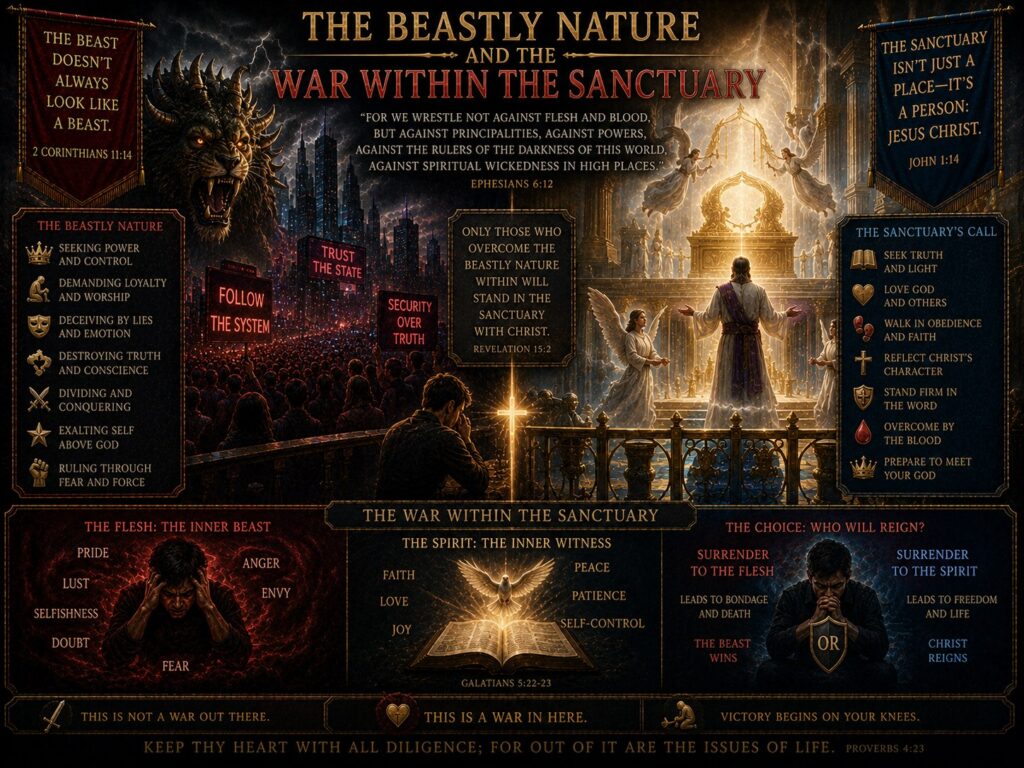
Throughout Scripture, beast imagery is repeatedly connected to kingdoms, rulers, pride, violence, domination, and fallen human nature operating apart from the Spirit of God. Daniel saw beastly kingdoms rising from turbulent waters. Revelation expands the same imagery into a prophetic portrait of corrupted power, counterfeit worship, and spiritual rebellion spreading through the visible covenant structure.
Yet one of the most important prophetic questions is often ignored: where does the beastly nature ultimately seek to enthrone itself? Scripture repeatedly returns to the sanctuary, the temple, the heart, and the people of God themselves. The war is not merely external. It is inward and covenantal.
“The mind set on the flesh is hostile toward God.”
Romans 8:7
Paul repeatedly contrasts the Spirit with the flesh, the old man with the new creation, and the inward transformation of Christ with the corrupted nature inherited from fallen Adam. The beastly nature is not merely political tyranny somewhere in the distance. It is fallen flesh seeking dominion where the Spirit of God should reign.
This is why Revelation continually centers upon worship, image, allegiance, and transformation. The sanctuary ultimately reflects whatever rules within it. When pride, spectacle, domination, fear, and counterfeit glory take the throne, the image of the beast begins forming within the covenant structure itself.
“Walk by the Spirit, and you will not carry out the desire of the flesh.”
Galatians 5:16
The final prophetic conflict is not merely about identifying outward systems of corruption. It is about whether the people of God will be transformed into the image of Christ or conformed to the beastly nature of fallen man within the sanctuary itself.
The Narrow Gate and the Purification of the Remnant
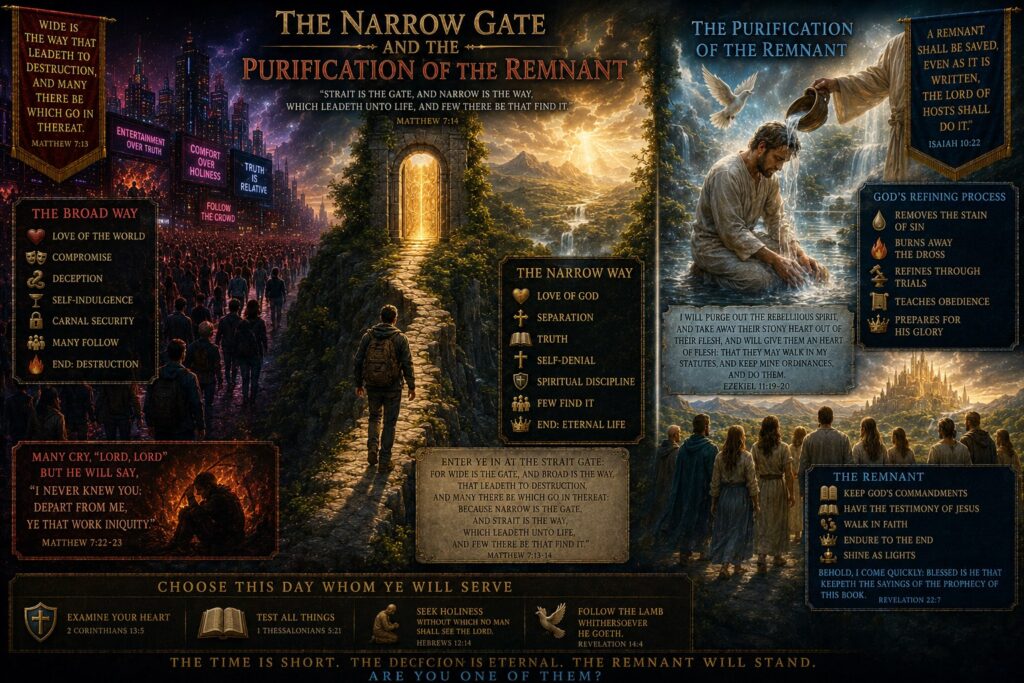
One of the most uncomfortable truths throughout Scripture is that the way of true transformation has always been narrow. The visible religious systems surrounding God’s people repeatedly drift toward mixture, compromise, spectacle, pride, and outward power, while the remnant path moves through purification, humility, repentance, and the cutting away of the fleshly nature.
“Enter through the narrow gate; for the gate is wide and the way is broad that leads to destruction.”
Matthew 7:13
The broad way is not always openly atheistic rebellion. Often it is religious mixture carried by crowds convinced they are secure while remaining untransformed inwardly. The sanctuary becomes filled with outward activity while the fleshly nature remains enthroned beneath the surface.
This is why Scripture repeatedly uses the language of cutting, circumcision, refinement, pruning, and purification. God continually works to remove the dominion of the flesh from within His people. The conflict is not merely external behavior. It is the inward transformation of the sanctuary itself.
“Circumcise your heart and stiffen your neck no longer.”
Deuteronomy 10:16
The remnant throughout Scripture is repeatedly purified through testing, refinement, and separation from mixture. While the broad religious systems seek earthly glory, visible power, and mass approval, the remnant is prepared inwardly for faithfulness to Christ even when standing against the current of the visible age.
The final prophetic battle is not merely about surviving external chaos. It is about whether the sanctuary will be purified into the image of Christ or consumed by the beastly nature of fallen flesh.
The Restoration of the Living Temple
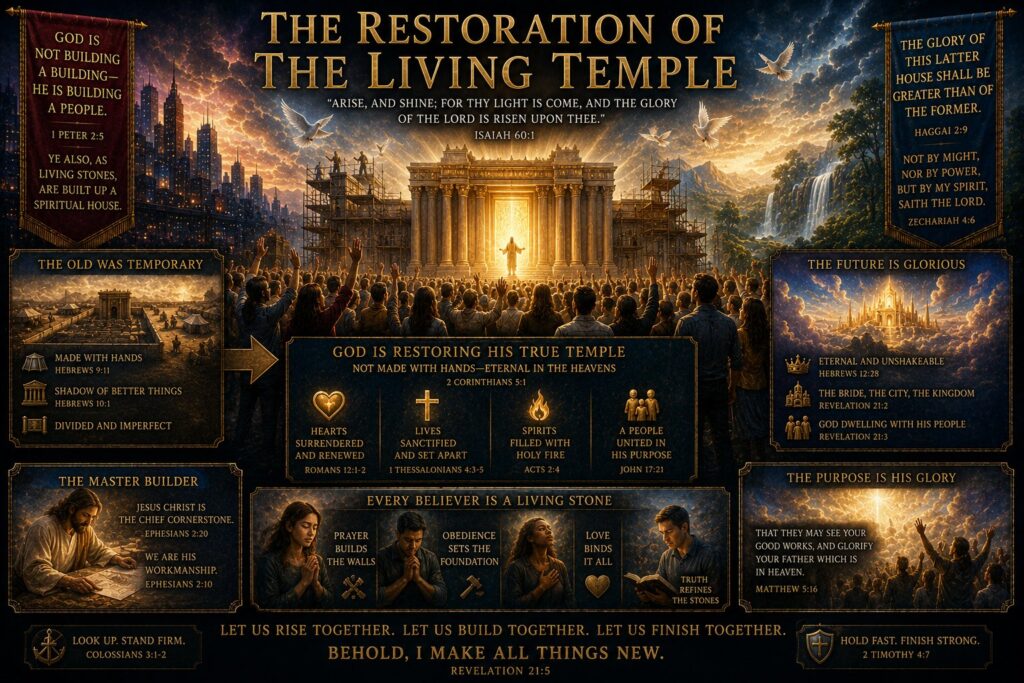
While Scripture contains severe warnings concerning apostasy, counterfeit worship, and corruption within the visible church, the prophetic story does not end with ruin. Again and again the prophets speak of restoration, purification, rebuilding, and the raising up of a faithful remnant through whom God restores His dwelling place among His people.
The New Testament transforms temple imagery completely. The sanctuary is no longer centered upon earthly stone buildings, but upon living stones joined together by the Spirit of God. The true temple becomes a people transformed inwardly into the image of Christ.
“You also, as living stones, are being built up as a spiritual house.”
1 Peter 2:5
This is why the final prophetic conflict continually returns to the sanctuary itself. The question is not merely whether outward religious systems survive. The question is whether the true temple of God is restored inwardly through the Spirit. The visible structures of religion can continue operating while the true sanctuary is being rebuilt quietly within a purified remnant.
The prophets repeatedly described God refining His people through fire, cutting away corruption, and restoring a faithful remnant after seasons of apostasy. The sanctuary is purified so that the glory of God may dwell among His people once again.
“I will refine them as silver is refined, and test them as gold is tested.”
Zechariah 13:9
The final hope of prophecy is not the triumph of counterfeit religion, earthly power, or beastly systems. The final hope is the restoration of a living temple filled with the Spirit of God, reflecting the image of Christ instead of the image of fallen man.
The Watchman and the Mirror of Prophecy
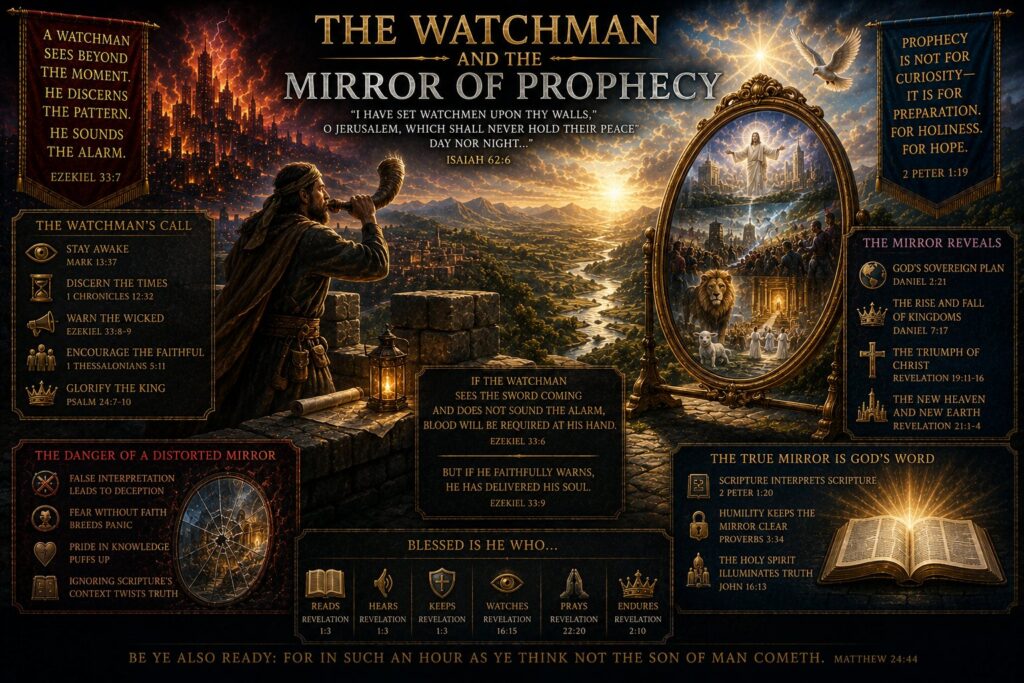
Every generation eventually reaches the same crossroads. Fear rises. Political turmoil increases. Public figures become symbols. The visible church begins searching desperately for prophetic certainty. Then once again the familiar cry spreads across the internet, through pulpits, across videos, books, and headlines: “This man is the Antichrist.”
Yet history shows that thousands of figures have already carried that accusation before. Emperors, kings, popes, dictators, presidents, reformers, and political rulers have all been declared the final beast by convinced voices certain they had finally solved the mystery. The names change generation after generation, but the deeper spiritual condition Scripture warns about continues repeating.
The visible church continues struggling with false prophets, counterfeit worship, spectacle religion, political idolatry, substitute saviors, spiritual intoxication, and the enthronement of fallen flesh within the sanctuary itself. Meanwhile prophecy culture often remains fixated upon identifying villains in the outer world while avoiding the mirror Scripture keeps holding before the people of God.
“Son of man, I have appointed you a watchman.”
Ezekiel 3:17
A true watchman does not merely point outward toward danger in distant lands. A true watchman warns the covenant community when corruption begins entering the sanctuary itself. The prophets repeatedly confronted mixture among the people of God because judgment begins at the house of God.
This is why the final prophetic question is much deeper than whether one politician fulfills the role of antichrist. The greater question is whether the visible church has begun reflecting the image of fallen man while still speaking the language of God. Whether pride has replaced humility. Whether spectacle has replaced holiness. Whether earthly power has replaced trust in Christ.
The final warning of prophecy was never merely about identifying one beast somewhere in the distance.
It was about guarding the sanctuary from becoming one.
The Counterfeit Kingdom Within the Sanctuary
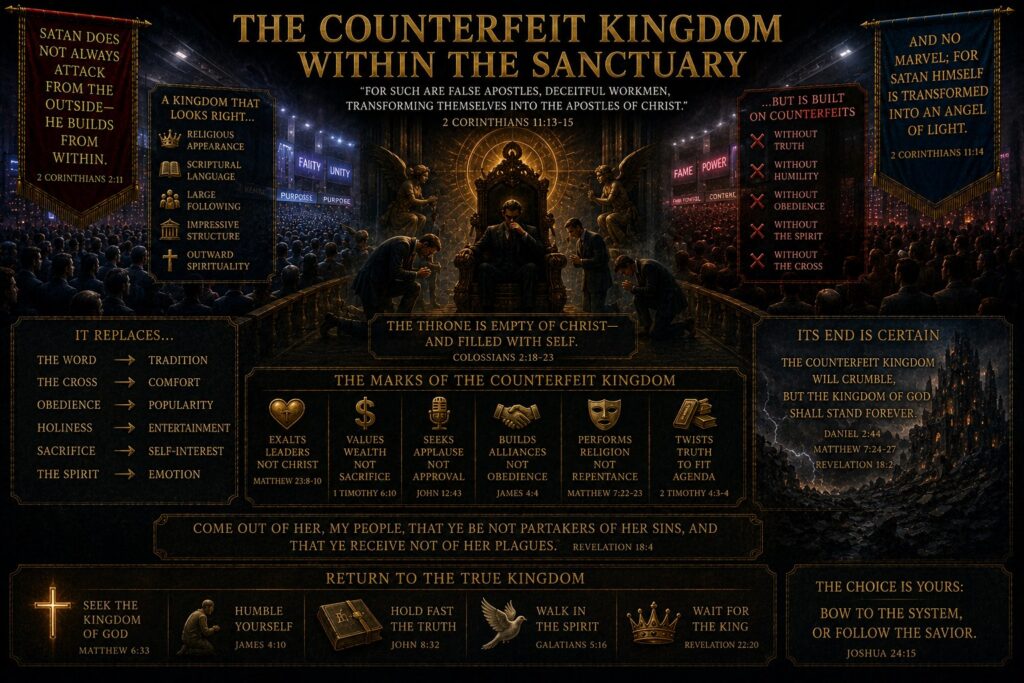
One of the most sobering realities in Scripture is that counterfeit kingdoms rarely announce themselves openly at first. They often emerge slowly within the visible covenant structure itself. The language of God remains. The symbols remain. The rituals remain. Yet inwardly another spirit begins shaping the sanctuary into the image of earthly power rather than the image of Christ.
This is why Jesus repeatedly warned His followers not to imitate the spirit of worldly rulership. Earthly kingdoms operate through domination, spectacle, coercion, pride, and visible glory. But the kingdom of Christ moves through humility, servanthood, truth, sacrifice, and inward transformation by the Spirit of God.
“My kingdom is not of this world.”
John 18:36
Whenever the visible church becomes intoxicated with earthly influence, political identity, spectacle religion, celebrity authority, or nationalistic glory, the sanctuary becomes vulnerable to forming a counterfeit kingdom while still using the name of Christ. The throne remains religious outwardly, yet another image slowly begins occupying the center.
This is why prophecy cannot simply be reduced to identifying one future tyrant. Scripture repeatedly warns about an entire spiritual atmosphere capable of overtaking the visible church itself. The beastly nature seeks imitation, admiration, and enthronement within the sanctuary long before it ever appears fully in the outer world.
“Do not love the world nor the things in the world.”
1 John 2:15
The final conflict of prophecy is ultimately a conflict between two kingdoms struggling over the sanctuary itself: the kingdom of Christ formed inwardly by the Spirit, or the counterfeit kingdom of fallen man seeking the throne through pride, fear, spectacle, and earthly power.
The Wheat, the Tares, and the Final Separation
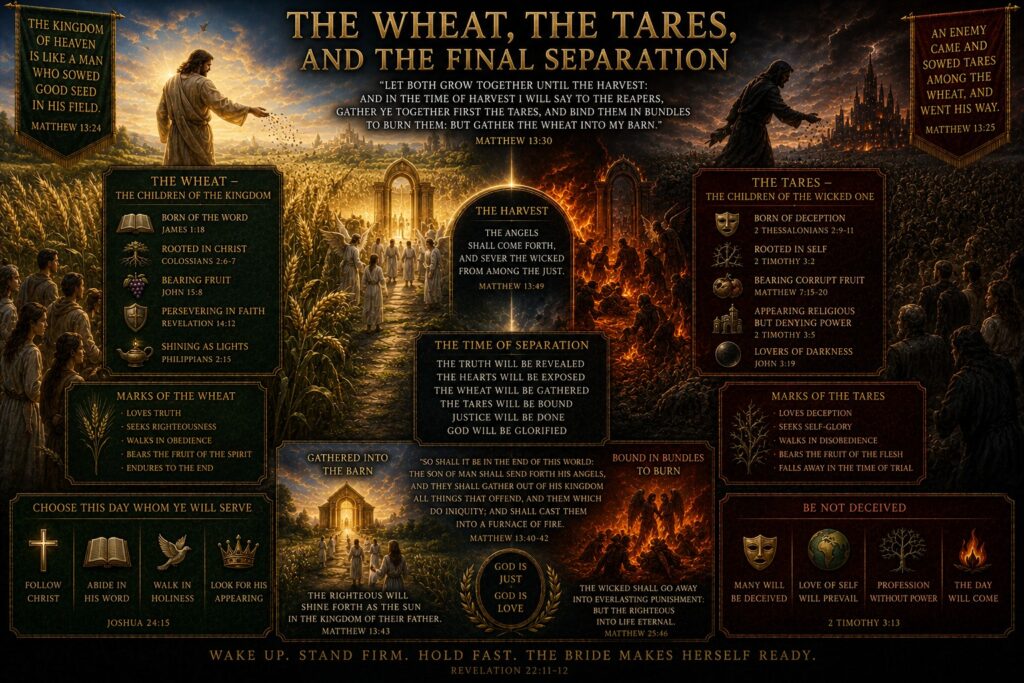
One of the clearest prophetic pictures Jesus ever gave concerning the end was not centered primarily upon worldly governments, but upon mixture existing within the visible covenant field itself. Wheat and tares grew together outwardly for a season. Both occupied the same field. Both appeared connected to the same kingdom environment. Yet inwardly they carried completely different natures.
“Allow both to grow together until the harvest.”
Matthew 13:30
This is why discernment becomes so critical in the final days. The greatest danger is not merely open darkness existing outside the sanctuary. The greater danger is counterfeit growth within the field itself. The tares resemble wheat outwardly for a season. The visible structure appears united while inwardly two different spirits are growing side by side.
Jesus repeatedly warned that many would appear religious outwardly while remaining untransformed inwardly. The issue was never merely outward profession. The issue was fruit, nature, and image-bearing. Every tree eventually reveals itself by what it produces.
“You will know them by their fruits.”
Matthew 7:16
The final prophetic separation is not merely political. It is spiritual. The sanctuary itself undergoes division between those transformed into the image of Christ and those continuing to reflect the beastly nature of fallen man while still standing within the visible field of religion.
This is why prophecy continually returns to the same central issue: the inward condition of the covenant community. The final harvest reveals what spirit truly ruled within the sanctuary all along.
Apocalypse: The Unveiling of the Sanctuary
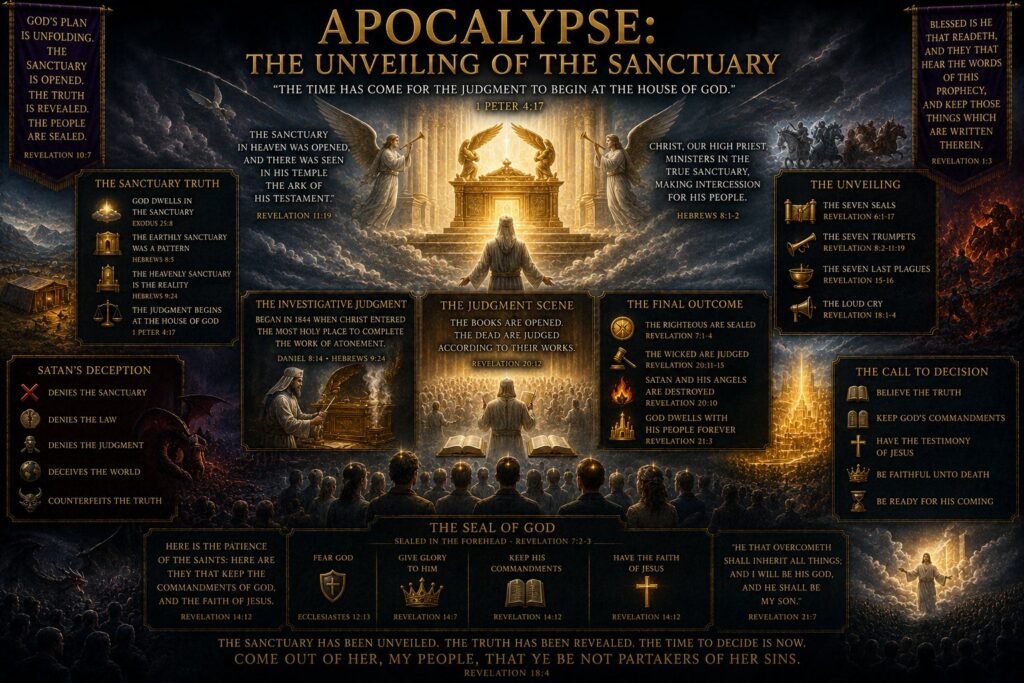
The word “apocalypse” has become almost entirely associated in modern culture with catastrophe, destruction, fear, and the collapse of civilization. Yet the biblical meaning of apocalypse is unveiling. Revelation. Disclosure. The uncovering of what was hidden beneath the surface all along.
This is why the final prophetic conflict is not merely about outward events shaking nations. It is also about the uncovering of the true condition of the sanctuary itself. The masks fall. Counterfeit worship is exposed. False shepherds are revealed. Mixture is uncovered. The hidden loyalties of the heart come into the light.
“For there is nothing hidden that will not become evident.”
Luke 8:17
The unveiling of Revelation ultimately exposes what spirit truly occupied the sanctuary. Did the visible church become transformed into the image of Christ through the Spirit of God, or did it gradually conform itself to the image of fallen man through pride, spectacle, counterfeit authority, political intoxication, and spiritual compromise?
This is why prophecy repeatedly returns to themes of discernment, testing, refining, separation, purification, and spiritual awakening. The apocalypse is not merely the unveiling of beasts in the outer world. It is the unveiling of the true condition of the covenant community itself.
“Judgment must begin at the house of God.”
1 Peter 4:17
The final unveiling does not merely expose the darkness of the nations. It reveals what has been enthroned within the sanctuary all along.
The Cleansing of the Temple
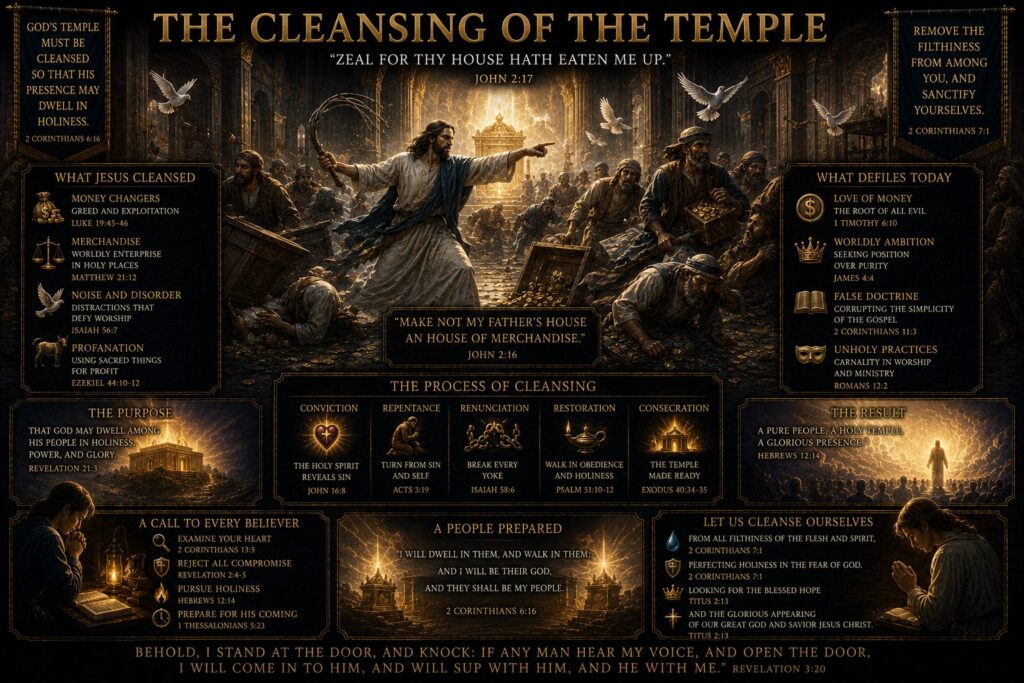
One of the most prophetic acts Jesus ever performed was the cleansing of the temple. Many people read the scene merely as anger toward dishonest merchants, but the symbolism reaches far deeper. The temple represented the dwelling place of God among His people, yet corruption had entered the sanctuary while still hiding beneath the appearance of religion.
Tables filled the courts. Commerce occupied sacred space. Outward worship continued functioning while inward corruption spread through the sanctuary itself. The visible structure still stood, yet the Spirit of God exposed what had been enthroned within it.
“My house shall be called a house of prayer; but you are making it a robbers’ den.”
Matthew 21:13
The cleansing of the temple becomes a prophetic picture of what Christ continually does within His covenant people. The sanctuary must be purified. Counterfeit worship must be exposed. Mixture must be overturned. The fleshly systems operating within sacred space cannot remain enthroned forever.
This is why the final prophetic conflict repeatedly returns to purification of the sanctuary itself. The issue is not merely the existence of darkness outside the temple. The issue is what has entered the temple while still wearing the garments of religion.
“Destroy this temple, and in three days I will raise it up.”
John 2:19
The true temple Christ raises is not merely stone architecture. It is a living sanctuary purified through death, resurrection, refinement, and transformation by the Spirit of God. The final cleansing of prophecy concerns the restoration of that living temple within the remnant of God’s people.
When the Stones Cry Out
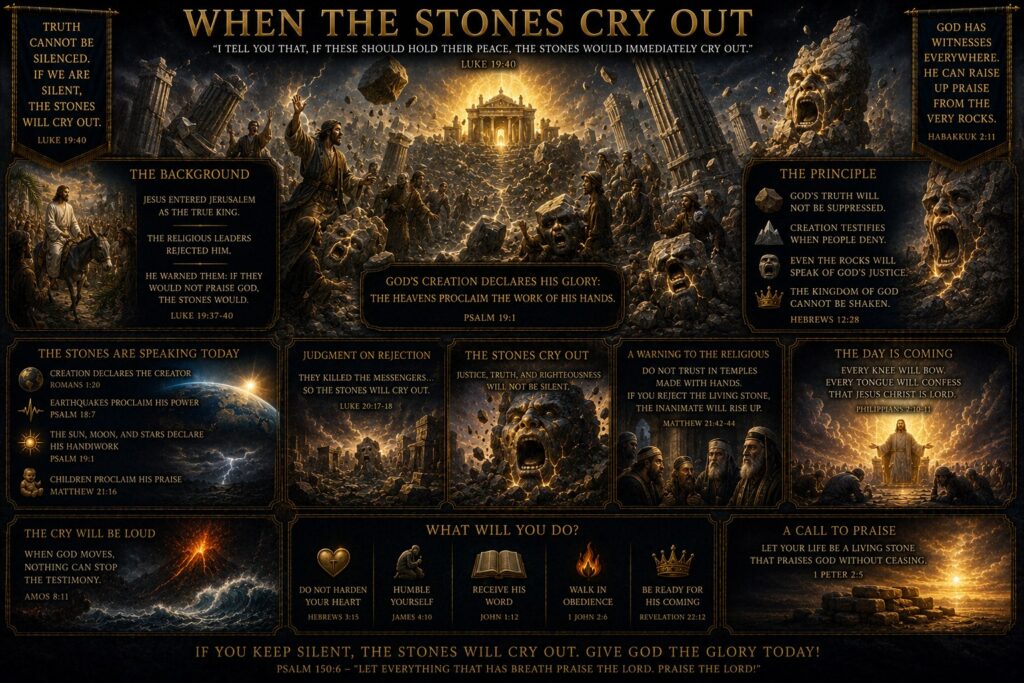
As Jesus entered Jerusalem, the crowds cried out in recognition while the religious establishment grew increasingly hostile toward Him. The leaders demanded silence. They wanted the testimony restrained. Yet Christ responded with one of the most mysterious prophetic statements in Scripture.
“I tell you, if these become silent, the stones will cry out!”
Luke 19:40
The statement carries deep prophetic symbolism. Throughout Scripture, stones are repeatedly connected to covenant witness, memorial testimony, temple imagery, altars, and the people of God themselves. The sanctuary was built of stones. Altars were built of stones. Memorials were raised with stones. Even believers themselves are described as living stones being assembled into a spiritual house.
When outward religious systems grow silent concerning truth, God raises witnesses anyway. When institutional structures become corrupted, compromised, intoxicated with power, or fearful of losing influence, the testimony of God still emerges through a remnant prepared to bear witness regardless of opposition.
“You also, as living stones, are being built up as a spiritual house.”
1 Peter 2:5
This is why the prophetic story does not end with apostasy alone. God continually preserves a witness within the sanctuary. A remnant refined through testing. Living stones prepared for a restored temple not built merely with outward religion, but with transformed hearts filled by the Spirit of God.
The final prophetic conflict ultimately reveals what kind of temple is being built within the covenant community: a sanctuary reflecting the image of Christ, or a structure filled with the image of fallen man.
The Hidden War Between Image and Spirit
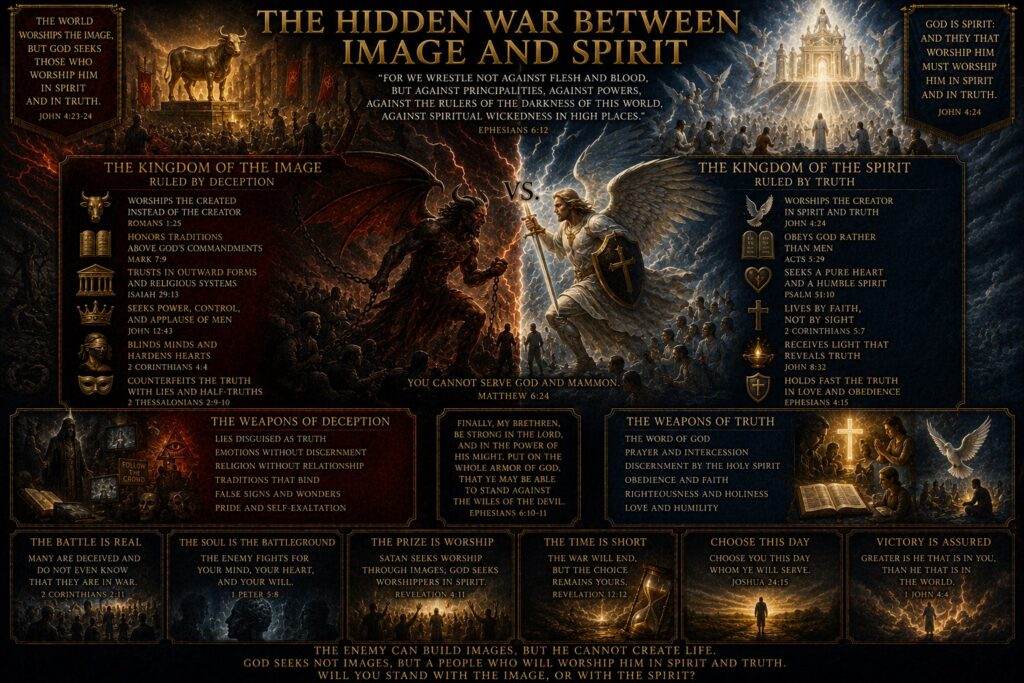
Beneath nearly every prophetic warning in Scripture lies a hidden war between two opposing realities: image and Spirit. One seeks outward glory, visible power, spectacle, emotional intoxication, domination, and self-exaltation. The other works quietly through humility, transformation, obedience, truth, and inward conformity to Christ.
This conflict appears from the very beginning. Humanity was created in the image of God, yet the fall introduced another image rooted in pride and self-rule. Since that moment, Scripture has traced the struggle between those two images moving through the sanctuary of God’s people.
“For all who are being led by the Spirit of God, these are sons of God.”
Romans 8:14
The remnant throughout Scripture is repeatedly defined not merely by outward profession, but by inward transformation through the Spirit of God. The counterfeit system, by contrast, continually emphasizes appearance, outward power, political influence, spectacle, and visible glory while often neglecting the deeper work of sanctification.
This is why the visible church can appear spiritually alive outwardly while inwardly drifting into mixture. Emotional intensity is mistaken for holiness. Celebrity influence is mistaken for authority. Political strength is mistaken for kingdom power. Outward excitement replaces inward transformation.
“The letter kills, but the Spirit gives life.”
2 Corinthians 3:6
The final prophetic battle is not merely a struggle between political systems. It is a struggle over what image the sanctuary will ultimately bear: the image of fallen man empowered by pride and spectacle, or the image of Christ formed inwardly through the Spirit of God.
The Bride, the Sanctuary, and the Final Restoration
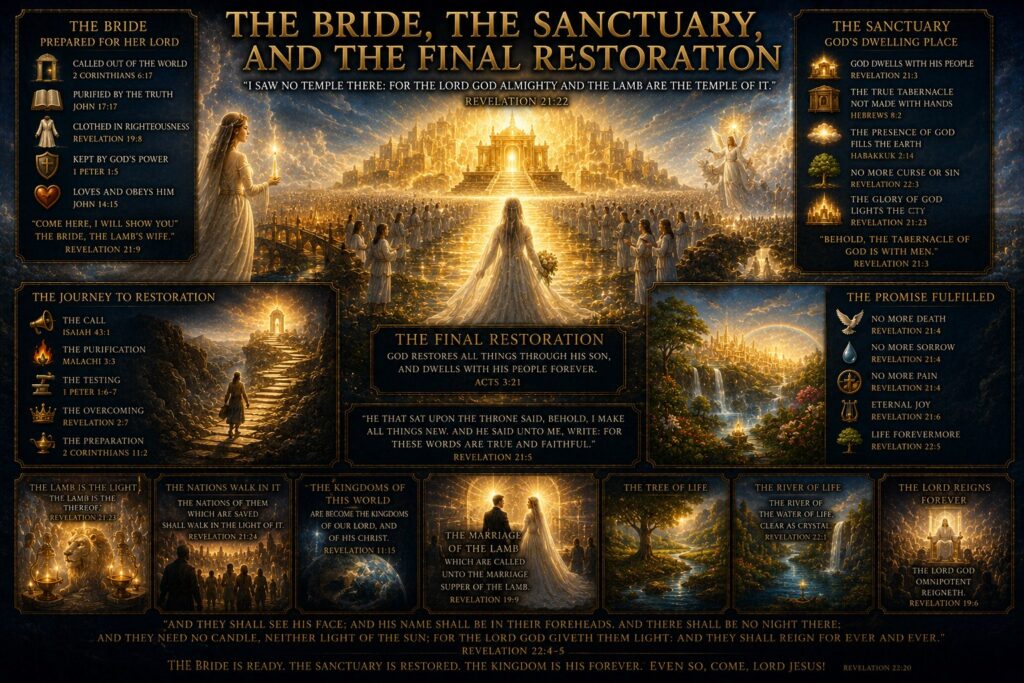
The prophetic story of Scripture does not end with corruption, apostasy, counterfeit worship, or the rise of beastly systems. Beneath every warning stands a promise: God will preserve and restore a faithful people purified through truth, refinement, and the Spirit of Christ.
Throughout Revelation, two women stand in contrast to one another. One becomes intoxicated with power, earthly glory, mixture, and corruption. The other is prepared as a bride purified for her husband. One reflects the image of Babylon. The other reflects the image of Christ.
“Let us rejoice and be glad and give the glory to Him, for the marriage of the Lamb has come and His bride has made herself ready.”
Revelation 19:7
The final prophetic hope is not the triumph of earthly kingdoms or spectacle religion. It is the restoration of a sanctuary fully surrendered to the Spirit of God. A people transformed inwardly into the image of Christ. A remnant refined through truth rather than intoxicated by counterfeit glory.
This is why the final conflict continually centers upon worship, image, allegiance, and spiritual identity. Every system ultimately produces fruit after its own nature. Babylon produces intoxication, pride, spectacle, and mixture. The Spirit of Christ produces humility, holiness, truth, faithfulness, and transformation.
“Behold, the tabernacle of God is among men, and He will dwell among them.”
Revelation 21:3
The story ends where it began: God dwelling among His people. Not merely within outward systems, but within a purified sanctuary transformed by His Spirit. The final unveiling of prophecy ultimately reveals two kingdoms, two images, two spirits, and two temples standing side by side until the harvest fully separates them.
The greatest prophetic question was never merely who the beast would be. It was always what image the sanctuary would ultimately reflect.
Epilogue: The Sanctuary and the Watchman
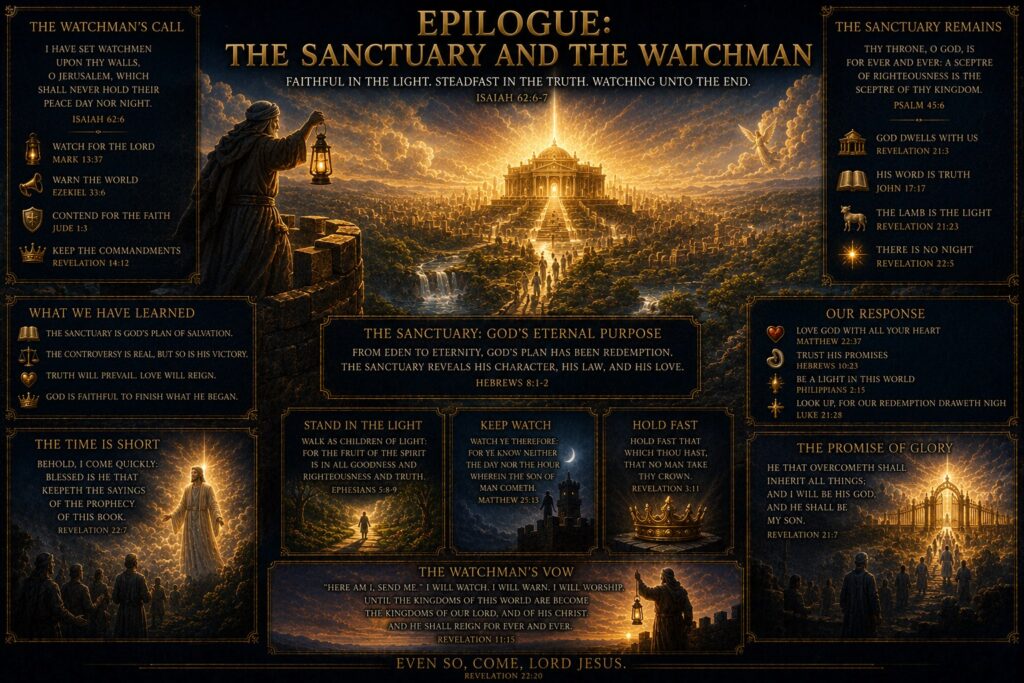
Perhaps the greatest deception of all was never merely convincing the world to rebel against God openly. Perhaps the greater deception was convincing the visible church to search endlessly for beasts in the distance while ignoring the throne within the sanctuary.
Generation after generation, believers were taught to fear outward kingdoms, outward rulers, outward systems, outward darkness. Meanwhile the prophets kept turning the mirror back toward the covenant people themselves.
The sanctuary.
The temple.
The throne of the heart.
Again and again Scripture warned that the greatest danger would not merely come from outside the gates. It would rise within the visible sanctuary itself.
“He who has an ear, let him hear what the Spirit says to the churches.”
Revelation 2:29
This is why discernment matters. This is why believers must become Bereans again. Question traditions. Search the Scriptures. Test every spirit. Do not surrender your discernment to personalities, movements, spectacle, fear, political systems, or counterfeit prophets.
The final battle was never merely about identifying one beast. It was about whether the sanctuary would reflect the image of Christ… or the image of fallen man.
Watch carefully. Discern prayerfully. And guard the sanctuary.
Support Truth Hunters
Truth Hunters is 100% viewer supported. Every article, documentary, study, investigation, and teaching is made possible through the support of viewers who believe these truths matter.
If this work has helped you, encouraged you, challenged you, or strengthened your discernment, please consider supporting the ministry so these teachings can continue reaching people around the world.
Support links for Venmo, Patreon, PayPal, and postal mail for check or money order are available on the website.


TV Show Host, Live Zoom Bible Study Teacher, Video Creator, Biblical Researcher & Truth Teller. Be sure and check out all her videos on her channel, https://youtube.com/lynleahz. You can email Lyn Leahz at Info@TruthHuntersShow.Com


