
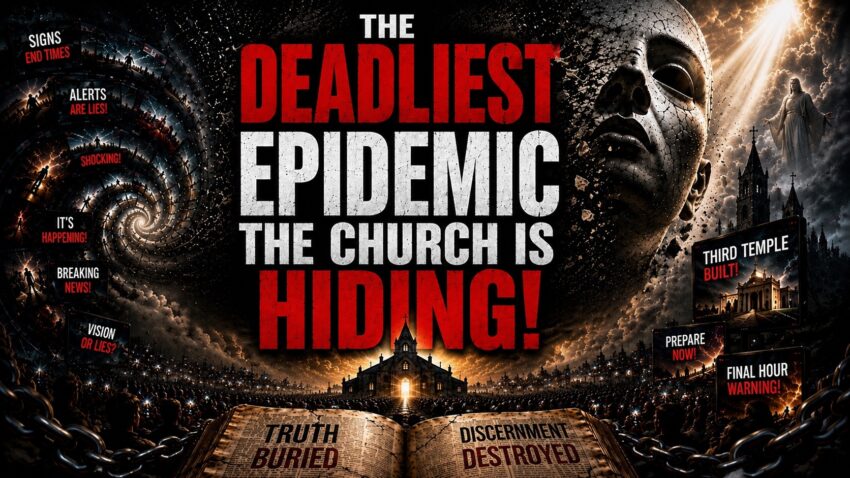
Something strange has happened to the modern church, and most people still cannot see it because the epidemic hides beneath the language of discernment, prophecy, revelation, urgency, signs, hidden knowledge, and spiritual awakening. At first glance it appears righteous. It appears passionate. It appears watchful. But beneath the surface, another force has quietly wrapped itself around modern Christianity like vines crawling across the walls of an ancient temple.
For years, believers warned the world about addiction while unknowingly developing one of the most dangerous addictions of all. Not addiction to alcohol. Not addiction to drugs. Not addiction to lust or pleasure. The modern church has become increasingly addicted to stimulation itself.
Addicted to fear. Addicted to sensationalism. Addicted to hidden knowledge. Addicted to emotional urgency. Addicted to the intoxicating feeling that somewhere, just beyond the next video, the next prophecy conference, the next insider, the next warning, the next “breaking revelation,” lies the final secret that will suddenly make sense of everything. And because the addiction wears religious clothing, millions no longer recognize it as addiction at all.
The soul was never designed to live in a perpetual state of panic, adrenaline, obsession, suspicion, and emotional escalation, yet modern prophecy culture often thrives on exactly those things. Every week brings another emergency. Another decoded sign. Another hidden warning. Another viral fear cycle. Another teacher claiming access to secret knowledge concealed from the masses. Another wave of emotional intoxication poured directly into exhausted minds already drowning in information.
In many places, the pursuit of Christ has quietly been replaced by the pursuit of stimulation about Christ. People no longer simply seek truth. They seek the emotional rush that comes from feeling connected to hidden truth. The excitement becomes the product. The urgency becomes the attraction. Fear becomes the engine. Spectacle becomes the ministry. And before long, many become trapped inside an endless cycle of consuming information without ever being transformed by it.
This is precisely why the Apostle Paul warned of a generation that would be “ever learning, and never able to come to the knowledge of the truth.” The danger was never merely ignorance. The danger was endless consumption without transformation. Endless hearing without repentance. Endless stimulation without sanctification. Minds flooded constantly with information while hearts slowly drift farther from wisdom, discernment, stillness, and intimacy with God.
“Always learning and never able to come to the knowledge of the truth.”
2 Timothy 3:7
And suddenly the warnings of Revelation begin to feel terrifyingly alive. Because Revelation does not merely describe deception. It describes intoxication. The nations are not just simply lied to, they are also made drunk. Drunk on mystery. Drunk on spectacle. Drunk on power. Drunk on fear. Drunk on hiddenness itself.
“With whom the kings of the earth committed acts of immorality, and those who dwell on the earth were made drunk with the wine of her immorality.”
Revelation 17:2
Babylon does not merely corrupt through obvious evil. She seduces through mixture. Truth blended with performance. Truth mixed with lies. Scripture blended with sensationalism. Discernment blended with emotional manipulation. Light carefully mixed with darkness until people can no longer distinguish the difference between revelation and addiction. And in an age of endless scrolling, prophecy entertainment, digital outrage, insider culture, conspiracy obsession, and algorithm-driven fear cycles, the ancient wine of Babylon may be flowing stronger than ever before.
The terrifying part is not merely that the cup exists. The terrifying part is that millions are drinking from it while believing they are growing spiritually sober.
THE INTOXICATION OF BABYLON
The book of Revelation describes the church drunk on deception, but most people were taught to imagine this intoxication only through governments, economies, wars, or worldly corruption. Yet Revelation repeatedly points toward something far more spiritual and far more seductive. Babylon does not merely conquer through force. She conquers through fascination. Through enchantment. Through intoxication. Through charisma. Through emotional seduction carefully disguised as enlightenment.
“Fallen, fallen is Babylon the great! She has become a dwelling place of demons and a prison of every unclean spirit.”
Revelation 18:2
Revelation says the nations became drunk from “the wine of the passion of her immorality.” That language is not accidental. Scripture could have simply said the nations were deceived. Instead, God chose the imagery of intoxication because intoxication changes perception itself. An intoxicated mind loses clarity. It loses balance. It becomes emotionally driven, impulsive, reactive, unstable, and easily manipulated. The more intoxicated a person becomes, the harder it becomes to recognize their own condition. That is the true horror of spiritual drunkenness. The victim often believes they are seeing more clearly precisely while becoming more blind.
“The woman was clothed in purple and scarlet, and adorned with gold and precious stones and pearls, having in her hand a gold cup full of abominations and of the unclean things of her immorality.”
Revelation 17:4
And suddenly modern culture begins to mirror the symbolism with terrifying precision. Endless fear cycles. Endless prophecy alerts. Endless emotional stimulation. Endless “urgent revelations.” Endless hidden codes. Endless insider warnings. Endless dopamine spikes generated through panic, speculation, outrage, and mystery. Millions now consume spiritual content the same way addicts consume narcotics: chasing stronger emotional highs with every new revelation. What once shocked the mind no longer feels powerful enough, so the content must become more dramatic, more urgent, more extreme, more hidden, more terrifying, more emotionally explosive. The appetite itself mutates.
This is why sensationalism spreads so rapidly online. Fear and urgency create chemical reactions inside the human brain. Studies repeatedly show that emotionally charged content spreads faster, receives higher engagement, produces stronger memory retention, and triggers greater compulsive consumption than calm or balanced information. The human nervous system becomes trapped in a stimulation loop, constantly scanning for the next emotional hit. Social media algorithms understand this deeply. Outrage spreads. Fear spreads. Shock spreads. Panic spreads. Calm rarely goes viral. Quiet wisdom rarely dominates the algorithm. Stillness rarely becomes profitable.
“For all the nations have drunk of the wine of the passion of her immorality.”
Revelation 18:3
“Your boasting is not good. Do you not know that a little leaven leavens the whole lump of dough?”
1 Corinthians 5:6
And this is where the symbolism of Babylon becomes chilling. Revelation portrays a harlot holding a golden cup filled with abominations. Gold on the outside. Poison within. Beautiful presentation masking spiritual corruption underneath. That image perfectly mirrors much of modern sensationalism culture. The presentation appears righteous. Biblical language is used. Spiritual vocabulary is everywhere. Jesus is mentioned constantly. Scripture verses flash across screens. But beneath the presentation often lies something feeding entirely different appetites: fear addiction, emotional dependency, spiritual vanity, ego, panic, performance, tribalism, and obsession with hidden knowledge itself.
The ancient seduction in Eden was never merely about forbidden information. It was about the intoxication of becoming “like gods” through secret knowledge. The serpent did not tempt Eve with obvious darkness. He tempted her with elevated perception. Hidden insight. Enlightenment. A higher awareness concealed from others. And that same pattern continues today every time people become spiritually addicted to feeling like they possess secret information unavailable to the masses. The emotional high itself becomes seductive. Not because all mysteries are false, but because the heart can become addicted to hiddenness itself rather than to God.
“For God knows that in the day you eat from it your eyes will be opened, and you will be like God, knowing good and evil.”
Genesis 3:5
This is why Scripture repeatedly calls believers to sobriety. “Be sober. Be vigilant.” Sobriety in the Bible is not merely the absence of alcohol. It is clarity of perception. Stability of mind. Freedom from intoxication. Freedom from emotional manipulation. Freedom from spiritual frenzy. A sober believer can discern truth without becoming consumed by spectacle. But an intoxicated culture begins craving stimulation so intensely that silence feels unbearable, stillness feels empty, and ordinary faithfulness feels powerless compared to the emotional rush of constant prophetic drama.
“Be sober, be vigilant; because your adversary the devil walks about like a roaring lion, seeking whom he may devour.”
1 Peter 5:8
THE PROPHECY MARKETPLACE
One of the most dangerous shifts in modern Christianity did not happen overnight. It emerged slowly, quietly, almost invisibly, until eventually an entire spiritual economy formed around fear, urgency, and spectacle. Prophecy became branding. Discernment became performance. Watchfulness became entertainment. And what once should have driven people deeper into repentance often became content designed to keep people emotionally dependent, constantly returning for the next warning, the next emergency, the next revelation, the next hidden sign supposedly proving that everything was about to happen “any moment now.”
“But false prophets also arose among the people, just as there will also be false teachers among you… and in their greed they will exploit you with false words.”
2 Peter 2:1-3
The modern prophecy culture increasingly mirrors the structure of a marketplace. Attention has become currency. Fear has become fuel. Algorithms reward emotional intensity, which means creators who produce the strongest reactions are often elevated the fastest. Calm voices rarely dominate the landscape. Careful study rarely explodes virally. But panic spreads instantly. Shock spreads instantly. Conspiracy spreads instantly. And because engagement itself becomes profitable through views, donations, subscriptions, conferences, books, memberships, sponsorships, and influence, a hidden temptation quietly forms beneath the surface: the temptation to keep audiences emotionally activated at all times.
“For the love of money is a root of all sorts of evil, and some by longing for it have wandered away from the faith.”
1 Timothy 6:10
This is precisely why Scripture repeatedly warns about spiritual merchandising. Second Peter speaks of false teachers who “in their greed” exploit people with deceptive words. Revelation portrays merchants growing wealthy through Babylon’s system. Even Jesus Himself entered the temple and overturned the tables of those buying and selling in the house that was supposed to represent prayer. Most modern readers interpret those passages only through money, but the symbolism reaches deeper. Buying and selling in Scripture repeatedly connects to spiritual exchange, religious corruption, manipulated access, counterfeit authority, and systems profiting from the spiritual hunger of the people.
“And Jesus entered the temple and drove out all those who were buying and selling in the temple, and overturned the tables of the money changers.”
Matthew 21:12
“My house shall be called a house of prayer; but you are making it a robbers’ den.”
Matthew 21:13
And now an entire online ecosystem thrives on perpetual urgency. Every week brings another “final warning.” Another “hidden sign.” Another “proof we are at the end.” Another emotional surge designed to keep audiences locked into fear cycles. Yet strangely, the emotional addiction often becomes more important than whether the claims themselves ever come true. Failed predictions rarely stop the cycle. Incorrect interpretations rarely break the dependency.
The audience simply moves to the next sensational claim because the emotional stimulation itself has become the product.
“For false christs and false prophets will arise and will show great signs and wonders, so as to mislead, if possible, even the elect.”
Matthew 24:24
This is where discernment becomes critical, because many sincere believers do not realize how deeply emotional conditioning shapes spiritual perception. Constant exposure to fear-based content changes the nervous system. It trains people to crave urgency. It creates hypervigilance. It produces anxiety disguised as watchfulness. It conditions believers to interpret every headline, every world event, every celebrity moment, every weather anomaly, and every political development through a lens of escalating panic. Eventually people no longer know how to sit quietly with Scripture without needing constant stimulation to feel spiritually engaged.
The irony is devastating. Many who believe they are “awake” become emotionally manipulated more easily than the world itself because fear bypasses discernment. Panic bypasses wisdom. Emotional intoxication bypasses patience. And once fear dominates the mind, almost any narrative can begin appearing believable so long as it produces enough emotional intensity. This is why false signs and wonders are so dangerous in Scripture. Their power is not merely deception through information. Their power is emotional seduction. Awe. Shock. Fear. Astonishment. Spectacle powerful enough to overwhelm sober judgment.
“See to it that no one misleads you.”
Matthew 24:4
Even the language of modern sensationalism begins sounding eerily ritualistic after enough exposure. “You won’t believe this.” “They don’t want you to know.” “Final warning.” “Massive revelation.” “Breaking prophecy.” “Urgent alert.” “Hidden truth exposed.” The cycle never ends because emotional dependency requires continual stimulation. The machine must constantly feed itself. And the more extreme the claims become, the harder it becomes for audiences to recognize how deeply conditioned they have become by fear-driven spiritual consumption.
Yet Christ consistently pointed people away from obsession with outward spectacle and back toward the condition of the heart. Again and again He warned that deception would become so powerful precisely because it would appear spiritual. False signs. False wonders. False prophets. False christs appearing as light. Not merely darkness pretending to be darkness, but darkness disguised as revelation. That is why sobriety matters so deeply in Scripture. The remnant is not merely called to knowledge. The remnant is called to clarity.
“LOOK HERE” — THE WARNING HIDDEN IN THE WILDERNESS
One of the most astonishing warnings Jesus ever gave about deception is hiding in plain sight, yet much of the modern church has rushed directly past it while unknowingly fulfilling the very pattern He described. In Matthew twenty four, while speaking about false christs, false prophets, and end-time deception, Jesus gives a strange and highly specific warning:
“At that time if anyone says to you, ‘Behold, here is the Christ,’ or ‘There He is,’ do not believe him.”
Matthew 24:23
“So if they say to you, ‘Behold, He is in the wilderness,’ do not go out, or, ‘Behold, He is in the inner rooms,’ do not believe them.”
Matthew 24:26
At first glance the passage appears simple, but the deeper symbolism becomes absolutely chilling once the biblical meanings begin unfolding beneath the surface. Jesus was not merely warning about geography. He was warning about spiritual psychology. About seduction. About the human tendency to chase hidden revelation, secret knowledge, isolated mysteries, and emotional spectacle disguised as divine insight.
The “wilderness” throughout Scripture repeatedly symbolizes desolation, testing, wandering, confusion, isolation, and spiritual barrenness. It is the realm of instability and vulnerability. Israel wandered in the wilderness. Demons were associated with desolate places. Christ Himself was tempted in the wilderness. And now modern Christianity has become flooded with voices constantly directing believers toward spiritual wildernesses filled with hidden conspiracies, secret signs, coded messages, forbidden knowledge, elite plots, mysterious beings, underground revelations, and endless speculative rabbit holes that never seem to produce greater holiness, greater love, greater obedience, or greater clarity of Christ.
“And he led him into the wilderness for forty days, being tempted by the devil.”
Luke 4:1-2
Then comes the second warning: “inner rooms.” The symbolism becomes even more revealing. Inner rooms throughout Scripture often represent hidden chambers, concealed places, secret counsel, private revelations, hidden initiations, and restricted access to supposedly deeper truth. In other words, Jesus warned that deception would flourish through the seduction of hiddenness itself. “Come here privately.” “We have secret knowledge.” “We know what others do not.” “We have insider revelation.” “We have decoded the mystery.” The emotional intoxication of exclusivity becomes the bait.
“For nothing is hidden that will not become evident, nor anything secret that will not be known and come to light.”
Luke 8:17
And suddenly the entire modern media landscape begins mirroring the warning almost perfectly. Endless videos promising hidden truth. Endless rabbit holes. Endless secret revelations. Endless “they are hiding this from you” narratives. Endless inner rooms where people gather around emotional speculation disguised as discernment. The internet itself has become a labyrinth of digital wildernesses and hidden chambers where millions wander endlessly searching for the next revelation while often drifting farther away from simplicity in Christ.
“See to it that you are not misled; for many will come in My name, saying, ‘I am He,’ and, ‘The time is near.’ Do not go after them.”
Luke 21:8
This is why Jesus immediately contrasted those warnings with lightning flashing openly across the sky. Truth does not need manipulation to sustain itself. Truth does not need constant emotional bait. Truth does not hide behind endless mystery loops designed to keep people psychologically dependent. Christ consistently pulled people back toward clarity, repentance, humility, love, obedience, and transformation of the heart. Counterfeit spirituality often does the opposite. It keeps people emotionally stimulated while leaving the inner man unchanged.
This does not mean every mystery is false or that believers should ignore discernment. Scripture absolutely warns about deception, falsehood, corrupt systems, and spiritual darkness. But there is a profound difference between sober discernment and compulsive obsession. One produces clarity. The other produces intoxication. One leads toward peace, wisdom, stability, and holiness. The other leads toward anxiety, fixation, emotional dependency, confusion, suspicion, and endless wandering through spiritual wildernesses searching for the next hidden thing.
“But examine everything carefully; hold fast to that which is good.”
1 Thessalonians 5:21
The tragedy is that many believers genuinely think they are pursuing truth while unknowingly becoming addicted to the emotional chemistry of fear and hiddenness itself. And that is precisely why Christ warned so carefully. Because in the last days, deception would not merely appear evil. It would appear fascinating.
ITCHING EARS AND THE PSYCHOLOGY OF FEAR
Long before social media algorithms existed, Scripture already described a generation psychologically addicted to emotional stimulation. Paul warned Timothy that a time would come when people would “not endure sound doctrine,” but instead would gather teachers who would satisfy their “itching ears.” Most believers imagine this only as people wanting soft messages or permissive teachings, but the deeper implications reach much farther. An itch is not stable hunger. An itch is agitation. Restlessness. Compulsion. Irritation demanding relief. The imagery itself describes psychological craving.
“For the time will come when they will not endure sound doctrine; but wanting to have their ears tickled, they will accumulate for themselves teachers in accordance to their own desires; and will turn away their ears from the truth and will turn aside to myths.”
2 Timothy 4:3-4
An itching ear is never satisfied for long. It constantly searches for another sensation. Another voice. Another emotional spark. Another urgent revelation. Another hidden insight. Another dramatic interpretation. And once the nervous system becomes conditioned to constant stimulation, ordinary truth begins feeling emotionally insufficient. Quiet faithfulness feels boring. Simplicity feels empty. Scripture studied patiently without spectacle begins feeling “dry” compared to emotionally charged prophetic drama.
“Be sober, be vigilant; because your adversary the devil walks about like a roaring lion, seeking whom he may devour.”
1 Peter 5:8
Modern neuroscience now confirms something Scripture revealed thousands of years ago: fear and novelty powerfully affect the reward systems of the brain. Emotional stimulation releases dopamine and adrenaline, especially when uncertainty, danger, mystery, urgency, or hidden knowledge are involved. The human brain becomes highly responsive to emotionally charged information because survival instincts are activated. This is why panic spreads rapidly. Why shocking headlines outperform balanced ones. Why fear-driven media dominates engagement online. Why outrage and conspiracy loops become psychologically addictive.
Modern social media systems are not neutral environments. They are engineered around emotional stimulation. Fear, outrage, urgency, novelty, shock, conflict, and anticipation generate engagement, and engagement generates profit. The result is an entire digital ecosystem designed to reward emotional escalation while quietly conditioning the nervous system to crave continual stimulation. This is one reason many people now feel psychologically compelled to keep scrolling even when the content itself leaves them fearful, exhausted, anxious, or spiritually drained.
And tragically, much of modern spiritual culture has unknowingly merged itself with this exact cycle. Entire ministries now operate through perpetual emotional activation. Every week becomes another emergency. Every headline becomes another prophetic sign. Every world event becomes another “proof” that the final collapse is moments away. Audiences remain locked in a continual state of hyper-alertness, emotionally scanning for danger, revelation, urgency, and hidden meaning. The nervous system never rests. The mind never quiets. The soul becomes conditioned to chaos.
This creates a devastating spiritual illusion because anxiety begins masquerading as discernment. Hypervigilance begins masquerading as watchfulness. Emotional obsession begins masquerading as wisdom. People mistake constant stimulation for spiritual depth because their nervous systems have become dependent on intensity itself. But the fruit reveals the truth. Many become increasingly fearful, suspicious, unstable, reactive, angry, exhausted, and emotionally consumed while believing they are becoming more spiritually awake.
Meanwhile Christ repeatedly described His Spirit very differently. Peace. Stability. Soundness of mind. Wisdom. Self-control. Clarity. Sobriety. Endurance. Patience. The voice of God throughout Scripture often appears not through frenzy, but through stillness. Elijah did not encounter the Lord in the earthquake, the fire, or the violent wind, but in the still small voice afterward. Yet modern culture increasingly conditions believers to believe God only speaks through emotional intensity, constant urgency, and nonstop stimulation.
“The wisdom from above is first pure, then peaceable, gentle, reasonable, full of mercy and good fruits, unwavering, without hypocrisy.”
James 3:17
This is precisely why the enemy’s greatest weapon is often not direct denial of truth, but overload. Endless noise. Endless alerts. Endless opinions. Endless interpretations. Endless reactions. Endless fear cycles flooding the mind until discernment itself becomes exhausted. A fatigued mind becomes far easier to manipulate because emotional exhaustion weakens critical thinking. People eventually stop examining claims carefully because the nervous system becomes trapped in survival mode.
“See to it that no one takes you captive through philosophy and empty deception, according to the tradition of men, according to the elementary principles of the world, rather than according to Christ.”
Colossians 2:8
And once fear becomes profitable, the cycle sustains itself. Fear creates engagement. Engagement creates visibility. Visibility creates influence. Influence creates income, power, validation, and audience loyalty. The system begins rewarding those who generate the strongest emotional reactions. Not necessarily those who speak most truthfully. Not necessarily those who produce the healthiest fruit. But those who keep the audience emotionally activated enough to return continuously for the next emotional surge.
“For where jealousy and selfish ambition exist, there is disorder and every evil thing.”
James 3:16
This is why Scripture’s repeated command to “be sober” becomes so prophetic for the modern age. Sobriety is not merely about avoiding substances. It is about remaining free from intoxication altogether, including emotional intoxication. Because once the heart becomes addicted to fear, panic, spectacle, hidden knowledge, and urgency, discernment itself slowly begins to erode beneath the surface while the person often believes they are becoming more enlightened than ever before.
“Therefore be of sound judgment and sober spirit for the purpose of prayer.”
1 Peter 4:7
EVER LEARNING, NEVER TRANSFORMED
One of the most haunting descriptions of the last days may be hidden inside a single phrase written by the Apostle Paul nearly two thousand years ago: “Ever learning, and never able to come to the knowledge of the truth.” At first glance the warning appears simple, but in the modern age it feels almost supernatural in its precision. Humanity now lives inside an endless river of information flowing twenty four hours a day. Millions scroll continuously through videos, headlines, teachings, reactions, prophecies, conspiracies, commentaries, podcasts, livestreams, alerts, threads, interviews, leaks, and emotional spectacles without ever reaching rest. Knowledge has become infinite, yet wisdom appears increasingly rare.
“But prove yourselves doers of the word, and not merely hearers who delude themselves.”
James 1:22
The terrifying part is that constant information consumption creates the illusion of spiritual growth even when genuine transformation is absent. People mistake exposure for maturity. Familiarity for wisdom. Information for revelation. They consume endless content about God while rarely becoming more like Christ Himself. The modern world has made it possible to drown spiritually while standing knee-deep in biblical information. Endless learning can actually become another form of distraction when the heart becomes addicted to accumulation instead of obedience.
“Knowledge makes arrogant, but love edifies.”
1 Corinthians 8:1
This is precisely why social media prophecy culture becomes so spiritually dangerous. Many believers now spend countless hours consuming warnings, theories, predictions, symbols, codes, controversies, insider claims, and speculative interpretations while spending very little time in silence, prayer, repentance, humility, mercy, forgiveness, self-examination, or quiet meditation on Scripture itself. The mind becomes overloaded while the inner man slowly starves. Information floods the intellect while transformation bypasses the heart.
“This people honors Me with their lips, but their heart is far away from Me.”
Matthew 15:8
Even the architecture of modern media reinforces this cycle. Algorithms are designed to keep people consuming endlessly. Every platform constantly asks the same question: “What will keep the user watching?” And emotionally stimulating content almost always performs best. Fear holds attention. Outrage holds attention. Mystery holds attention. Urgency holds attention. Spectacle holds attention. This means the digital world increasingly rewards emotional activation over sober reflection. People are subtly conditioned to crave stronger stimulation because calm truth rarely produces the same addictive neurological response.
“Take care what you listen to. By your standard of measure it will be measured to you; and more will be given you besides.”
Mark 4:24
The result is a generation that often knows enormous amounts of information while possessing very little peace. Many can discuss prophetic timelines, hidden symbols, conspiracies, current events, and speculative mysteries for hours while struggling to exhibit the fruit of the Spirit in ordinary life. Anxiety increases. Fear increases. Suspicion increases. Emotional exhaustion increases. And yet many continue believing they are growing spiritually because the constant flow of information creates the feeling of progress.
“There is no fear of God before their eyes.”
Romans 3:18
This is where Scripture draws an absolutely devastating distinction between knowledge and wisdom. Knowledge accumulates information. Wisdom transforms perception. The Pharisees possessed enormous knowledge, yet failed to recognize Christ standing directly before them. The tree in Eden was not called the tree of evil alone. It was the tree of the knowledge of good and evil, revealing that knowledge itself can become dangerous when separated from intimacy with God. Information alone does not sanctify the heart. In fact, information mixed with pride, fear, ego, and spectacle can actually deepen spiritual blindness while convincing the person they are becoming enlightened.
“For the wisdom of this world is foolishness before God.”
1 Corinthians 3:19
And suddenly modern culture begins resembling Babel once again. Humanity endlessly reaching upward through information, technology, hidden knowledge, endless voices, and self-generated enlightenment while becoming increasingly fragmented, anxious, confused, and spiritually unstable. The noise never stops. The consumption never stops. The searching never stops. Yet many souls remain deeply restless because the human spirit was never designed to be sustained by endless stimulation.
“Come, let us build for ourselves a city, and a tower whose top will reach into heaven, and let us make for ourselves a name.”
Genesis 11:4
Christ consistently invited people into something radically different. Stillness. Abiding. Simplicity. Humility. Obedience. Transformation. The kingdom of God does not function through perpetual frenzy. The Spirit of God does not require endless emotional escalation to remain alive. Yet modern culture has conditioned many believers to feel spiritually empty whenever stimulation disappears. Silence now feels uncomfortable because the nervous system has become dependent on noise.
“Be still, and know that I am God.”
Psalm 46:10
This is why the modern epidemic is so deceptive. The danger is not merely false information. The danger is endless consumption without transformation. Endless learning without repentance. Endless fascination without holiness. Endless searching without rest. And perhaps most terrifying of all, many people trapped in the cycle sincerely believe they are becoming spiritually deeper while slowly drifting farther away from the simplicity and sobriety that Christ continually called His followers toward.
“For what will it profit a man if he gains the whole world and forfeits his soul?”
Matthew 16:26
THE SIGN-SEEKING GENERATION
One of the most overlooked warnings Jesus ever gave may also be one of the most relevant for the modern church. While crowds constantly demanded supernatural evidence, signs, spectacles, and outward manifestations, Christ answered them with a statement so severe that most people barely stop long enough to feel its weight: “An evil and adulterous generation seeks after a sign.” Those words were not directed toward atheists. They were directed toward religious people obsessed with outward manifestations while remaining inwardly unchanged.
“An evil and adulterous generation craves for a sign; and yet no sign will be given to it but the sign of Jonah the prophet.”
Matthew 12:39
The warning becomes even more profound when viewed through the lens of modern culture. Never in human history have people had such unlimited access to signs, rumors, prophecies, spectacles, theories, viral clips, fear narratives, unexplained phenomena, and emotional stimulation. Every day the world floods millions of minds with another wave of dramatic imagery designed to provoke emotional reaction. Signs in the heavens. Signs in politics. Signs in technology. Signs in celebrities. Signs in weather. Signs in war. Signs hidden supposedly everywhere. Yet despite the endless obsession with external signs, genuine transformation often remains strangely absent.
Jesus did not say there would be no signs at all. Scripture absolutely speaks about signs, wonders, and prophetic fulfillment. But Christ exposed something far deeper: the human heart can become addicted to chasing outward manifestations while neglecting inward repentance. The danger was never merely signs themselves. The danger was obsession. The danger was spiritual adultery through fascination with spectacle rather than intimacy with God.
“For false christs and false prophets will arise and will show great signs and wonders, so as to mislead, if possible, even the elect.”
Matthew 24:24
This is precisely why Jesus answered by saying that no sign would ultimately be given except the sign of Jonah. Most people interpret this only as a prophecy about Christ’s death and resurrection, which it absolutely is, but the symbolism stretches even deeper. Jonah descended into the depths and emerged again. Christ descended into death and rose again. The true sign was never endless spectacle. The true sign was transformation through death and resurrection. Death to the flesh. Death to pride. Death to the old man. Resurrection into a new creation transformed by the Spirit of God.
And suddenly the contrast becomes devastatingly clear. The modern world craves spectacle while Christ points toward inward transformation. Modern culture seeks endless stimulation while Christ calls people to die to themselves. The flesh constantly wants another emotional high, another urgent revelation, another supernatural display proving something dramatic is happening. But the gospel continually redirects attention back toward repentance, humility, obedience, sanctification, and the transformation of the heart.
This is why sensationalism becomes spiritually dangerous even when wrapped in biblical language. It conditions believers to seek external excitement rather than inward renewal. It trains the nervous system to crave intensity rather than stillness. It creates emotional dependency on stimulation while ordinary faithfulness begins feeling spiritually “dead” by comparison. Prayer without adrenaline feels weak. Scripture without spectacle feels empty. Quiet obedience feels unimpressive. Yet throughout Scripture, God repeatedly performed His deepest work not through frenzy, but through hidden transformation.
“He performs great signs, so that he even makes fire come down out of heaven to the earth in the presence of men. And he deceives those who dwell on the earth because of the signs.”
Revelation 13:13-14
Even Revelation itself begins by declaring that it is “The Revelation of Jesus Christ.” Not merely revelation about beasts, disasters, signs, or catastrophes, but revelation of Christ Himself. Yet many become so consumed with decoding external symbols that they lose sight of the One being revealed. The signs become more fascinating than the Savior. The speculation becomes more captivating than sanctification. Fear becomes more emotionally stimulating than love. And slowly, almost invisibly, the heart drifts into spiritual imbalance while believing it has become spiritually awakened.
The tragedy is that a sign-seeking generation rarely knows when enough is enough. Spectacle always demands escalation. The emotional threshold keeps rising. What once shocked no longer satisfies. What once fascinated no longer feels powerful enough. The appetite constantly seeks stronger stimulation because emotional intoxication behaves exactly like addiction. The soul becomes conditioned to perpetual urgency, perpetual fascination, perpetual anticipation, perpetually searching for the next great revelation hidden just beyond the horizon.
But Christ pointed toward something entirely different. Not endless intoxication through outward spectacle, but inward resurrection through surrender. The greatest sign was never hidden in the sky, buried in conspiracy, locked inside secret knowledge, or concealed within emotional frenzy. The greatest sign was the transformation of the human heart through the death and resurrection of Jesus Christ Himself.
“For we walk by faith, not by sight.”
2 Corinthians 5:7
WATCH THE FULL VIDEO
One of the clearest modern examples of emotional intoxication, spectacle-driven deception, fear addiction, and obsessive sign-seeking can now be seen in the exploding fascination surrounding alien phenomena, hidden disclosures, and mystery culture.
In this Truth Hunters investigation, we examine how modern fear-based media systems psychologically condition people through fascination, uncertainty, hidden knowledge, and continual emotional stimulation while disguising themselves as “discernment.”
This video directly connects to the themes explored throughout this article and exposes how spectacle itself can quietly become spiritually intoxicating.
If this message resonates with you, please share the article, leave a comment, and help spread the truth.
MYTHS, ENDLESS RABBIT HOLES, AND THE HUNGER FOR SECRET KNOWLEDGE
One of the clearest warnings the Apostles repeatedly gave to the early church was not merely against immorality or persecution, but against becoming consumed by speculative obsession. Paul warned believers not to devote themselves to “myths and endless genealogies,” explaining that such things only produced confusion, arguments, distractions, and spiritual instability rather than genuine godliness. Yet in the modern age, an entire ecosystem has emerged built almost entirely upon endless rabbit holes disguised as spiritual enlightenment.
The internet has transformed speculation into a global industry. Every day millions disappear into digital labyrinths filled with hidden codes, secret bloodlines, forbidden knowledge, elite conspiracies, mysterious entities, underground revelations, supernatural rumors, speculative timelines, decoded symbols, and endless theories spiraling deeper and deeper into emotional fascination. Some of these discussions contain fragments of truth. Some contain complete fabrication. Most contain mixtures so tangled together that the mind becomes trapped in perpetual searching without ever arriving at clarity. The rabbit hole itself becomes the addiction.
“But avoid foolish controversies and genealogies and strife and disputes about the Law, for they are unprofitable and worthless.”
Titus 3:9
This is precisely why the ancient temptation in Eden remains so relevant. The serpent did not tempt humanity with obvious darkness. He tempted humanity through the seduction of elevated perception. “You will be like gods.” Hidden understanding. Secret enlightenment. Access to knowledge supposedly withheld from others. And now the modern world operates through the exact same psychological mechanism. People crave the emotional rush that comes from believing they possess information hidden from the masses. The sensation itself becomes intoxicating. Not merely truth, but exclusivity.
“For God knows that in the day you eat from it your eyes will be opened, and you will be like God, knowing good and evil.”
Genesis 3:5
This is why conspiracy culture and sensational prophecy culture often overlap so naturally. Both thrive on hiddenness. Both thrive on emotional escalation. Both thrive on the feeling of awakening into secret understanding while others supposedly remain blind. And because hidden knowledge creates emotional intensity, the nervous system begins rewarding the search itself. The deeper the mystery becomes, the more psychologically captivating it feels. Eventually some people become less interested in truth than in the emotional excitement generated by chasing mysteries endlessly.
Scripture repeatedly exposes this danger through remarkably specific language. Paul warned against “foolish controversies.” Titus warned against “foolish disputes.” Timothy was warned to avoid “worldly and empty chatter.” The issue was never thoughtful study or discernment. Scripture absolutely encourages wisdom, discernment, and testing all things carefully. The danger emerges when fascination with speculation begins consuming the mind while producing little spiritual fruit. Endless theories can create the illusion of depth while quietly distracting the heart from obedience, humility, love, repentance, and transformation.
“Avoid worldly and empty chatter, for it will lead to further ungodliness.”
2 Timothy 2:16
And this is exactly why many modern believers live in a continual state of mental exhaustion. Endless speculation produces endless instability because the mind never arrives at rest. Every answer produces ten new questions. Every theory creates deeper suspicion. Every hidden revelation demands another hidden revelation behind it. The search becomes infinite. Meanwhile the soul slowly loses its ability to simply abide in Christ without needing constant emotional stimulation to remain engaged.
“There is a way which seems right to a man, but its end is the way of death.”
Proverbs 14:12
The irony is that many people trapped in these cycles genuinely believe they are becoming more spiritually awake while often becoming increasingly fearful, anxious, suspicious, reactive, isolated, and emotionally overwhelmed. Yet Scripture describes the wisdom from above very differently: pure, peaceable, gentle, reasonable, full of mercy, unwavering, without hypocrisy. The fruit reveals the source. Truth may challenge the heart, but it ultimately leads toward clarity, sobriety, peace, stability, and greater conformity to Christ. Endless obsession rarely produces those things.
This is also why Jesus continually redirected people away from fascination with hidden signs and back toward the condition of the heart. The Pharisees searched endlessly for outward evidence while standing face to face with Truth Himself. Their obsession with signs blinded them to the deeper reality directly before them. And now modern culture risks repeating the same pattern through endless fascination with hidden codes, speculative mysteries, conspiracies, sensational revelations, and emotional spectacle while neglecting the inward transformation the gospel actually demands.
The deepest danger of the rabbit hole is not merely false information. The deepest danger is that endless searching can quietly replace surrender. The pursuit itself becomes the idol. The mystery becomes the intoxication. And the soul eventually becomes trapped wandering through an endless wilderness of speculation while believing it is drawing closer to truth.
THE DIGITAL GOLDEN CALF
When Moses descended from the mountain, he did not find Israel openly rejecting God altogether. That is one of the most important details in the entire story. The people still wanted spirituality. They still wanted worship. They still wanted something divine to follow. But while Moses delayed on the mountain, impatience began transforming the hearts of the people. Silence became unbearable. Waiting became intolerable. The invisible God no longer satisfied their need for immediacy, certainty, stimulation, and visible manifestation. So they demanded something they could see, something emotionally engaging, something visually captivating, something they could gather around collectively and consume together.
“Come, make us a god who will go before us.”
Exodus 32:1
And Aaron fashioned the golden calf.
The tragedy of the golden calf was never merely idolatry through another god. The deeper tragedy was mixture. The people attempted to merge the worship of God with a manmade image capable of satisfying emotional cravings more quickly than patient faith. They wanted spirituality without stillness. Revelation without waiting. Worship without surrender. Presence without transformation. The image became a substitute for trust.
Now look carefully at the modern age.
Humanity wakes each morning and reaches immediately for glowing images held in the palm of the hand. Millions gather around digital spectacles for comfort, identity, fear, outrage, stimulation, validation, revelation, and emotional intoxication. Endless streams of content now shape perception more powerfully than quiet prayer, contemplation, Scripture, or stillness before God. The modern nervous system has become conditioned to constant visual stimulation, constant emotional activation, and constant informational feeding. Silence feels unnatural. Stillness feels uncomfortable. Reflection feels weak compared to the immediate emotional rewards offered by endless digital consumption.
And suddenly the symbolism of the golden calf begins looking disturbingly modern.
The issue was never merely carved statues. The issue was the human tendency to create visible systems capable of emotionally replacing dependence upon God. Ancient idols were crafted from gold, silver, wood, and stone. Modern idols are crafted from algorithms, screens, branding, emotional manipulation, outrage cycles, viral spectacle, digital identity, and perpetual stimulation. Yet both function through the same spiritual mechanism: they capture attention, shape perception, generate emotional dependency, and gradually redirect the affections of the heart.
“Their idols are silver and gold, the work of man’s hands. They have mouths, but they cannot speak; they have eyes, but they cannot see.”
Psalm 115:4-5
This is why the modern attention economy becomes so spiritually dangerous. Attention itself has become one of the most valuable currencies on earth. Entire industries now compete relentlessly to capture, manipulate, monetize, and retain human attention for as long as possible. Fear holds attention. Outrage holds attention. Spectacle holds attention. Novelty holds attention. Emotional stimulation holds attention. The longer attention remains captured, the more profitable the system becomes. And because prophecy sensationalism often produces extremely strong emotional reactions, it spreads rapidly through the same digital machinery.
“Professing to be wise, they became fools, and exchanged the glory of the incorruptible God for an image.”
Romans 1:22-23
The terrifying part is that many believers no longer realize how profoundly technology shapes spiritual perception. Endless exposure to fear-based content conditions the mind toward anxiety. Endless outrage conditions the mind toward anger. Endless stimulation conditions the mind toward restlessness. Endless spectacle conditions the mind toward emotional dependency. The soul gradually loses its ability to remain spiritually sober because the nervous system becomes addicted to constant activation.
Meanwhile Christ consistently invited people into an entirely different rhythm. “Come away and rest.” “Be still.” “Abide in Me.” “Do not be troubled.” The kingdom of God does not function through perpetual frenzy. Yet modern digital culture increasingly conditions believers to believe that if they are not constantly consuming information, reacting emotionally, decoding signs, following alerts, or chasing the next revelation, they are somehow spiritually falling behind.
“Come away by yourselves to a secluded place and rest a while.”
Mark 6:31
And this is where the symbolism becomes devastating. Israel danced around the golden calf believing they were still worshiping God. That is precisely what makes idolatry so deceptive. The heart rarely recognizes its idols immediately because idols often attach themselves to legitimate desires. The desire for discernment. The desire for truth. The desire for protection. The desire for understanding. But once those desires become fused with emotional intoxication, spectacle, fear addiction, and constant stimulation, the line between devotion and dependency begins quietly disappearing.
The modern church often condemns ancient idols while carrying glowing idols in its own hands every single day. And unless believers learn once again how to sit quietly before God without needing constant emotional stimulation, many may continue mistaking digital intoxication for spiritual awakening.
FALSE LIGHT AND THE PERFORMANCE OF DISCERNMENT
One of the greatest dangers in the last days is not darkness appearing as darkness. Most people can recognize obvious corruption eventually. The greater danger is darkness disguised as light, deception wrapped carefully in spiritual language, emotional intoxication wearing the garments of discernment while quietly feeding entirely different appetites beneath the surface. This is why Scripture repeatedly warns that Satan himself transforms into an “angel of light.” The deception works precisely because it appears righteous, urgent, informed, awakened, watchful, and spiritually enlightened.
“Even Satan disguises himself as an angel of light.”
2 Corinthians 11:14
The modern age has perfected the performance of discernment. Entire online ministries now function through continual exposure cycles where emotional intensity becomes confused with spiritual authority. The louder the warning, the more convincing it appears. The more dramatic the revelation, the more spiritual it seems. The more emotionally charged the content becomes, the more audiences interpret the speaker as “bold,” “awake,” or “anointed.” Yet truth does not become more true because it is emotionally overwhelming. And fear does not become discernment simply because biblical language is attached to it.
“Beware of the false prophets, who come to you in sheep’s clothing, but inwardly are ravenous wolves.”
Matthew 7:15
This is why so many people now live in a continual state of spiritual hypervigilance. Every event becomes charged with apocalyptic meaning. Every headline becomes another sign. Every celebrity becomes symbolic. Every political shift becomes prophetic. Every world event becomes evidence of hidden agendas operating behind the scenes. Some concerns may contain legitimate elements. Some warnings may even contain partial truth. But partial truth mixed with emotional manipulation can become more dangerous than obvious falsehood because mixture clouds perception.
Revelation repeatedly warns about mixture. Babylon is not portrayed as pure darkness alone, but as corruption wrapped in beauty, wealth, luxury, mystery, seduction, and spiritual intoxication. The harlot’s cup is golden. Attractive. Fascinating. Appealing. That symbolism matters deeply because deception rarely arrives looking ugly. It arrives emotionally irresistible. It offers excitement. Certainty. Secret understanding. A sense of superiority. The feeling of finally “seeing what others cannot see.” And once the ego becomes emotionally attached to feeling spiritually awakened, discernment itself can begin deteriorating rapidly.
“Because you are lukewarm, and neither hot nor cold, I will spit you out of My mouth.”
Revelation 3:16
This is one reason fear-based ministries often struggle to slow down even after failed predictions, false alarms, or exaggerated claims. The emotional ecosystem becomes self-sustaining. Audiences conditioned to constant stimulation demand continual escalation. The machine must keep producing stronger warnings, stronger reactions, stronger revelations, stronger enemies, stronger spectacles, and stronger emotional highs to maintain engagement. Eventually performance replaces sobriety. Spectacle replaces wisdom. Emotional urgency replaces patience. And the line between discernment and addiction becomes almost impossible for many people to recognize anymore.
Meanwhile Scripture consistently points toward fruit rather than frenzy. Jesus said false prophets would be recognized not merely by charisma, giftedness, emotional intensity, or supernatural claims, but by fruit. Fruit requires time. Fruit grows slowly. Fruit reveals character. Fruit exposes whether something ultimately produces peace, humility, love, stability, mercy, holiness, patience, self-control, and greater conformity to Christ. Emotional spectacle can produce excitement instantly, but excitement is not the same thing as transformation.
“You will know them by their fruits.”
Matthew 7:16
This is why many believers now feel spiritually exhausted. Endless outrage cycles drain the nervous system. Endless fear narratives drain emotional stability. Endless prophecy alerts drain peace. Endless speculation drains clarity. The soul slowly becomes trapped in continual anticipation, continually preparing for catastrophe, continually scanning for hidden danger, continually reacting to the next emotional surge. Yet Christ repeatedly told His followers, “Do not be troubled.” Not because deception would not exist, but because fear itself becomes one of deception’s most powerful tools.
And perhaps this is one of the most devastating realities of all: many people sincerely believe they are growing in discernment while becoming increasingly controlled by fear, obsession, outrage, emotional dependency, and stimulation addiction. The appearance of spiritual intensity can hide enormous inward instability. This is precisely why false light is so dangerous. It does not merely distort information. It distorts perception itself.
The remnant church will not merely be distinguished by knowledge, speculation, emotional intensity, or endless fascination with hidden things. The remnant will be distinguished by clarity, sobriety, wisdom, stability, humility, love of truth, and hearts that remain anchored in Christ even while surrounded by a world intoxicated with spectacle.
THE WAY OUT OF THE INTOXICATION
The solution to spiritual intoxication is not ignorance. It is not pretending deception does not exist. It is not abandoning discernment, ignoring prophecy, or closing our eyes to corruption in the world. Scripture absolutely warns believers to remain watchful, discerning, awake, sober, and grounded in truth. But there is a profound difference between sober discernment and compulsive obsession. One produces clarity. The other produces bondage. One leads toward peace and stability. The other traps the soul inside endless emotional turbulence.
“But examine everything carefully; hold fast to that which is good.”
1 Thessalonians 5:21
This is why Scripture repeatedly returns to the language of sobriety. “Be sober.” “Be vigilant.” “Do not be deceived.” Sobriety in the biblical sense is far deeper than avoiding substances. It is freedom from intoxication itself, including emotional intoxication, fear intoxication, spectacle intoxication, outrage intoxication, and the endless craving for stimulation. A sober mind can examine truth carefully without becoming psychologically consumed by it. A sober heart can recognize deception without spiraling into paranoia, frenzy, or emotional addiction.
“Therefore be of sound judgment and sober spirit for the purpose of prayer.”
1 Peter 4:7
The modern world profits from keeping human beings emotionally activated because activated people are easier to control, easier to monetize, easier to manipulate, and easier to keep engaged endlessly. Fear generates clicks. Outrage generates clicks. Urgency generates clicks. Hidden knowledge generates clicks. Panic generates clicks. Entire systems now depend upon maintaining perpetual emotional stimulation because calm minds rarely remain glued to screens for very long. And once believers begin feeding constantly from those systems, many slowly lose the ability to rest quietly in the presence of God without needing continual emotional reinforcement.
But Christ continually invited His followers into another rhythm entirely. “Come away and rest.” “Be still and know.” “Do not let your heart be troubled.” “Abide in Me.” The kingdom of God does not operate through perpetual adrenaline. The Spirit of God does not require nonstop emotional escalation to remain alive within the believer. In fact, some of the deepest spiritual transformation in Scripture occurred in silence, wilderness, waiting, hiddenness, humility, repentance, and stillness before God.
“Abide in Me, and I in you.”
John 15:4
This is one reason the enemy fights silence so fiercely in the modern age. Silence exposes addiction. Stillness exposes dependency. The moment many people attempt to sit quietly before God without stimulation, the nervous system immediately begins craving another distraction, another alert, another headline, another prophecy update, another emotional hit. The mind has become conditioned to constant activation. Yet the voice of God throughout Scripture often emerges not through frenzy, but through clarity. Not through chaos, but through peace. Not through emotional overload, but through truth spoken quietly into a surrendered heart.
“In repentance and rest you will be saved, in quietness and trust is your strength.”
Isaiah 30:15
The way out begins by reclaiming spiritual sobriety. Slowing down. Testing everything carefully. Refusing to surrender discernment to emotional reaction. Refusing to treat fear as wisdom. Refusing to confuse adrenaline with anointing. Refusing to chase every spectacle, every theory, every insider, every viral panic, every emotionally manipulative narrative that sweeps across the internet demanding immediate attention. The remnant church must learn once again how to discern fruit rather than merely reacting to intensity.
This is why Jesus continually redirected people back toward the heart. Again and again He exposed religious systems obsessed with outward appearance while inwardly remaining corrupted. The true battlefield was never merely external events. The true battlefield has always been the human heart itself. A heart addicted to fear becomes easy to manipulate. A heart addicted to spectacle becomes easy to deceive. A heart addicted to hidden knowledge becomes vulnerable to spiritual intoxication. But a heart anchored in Christ, grounded in truth, walking in humility, patience, wisdom, and love becomes far more difficult to control through emotional manipulation.
And perhaps this is the greatest revelation hidden beneath all of it: the opposite of Babylon is not merely correct information. The opposite of Babylon is sobriety. Clarity. Stillness. Faithfulness. Truth without intoxication. Discernment without frenzy. Wisdom without spectacle. Revelation without addiction. The Spirit of God does not enslave the soul through panic and emotional dependency. He restores clarity. He restores peace. He restores soundness of mind.
The deadly epidemic spreading through the modern church is not merely false teaching. It is addiction to intoxication itself. And until believers recognize the difference between genuine spiritual discernment and emotional dependency disguised as revelation, many will continue drinking from Babylon’s cup while sincerely believing they are becoming spiritually awake.
THE MIRROR MOST PEOPLE REFUSE TO FACE
Perhaps the most dangerous part of all of this is that modern believers have become extraordinarily skilled at identifying deception everywhere except within themselves. Entire communities now spend countless hours analyzing governments, elites, secret societies, technologies, celebrities, media systems, hidden agendas, prophetic timelines, global conspiracies, and supposed end-time signs while rarely stopping long enough to examine the condition of their own hearts. The attention is constantly directed outward. The danger is always “out there.” The corruption is always someone else. The deception is always happening somewhere beyond the mirror.
“Why do you look at the speck that is in your brother’s eye, but do not notice the log that is in your own eye?”
Matthew 7:3
And yet Scripture repeatedly redirects the focus inward.
James describes the Word of God as a mirror revealing the true condition of the soul. Paul warns believers repeatedly to “examine yourselves.” Christ exposed religious leaders who could discern the appearance of the sky yet remained blind to their own spiritual state. Again and again the biblical pattern remains the same: the greatest deception often occurs when human beings become obsessed with external darkness while remaining unable to recognize the darkness operating within their own hearts.
“For if anyone is a hearer of the word and not a doer, he is like a man who looks at his natural face in a mirror.”
James 1:23
This is precisely why emotional sensationalism becomes so spiritually intoxicating. It constantly redirects attention outward. Another enemy. Another hidden group. Another conspiracy. Another terrifying revelation. Another external threat demanding emotional reaction. The mind remains perpetually occupied with the next spectacle while deeper inward issues remain untouched. Pride remains untouched. Fear remains untouched. Ego remains untouched. Anger remains untouched. Spiritual vanity remains untouched. The soul becomes filled with information about evil while remaining largely untransformed itself.
“The heart is more deceitful than all else and is desperately sick; who can understand it?”
Jeremiah 17:9
This is why Jesus’ warnings about false prophets and deception were always connected to fruit. Fruit cannot be hidden forever because fruit eventually exposes the true condition of the tree itself. Fear produces fruit. Obsession produces fruit. Panic produces fruit. Spectacle produces fruit. Endless outrage produces fruit. Constant emotional stimulation produces fruit. And many believers who consume fear-driven sensationalism continually begin displaying the exact symptoms of intoxication Scripture warned about: anxiety, instability, suspicion, exhaustion, emotional volatility, confusion, anger, compulsive fixation, and inability to rest.
The irony is heartbreaking. Many sincerely believe they are becoming spiritually stronger while their inner peace quietly deteriorates. They believe they are becoming more discerning while becoming increasingly reactive. They believe they are becoming more awake while becoming emotionally dependent on constant stimulation. The addiction hides itself behind the appearance of spiritual vigilance. But the nervous system reveals the truth. The fruit reveals the truth. The inability to rest reveals the truth.
And perhaps this is why the command to “watch” in Scripture has become so misunderstood. Watching was never meant to mean endless panic, compulsive speculation, emotional exhaustion, or obsessive scanning of world events twenty four hours a day. Biblical watchfulness was rooted in sobriety, wisdom, prayer, discernment, and readiness of heart. It was not hysteria. It was not addiction. It was not perpetual emotional overload. A watchman who becomes intoxicated loses the ability to see clearly.
“Keep watching and praying that you may not enter into temptation; the spirit is willing, but the flesh is weak.”
Matthew 26:41
This is also why Christ continually called people back toward childlike faith, humility, simplicity, and surrender. The kingdom of God does not belong to those who endlessly consume hidden information while neglecting transformation. It belongs to those whose hearts become renewed. The Pharisees possessed extraordinary religious knowledge while remaining inwardly blind. And modern believers must honestly ask themselves whether endless fascination with sensationalism, prophecy drama, conspiracies, hidden revelations, and emotional spectacle may be producing a similar blindness today.
The modern church often speaks constantly about exposing darkness, yet exposure without transformation can quietly become another form of entertainment. People begin consuming corruption almost recreationally. Outrage becomes stimulating. Fear becomes stimulating. The nervous system becomes conditioned to chaos until ordinary peace feels emotionally unsatisfying. Meanwhile the mirror remains largely untouched because the focus never returns inward long enough for genuine repentance to occur.
And perhaps this is the final tragedy of the epidemic: many people in the visible church searching desperately for hidden evil in the world never realize the deepest battle was always taking place inside the human heart itself. The mirror was never meant merely to reflect the darkness of the world. It was meant to reveal the condition of the one staring into it.
WHEN THE WARNING BECOMES THE TEMPTATION
One of the strangest paradoxes of the modern church is that many believers have become consumed by the very thing Scripture warned them to resist. The Bible absolutely warns about deception, false prophets, false signs, false wonders, seducing spirits, corrupt systems, and spiritual darkness operating beneath the surface of the world. Those warnings are real. They matter deeply. But somewhere along the way, many people stopped treating those warnings as calls to sobriety and began turning them into sources of emotional stimulation instead.
“See to it that you are not frightened; for those things must take place, but that is not yet the end.”
Matthew 24:6
The warning itself became the temptation.
“But each one is tempted when he is carried away and enticed by his own lust.”
James 1:14
Fear became exciting. Hidden knowledge became emotionally intoxicating. Discernment became performance. Exposure became entertainment. The flesh discovered that even spiritual warnings could produce adrenaline, excitement, fascination, tribal identity, and a powerful sense of emotional significance. And once the flesh attaches itself to that emotional reward system, it begins craving stronger and stronger stimulation while still believing it is pursuing truth.
This is why so much modern content feels spiritually exhausting even when portions of it contain legitimate concerns. The nervous system can only sustain so much continual activation before exhaustion begins distorting perception itself. Yet many believers remain trapped inside perpetual cycles of outrage, urgency, panic, and emotional overload because the stimulation itself has become chemically reinforcing. Fear sharpens attention. Uncertainty heightens anticipation. Mystery intensifies curiosity. The brain begins rewarding the search itself regardless of whether genuine spiritual growth is occurring underneath.
And perhaps nowhere is this more visible than within modern prophecy sensationalism. Entire audiences now wait constantly for the next collapse, the next catastrophe, the next hidden revelation, the next secret insider, the next decoded sign proving something enormous is about to happen. Yet even when predictions fail repeatedly, the emotional ecosystem often survives untouched because the addiction was never merely about accuracy. The addiction was about emotional intoxication. The audience was being fed a continual stream of urgency powerful enough to keep the nervous system emotionally dependent.
This is why Jesus repeatedly warned His followers not merely about deception, but about emotional reaction itself. “See that you are not troubled.” “Do not go after them.” “Do not believe it.” Those warnings reveal something profound: deception gains enormous power when fear overwhelms discernment. Panic clouds perception. Emotional overload weakens judgment. A frightened population becomes easier to manipulate because fear bypasses patience, wisdom, and careful examination.
“See to it that no one misleads you.”
Matthew 24:4
The modern attention economy understands this perfectly. Fear captures attention more effectively than peace. Outrage captures attention more effectively than patience. Spectacle captures attention more effectively than quiet truth. This is why algorithms continuously amplify emotionally charged content while calmer voices often disappear beneath the noise. And once ministries begin operating inside those same attention systems, enormous pressure emerges to continually increase emotional intensity simply to maintain visibility.
But the Spirit of God does not operate through manipulation. He convicts without intoxicating. He reveals without enslaving. He warns without producing compulsive obsession. The fruit of the Spirit does not resemble perpetual panic, paranoia, rage, instability, or emotional addiction. Yet many believers now consume spiritual content in ways that leave them increasingly anxious, exhausted, suspicious, angry, and emotionally overwhelmed while still believing they are growing spiritually stronger.
“For God is not a God of confusion but of peace.”
1 Corinthians 14:33
And this may be one of the enemy’s most effective strategies in the modern age: not merely convincing people to ignore biblical warnings, but trapping them in endless fascination with the warnings themselves. The believer becomes so consumed with signs, darkness, deception, conspiracies, and fear that Christ Himself slowly drifts toward the background. The warning becomes the center. The spectacle becomes the center. The emotional stimulation becomes the center.
Meanwhile intimacy with God quietly deteriorates within the professing church beneath the noise.
The remnant church must learn once again how to remain awake without becoming intoxicated, discerning without becoming obsessed, informed without becoming consumed, and watchful without surrendering the mind to perpetual fear. Because once the warning itself becomes addictive, deception no longer needs to arrive openly. The heart begins chasing it willingly.
THE REMNANT AND THE RETURN TO SOBRIETY
In the midst of all the noise, confusion, emotional overload, and spiritual intoxication flooding the modern age, Scripture continually points toward a remnant. Not a remnant defined merely by information, prophetic speculation, hidden codes, or endless fascination with mysteries, but a remnant distinguished by sobriety, clarity, endurance, humility, discernment, and unwavering love for truth itself. Throughout the Bible, whenever entire systems drifted into corruption, spectacle, mixture, and spiritual blindness, God always preserved a people who refused to bow completely to the intoxication surrounding them.
“In the same way then, there has also come to be at the present time a remnant according to God’s gracious choice.”
Romans 11:5
The remnant does not survive because it possesses the most sensational information. The remnant survives because it refuses to surrender its heart to emotional captivity. While much of the visible church spirals deeper into fear, panic, outrage, spectacle, tribalism, manipulation, and endless stimulation, the remnant learns how to remain spiritually grounded. While others become addicted to constant urgency, the remnant learns patience. While others chase every hidden revelation, the remnant learns stillness. While others become emotionally consumed by signs and wonders, the remnant remains anchored in Christ Himself.
This is why sobriety becomes one of the most prophetic spiritual conditions in the final age. The ability to remain clear-minded in a world intoxicated with fear may itself become a form of spiritual warfare. To remain peaceful while surrounded by panic. To remain discerning while surrounded by manipulation. To remain patient while surrounded by urgency. To remain truthful while surrounded by spectacle. To remain inwardly anchored while entire systems profit from emotional instability. These things require spiritual maturity far deeper than merely accumulating information.
“Be sober in spirit, be on the alert.”
1 Peter 5:8
And perhaps this is why Scripture repeatedly associates wisdom with stillness and restraint rather than frenzy. The wisdom from above is described as pure, peaceable, gentle, reasonable, unwavering, and full of mercy. Christ Himself often withdrew from the crowds, withdrew from noise, withdrew from public frenzy, withdrew from constant demands for signs and spectacles. Again and again He stepped away from the emotional storms consuming the masses because truth does not require chaos to sustain itself.
“Come out of her, my people, so that you will not participate in her sins and receive of her plagues.”
Revelation 18:4
The modern church culture constantly pressures believers to react instantly to everything. Every headline demands outrage. Every event demands interpretation. Every controversy demands emotional investment. Every rumor demands response. Yet the remnant learns something radically different: not every noise deserves attention. Not every fear deserves agreement. Not every theory deserves emotional occupation inside the mind. Wisdom often requires refusing to surrender mental and spiritual space to endless cycles of manufactured urgency.
This is why spiritual sobriety ultimately becomes an act of resistance against Babylon itself. Babylon feeds upon emotional intoxication. It feeds upon endless consumption, endless stimulation, endless outrage, endless fear, endless appetite. But the remnant steps out of the cycle. The remnant refuses to drink endlessly from the cup. The remnant refuses to become psychologically enslaved to spectacle. And in doing so, the remnant begins recovering something the modern world is rapidly losing: clarity.
Clarity to discern fruit rather than performance. Clarity to recognize when fear is masquerading as wisdom. Clarity to see when emotional addiction is disguising itself as discernment. Clarity to understand that truth does not need manipulation to remain true. Clarity to recognize that the kingdom of God is not built through perpetual frenzy, but through transformed hearts surrendered fully to Christ.
And perhaps this is the deepest call hidden beneath all of these warnings. Not merely a call to identify deception in the world, but a call to become free from the emotional systems that keeps much of the visible church spiritually intoxicated. Free from addiction to fear. Free from addiction to outrage. Free from addiction to spectacle. Free from addiction to hiddenness itself. Free from the endless emotional slavery that keeps the modern mind continually agitated, continually searching, continually restless, continually consuming while never arriving at peace.
Because in the end, the true remnant may not simply be those who knew the most information about the darkness of the last days. The true remnant may be those who remained spiritually sober while the rest of the world became drunk.
“Here is the perseverance of the saints who keep the commandments of God and their faith in Jesus.”
Revelation 14:12
THE FINAL WARNING
Perhaps the greatest danger facing the modern church is not merely false doctrine, corrupt systems, deception in the world, or even the rise of spiritual darkness itself. Perhaps the greatest danger is that many believers have become so emotionally conditioned by fear, spectacle, outrage, urgency, and endless stimulation that they no longer recognize spiritual sobriety when they encounter it. Silence feels empty. Stillness feels uncomfortable. Patience feels weak. Calm discernment feels powerless compared to emotional intensity. And because the modern mind has become conditioned to constant stimulation, many now confuse emotional reaction with spiritual depth.
“Take care that no one deceives you.”
Matthew 24:4
But Christ never called His followers into perpetual panic. He never called them into compulsive obsession. He never called them into endless fear cycles, endless speculation, endless outrage, or endless emotional intoxication disguised as discernment. Again and again, He warned His people not to be deceived, not to be troubled, not to chase every hidden claim, not to surrender themselves to fear, and not to become consumed by outward spectacle while neglecting the condition of the heart.
“Peace I leave with you; My peace I give to you; not as the world gives do I give to you. Do not let your heart be troubled, nor let it be fearful.”
John 14:27
The modern church has become flooded with voices constantly demanding attention, constantly demanding emotional reaction, constantly demanding urgency. “Look here.” “Look there.” “This changes everything.” “Final warning.” “Secret revelation.” “Breaking prophecy.” “They are hiding this.” Yet Christ warned specifically about voices drawing people endlessly into wildernesses and hidden chambers searching for secret revelations while drifting farther away from simplicity in Him.
And perhaps this is the most sobering reality of all: deception becomes most dangerous when it feels spiritually exciting. When it produces adrenaline. When it creates emotional fascination. When it offers the intoxicating feeling of possessing hidden knowledge unavailable to others. The flesh loves spectacle because spectacle feeds the ego while bypassing transformation. But the gospel does not merely inform the mind. The gospel crucifies the old man and transforms the heart.
This is why the final battle may not simply be over information, but over attention itself. What captures the heart eventually shapes the soul. What continually occupies the mind eventually influences perception. And if believers spend their lives consuming endless fear, outrage, panic, spectacle, and emotional manipulation, eventually those things begin shaping their inner world far more than they realize.
The remnant church must return to spiritual sobriety. Back to stillness. Back to truth. Back to testing all things carefully. Back to fruit. Back to discernment without obsession. Back to wisdom without frenzy. Back to revelation centered upon Jesus Christ Himself rather than endless fascination with darkness. Because Revelation was never meant to intoxicate believers with fear. It was meant to reveal Christ.
“The Revelation of Jesus Christ, which God gave Him to show to His bond-servants.”
Revelation 1:1
The deadly epidemic spreading through the modern church is not merely deception. It is addiction to intoxication itself. And until believers recognize how deeply spectacle culture has shaped modern spirituality, many will continue drinking from Babylon’s cup while sincerely believing they are walking in light.
SUPPORT TRUTH HUNTERS
Truth Hunters is 100% viewer supported. If this article blessed you, challenged you, or helped expose deception hiding beneath the surface of modern Christianity, please consider supporting this work and sharing it with others.
All support links including Venmo, PayPal, Patreon, and mailing information for checks or money orders can be found on the official website:
Please share this article, subscribe, follow, comment, and help spread the truth while there is still time.
🎬 A full cinematic Truth Hunters video documentary on this subject is also coming soon. Stay tuned.
SCRIPTURES AND RESEARCH REFERENCES
Key Scriptures Referenced:
- Matthew 24:23-26 — “If they say to you, ‘Behold, He is in the wilderness,’ do not go out…”
- 2 Timothy 3:7 — “Ever learning, and never able to come to the knowledge of the truth.”
- 2 Timothy 4:3 — “Having itching ears…”
- Matthew 12:39 — “An evil and adulterous generation seeks after a sign.”
- Revelation 17:1-6 — The harlot and the cup of intoxication.
- 1 Peter 5:8 — “Be sober, be vigilant.”
- James 1:23-24 — The mirror of the Word.
- 1 Timothy 1:4 — “Myths and endless genealogies.”
- Titus 3:9 — “Avoid foolish controversies.”
- 2 Corinthians 11:14 — “Satan disguises himself as an angel of light.”
- Exodus 32 — The golden calf.
- 1 Thessalonians 5:21 — “Test all things; hold fast what is good.”
- Revelation 1:1 — “The Revelation of Jesus Christ.”
Psychological & Cultural Research References:
Harvard Health — Doomscrolling Dangers
Research discussing the psychological effects of doomscrolling, anxiety cycles, emotional overload, and compulsive negative media consumption.
Stanford HAI — The Data Behind Your Doomscroll
Research explaining how emotionally negative content spreads more virally online and why fear-based material dominates engagement systems.
American Psychological Association — Stress in America & Negative News Exposure
Discussion regarding emotional stress responses, media exposure, anxiety, and psychological conditioning connected to continual negative news consumption.
Psychology Today — Doomscrolling: Why We Do It
Analysis of fear-driven information loops, compulsive scrolling behavior, and dopamine reinforcement connected to uncertainty and emotional stimulation.
MIT Research — False News Travels Faster Than Truth
MIT research demonstrating that emotionally provocative and sensational information spreads significantly faster online than calm factual information.


TV Show Host, Live Zoom Bible Study Teacher, Video Creator, Biblical Researcher & Truth Teller. Be sure and check out all her videos on her channel, https://youtube.com/lynleahz. You can email Lyn Leahz at Info@TruthHuntersShow.Com


